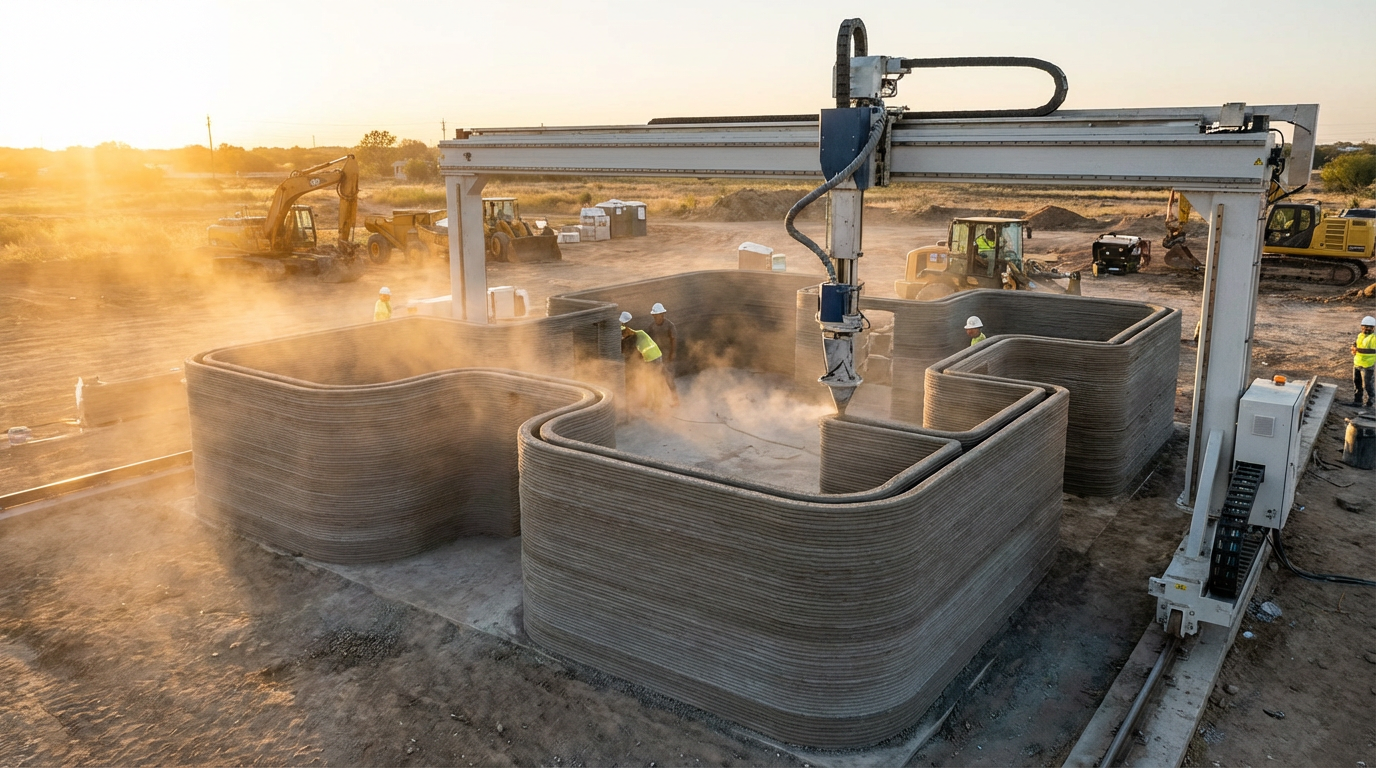
Thirty miles north of Austin, in a neighborhood called Wolf Ranch, a machine the size of a shipping container has been squeezing concrete through a nozzle — layer by layer, wall by wall — to build an entire neighborhood. The result is 100 homes, the world’s largest 3D-printed housing community, completed by ICON using its Vulcan printer system. The walls are so dense that residents report one unexpected problem: the Wi-Fi signal can’t get through them.
That quirky detail captures something essential about 3D-printed construction: the technology works differently enough from traditional building that you discover surprises in places nobody expected. But the big numbers — on cost, speed, and labor — aren’t surprises at all. They’re the reason this technology is finally moving from lab curiosity to production reality.
The Machine: ICON’s Vulcan
ICON’s Vulcan is a gantry-style printer that moves on rails above the construction area. It extrudes Lavacrete, a proprietary concrete mixture optimized for layer adhesion and compressive strength. A single operator runs the system from a tablet. The machine prints walls at roughly 5–10 inches per second, and a typical 1,500-square-foot home’s wall structure can be completed in 24 to 48 hours of active print time — compared to weeks of traditional framing.
The Georgetown homes are full-production houses, not prototypes. They range from 1,574 to 2,112 square feet with three to four bedrooms, two-car garages, and all the standard finishes buyers expect. The finished homes list in the mid-$400,000s — competitive with conventionally built homes in the same Austin metro market. ICON partnered with Lennar, one of America’s largest homebuilders, for the project.
The Cost Equation
Here’s where the math gets interesting. The 3D-printed wall structure — the part the robot actually builds — costs between $10,000 and $35,000, depending on home size. That’s a fraction of traditional framing costs. But a home is more than walls. Plumbing, electrical, roofing, insulation, finishes, HVAC, and site work still account for the majority of the build cost. A fully finished 3D-printed home typically runs $120,000 to $225,000 for a 1,500-square-foot build, according to HomeGuide’s 2026 pricing data.
The savings are real but concentrated. 3D printing eliminates the most labor-intensive phase of construction — framing — and replaces it with a machine that runs 24/7, doesn’t take sick days, and doesn’t need a crew of eight. One operator replaces an entire framing team. In an industry short 349,000 workers (ABC, January 2026), that’s not just cost savings — it’s the ability to build homes that otherwise wouldn’t get built.
“If it can’t survive a job site, it doesn’t belong on one. The Vulcan is built like a piece of heavy equipment, not a lab prototype. It runs in rain, heat, and Texas wind.”
Beyond ICON: The Competitive Landscape
ICON isn’t the only player. The field has split into distinct tiers:
SQ4D, based in New York, made headlines by listing the first commercially available 3D-printed home in the US for $299,999 — a 1,400-square-foot, three-bedroom concrete house in Riverhead, Long Island, with a 50-year structural warranty. Their ARCS printer is smaller than the Vulcan but cheaper to deploy, targeting the starter-home segment.
COBOD, out of Denmark, builds the BOD2 printer with a maximum print height of 14.6 meters — tall enough for multi-story residential. They’ve partnered with Holcim (the world’s largest cement company) and have printers deployed across Europe, Africa, and the Middle East. A 3-bedroom home in Kampala, Uganda was printed in just 12 hours of active time.
Alquist 3D, partnering with Habitat for Humanity, is targeting the affordable housing gap. They built the East Coast’s first 3D-printed Habitat home in Virginia, collaborating with Virginia Tech’s Center for Housing Research to study long-term performance. Their approach: use 3D printing to bring construction costs low enough that nonprofit housing organizations can actually scale.
Where AI Enters the Picture
The printer is only half the story. The software controlling it is where artificial intelligence is making the biggest difference. ICON’s AI-optimized toolpath planning adjusts extrusion parameters in real time — layer height, print speed, material flow rate — based on ambient temperature, humidity, and the structural demands of each wall section. Overhangs, corners, and window lintels each require different printing strategies, and the AI adapts on the fly rather than following a rigid program.
Material science benefits from AI too. Concrete mix design involves dozens of variables — aggregate size, water-cement ratio, admixture concentrations, curing conditions — and machine learning models can optimize printability and strength simultaneously. COBOD’s partnership with Holcim includes AI-driven mix optimization that reduced material waste by an estimated 30% compared to first-generation mixes.
Generative design is the next frontier. Instead of an architect designing a home and then figuring out how to print it, AI can generate floor plans that are optimized for printing from the start — continuous wall paths that minimize nozzle lifts, structural geometries that eliminate the need for temporary supports, and organic curves that are actually easier to print than straight lines (concrete doesn’t care about right angles).
The Regulatory Bottleneck
The technology is ready. The regulations mostly aren’t. Building codes were written for wood, steel, and poured concrete — not extruded concrete. Every 3D-printed home currently requires custom engineering approval, which means structural engineers reviewing each design individually and building departments evaluating each project as a one-off. Some jurisdictions have embraced it — Texas, Florida, and Virginia have all permitted 3D-printed homes. Others haven’t figured out where it fits in the code.
The International Code Council is working on standardized provisions for 3D-printed construction, but widespread code adoption is still years away. In the meantime, builders like ICON and Alquist navigate the approval process project by project, accumulating the performance data that will eventually make code inclusion routine.
What It Means for Housing
America is short roughly 4 million homes, according to Freddie Mac estimates. Conventional builders can’t find enough workers to meet demand. 3D printing doesn’t replace the entire construction process — it replaces the part that’s hardest to staff. One operator running a Vulcan can produce the wall structure that would have required a framing crew of eight working for two weeks. The math is simple: fewer hands, faster builds, more homes.
The Georgetown project isn’t a science experiment. It’s 100 families living in 3D-printed houses, dealing with mesh routers for their Wi-Fi and otherwise living normal suburban lives. The question isn’t whether 3D-printed homes work. It’s how fast the industry, the codes, and the financing can catch up to a machine that’s already ready to build.
Sources: ICON & Lennar Wolf Ranch Community — ArchDaily · Lennar 3D-Printed Homes Georgetown — Lennar Resource Center · SQ4D First 3D-Printed Home Listed for Sale — 3DPrint.com · COBOD & Holcim 3D-Printed Housing — 3DPrint.com · Alquist & Habitat for Humanity 3D-Printed Home — Builder Online · Freddie Mac Housing Supply Shortage Estimate — Freddie Mac Research · ABC: Construction Must Attract 349,000 Workers in 2026 — ABC.org