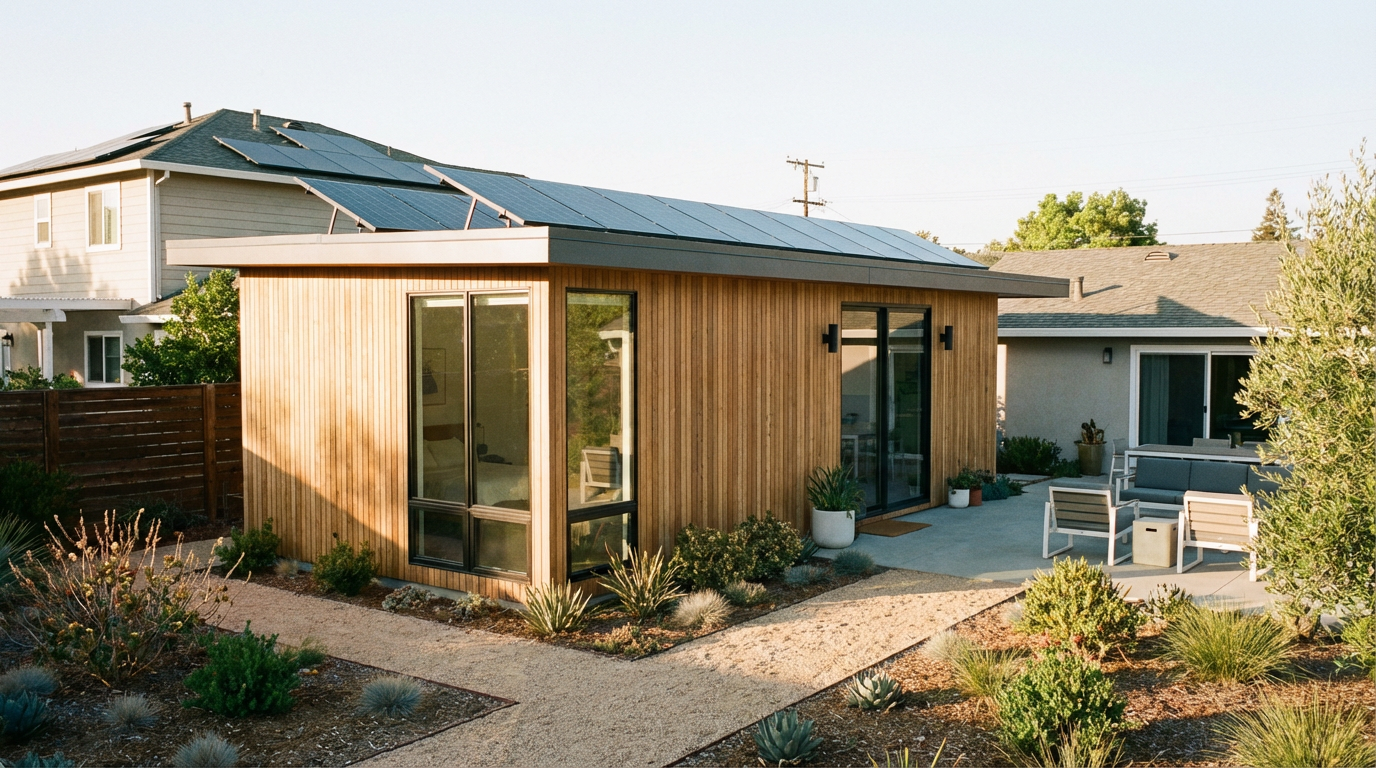
My neighbor spent four months trying to figure out if she could add a one-bedroom cottage behind her house in San Jose. She hired an architect ($4,200), who told her to check with the city. The city told her to check with the county. The county pointed her to a 47-page zoning overlay document last updated in 2019. She gave up in November.
In January, she typed her address into FutureLot and got the answer in ninety seconds: yes, detached ADU up to 1,200 square feet, 4-foot side setback, 16-foot height limit, no owner-occupancy requirement. Lot-specific. Zoning-verified. Free.
That gap — between legal permission and practical knowledge — is the bottleneck strangling the ADU boom.
The Policy Wave Is Real
According to a 2025 Mercatus Center analysis by Emily Hamilton and Kol Peterson, 18 states now have laws broadly legalizing ADU construction and rental. Ten of those laws rank as "strong" — meaning they preempt local zoning to guarantee by-right approval. Eight more have weaker versions with carve-outs. Eleven of the 18 passed their laws in just the last four years.
California started the cascade. Oregon followed. Washington, Montana, Vermont, Connecticut. Even Texas, not known for telling cities what to do, passed HB 3697 in 2023.
But legalizing ADUs doesn't mean people build them. Peterson, who wrote the book on ADUs (Backdoor Revolution, 2018), identified three "poison pill" regulations that kill construction even where it's legal: owner-occupancy mandates, off-street parking requirements, and minimum lot sizes. States that eliminated all three — California, Oregon — see dramatically higher permit volume. States that kept even one see a fraction.
The Zoning Problem AI Is Solving
Zoning codes are local. There are roughly 36,000 jurisdictions in the US with independent land-use authority. Each maintains its own overlay districts, setback tables, height limits, lot coverage ratios, and conditional use exceptions. Many haven't digitized their codes at all.
A homeowner in, say, Palo Alto faces different rules than someone three miles away in Mountain View. Same county. Different setbacks, different height limits, different pathway to approval. Nobody without a JD or a planning background can navigate this blind.
This is where the new AI zoning platforms operate:
| Platform | What It Does | Data Source |
|---|---|---|
| FutureLot | Lot-specific feasibility (ADU size, setbacks, height) from an address | Proprietary zoning engine, GIS parcel data |
| Shovels | National permit database (2.8M+ ADU permits), contractor scoring | County recorder filings, permit offices |
| PlanChecker AI | Automated code compliance review against local building codes | Digitized building codes, plan submissions |
| Symbium (now Clariti) | Zoning lookup + ADU feasibility for municipalities | Municipal zoning databases |
FutureLot, formerly TheBuilder AI, was selected for the 2026 International Builders’ Show startup zone. Its pitch is simple: type an address, get a zoning-verified answer about what you can build. No architect consultation. No $200/hour land-use attorney. Ninety seconds.
The Numbers Behind the Boom
Shovels, which aggregates permit data from county offices nationwide, reports over 2.8 million ADU permits in its database. California dominates — the state's Department of Housing and Community Development tracks annual ADU permit applications, which surged from roughly 6,000 in 2018 to over 20,000 by 2022, driven by a series of bills (AB 68, SB 13, AB 2221) that systematically dismantled the poison pills.
San Diego's Bonus ADU Program is the most aggressive experiment. A UC Berkeley Terner Center study (Wegmann, Chapple et al., 2024) found the program "startling in its permissiveness" — allowing unlimited bonus ADUs on any site in a Transit Priority Area with no parking requirement. As of February 2024, nearly 1,300 units had been proposed under the program, 488 with recorded agreements.
Where I’m Skeptical
AI can tell you whether you’re allowed to build. It cannot tell you whether you should.
A detached ADU runs $140,000 to $380,000, averaging around $240,000. Permitting and design alone eat 10–15% of that. The Mercatus analysis notes that 60% of adults say they’d consider building an ADU — but only 4% currently have one. That intent-to-action gap isn’t a zoning problem. It’s a $240,000 problem.
The AI platforms accelerate feasibility. They do nothing for financing. An owner who learns in ninety seconds that she can build a 1,200-square-foot cottage still needs a construction loan, a contractor, and twelve months of patience. Shovels can score contractors by permit history, which helps. But the capital stack remains the real gate.
There’s also a data freshness issue. Municipal zoning changes constantly — overlay amendments, conditional rezonings, voter initiatives. Any AI system is only as current as its last data pull. FutureLot acknowledges this with "AI with human oversight" framing, which is honest. PlanChecker, which automates code compliance checks, faces the same temporal risk: a code adopted last Tuesday might not appear in the system until next month.
What Actually Moves the Needle
The UC Berkeley/Terner Center research points to an uncomfortable conclusion for the tech platforms: policy changes move permits far more than information tools. California’s ADU explosion tracks almost perfectly to specific legislative moments — each bill that removed an owner-occupancy rule or parking mandate produced a measurable step-change in applications.
AI zoning tools reduce friction at the margin. They convert a four-month research project into a ninety-second query. That matters. But the homeowner who can’t build because her city requires owner-occupancy, or mandates two off-street parking spaces she doesn’t have room for, won’t be helped by a faster answer to the same "no."
The most interesting play might be Shovels’ data layer — 2.8 million permits make it possible to identify which jurisdictions are actually issuing ADU permits versus which ones legalized them on paper and then slow-walked approvals through discretionary review. That transparency is worth more than any individual feasibility check. It names the bottleneck.
Eighteen states have said yes. The tools to navigate the yes are here. The question is whether "yes, you can build a $240,000 cottage in your backyard" is an answer anyone outside the top income quintile can actually use.