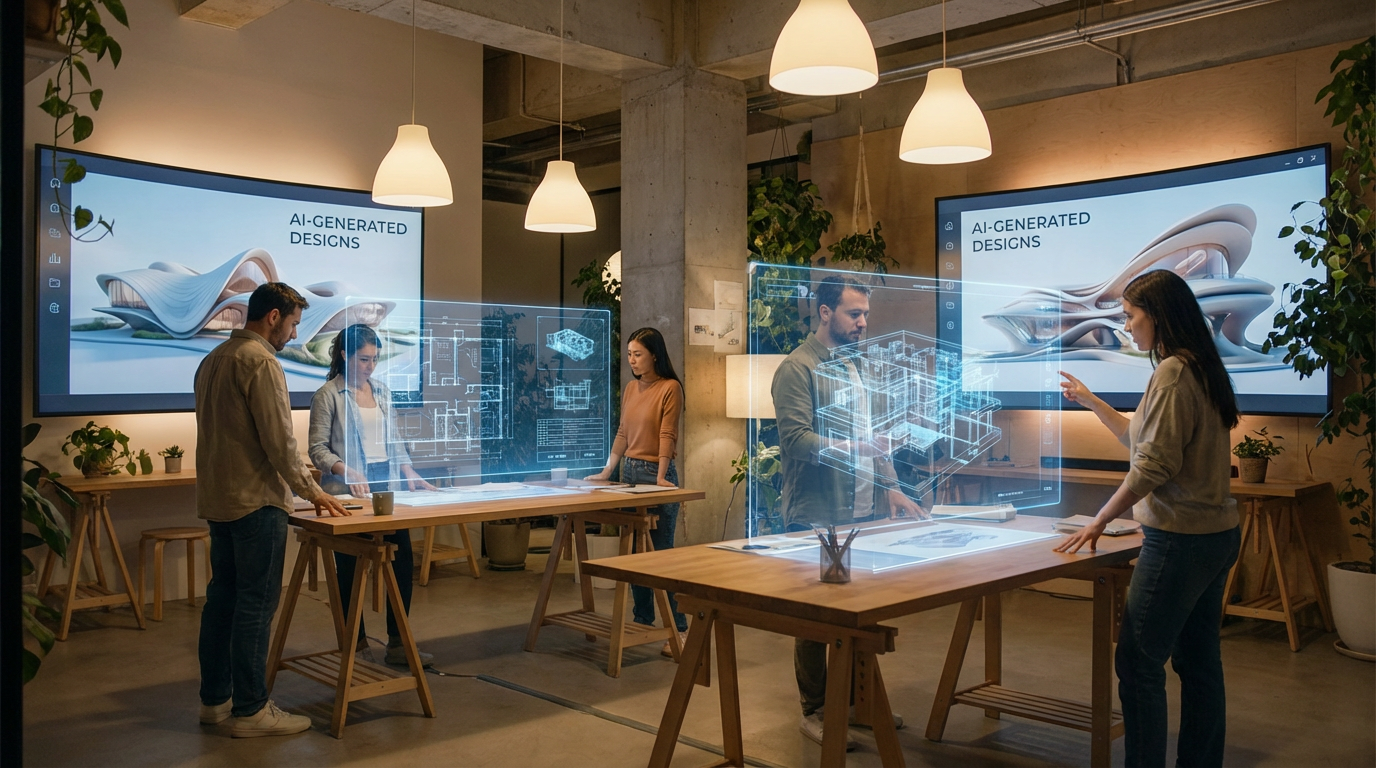
In an office in San Francisco's SoMa district, an architect named Sarah Chen clicks "generate." Her screen fills with 10,000 floor plan variations for a three-bedroom home in 47 seconds. Each one satisfies the structural requirements, the lot constraints, the client's desire for a southern-facing kitchen, and the local zoning code. A task that once took her team two weeks now takes less than a minute.
This isn't a prototype. This is Tuesday.
The Generative Design Revolution
Generative design — the practice of using AI algorithms to explore thousands of design solutions from a set of constraints — has moved from industrial manufacturing into residential architecture faster than anyone predicted. Autodesk's generative tools, originally built for aerospace parts, now handle load-bearing wall placement. Hypar, a startup out of AEC tech, lets architects define parametric rules and watch AI iterate through structural possibilities in real time.
The numbers are staggering. According to McKinsey's 2024 report on construction technology, firms using AI-driven design tools report 30-50% reductions in design phase timelines and 15-25% material savings through optimized structural layouts. The global AI in construction market, valued at $1.75 billion in 2023, is projected to reach $8.6 billion by 2029.
But the real story isn't speed. It's what AI finds that humans don't.
Discovering What Architects Miss
TestFit, a Dallas-based company, uses AI to optimize site plans for residential developments. Their system considers variables that would take a human designer weeks to cross-reference: solar exposure angles at every hour of the year, prevailing wind patterns for natural ventilation, noise propagation from nearby roads, and utility connection costs based on pipe routing.
In one project, TestFit's algorithm discovered that rotating a planned subdivision 11 degrees from the developer's original orientation would reduce HVAC energy costs by 18% across all units while increasing natural daylight by 23%. No architect had considered it because the lot's shape made that rotation seem counterintuitive.
"The AI doesn't have architectural intuition," says Dr. Caitlin Mueller, an MIT professor who studies computational design. "That's exactly its advantage. It doesn't skip over solutions that look wrong to a trained eye."
The Architect's New Role
The fear, predictably, is displacement. But the data tells a more nuanced story. The Bureau of Labor Statistics projects 5% growth in architecture jobs through 2032 — modest but positive. What's changing isn't the number of architects; it's what they do all day.
Junior architects who once spent months on space planning iterations now spend that time on client interaction, material selection, and design refinement — the parts of architecture that require human judgment about how spaces feel, not just how they function. Senior architects report spending 40% less time on code compliance checks, which AI handles near-perfectly.
Katerra, the construction startup that famously raised $2 billion and then collapsed, failed not because of AI but because of execution. The lesson the industry took: AI design tools work. The hard part is still building the thing.
What's Next
The frontier is AI that doesn't just optimize within constraints but proposes constraints humans haven't considered. Sidewalk Labs (an Alphabet subsidiary) has experimented with AI that analyzes neighborhood-level social dynamics — foot traffic patterns, community gathering behaviors — and feeds that data into residential design. The result: homes designed not just for their occupants but for how those occupants interact with their neighbors.
We're still early. But the architect's brain just got a very powerful collaborator. The question isn't whether AI will change home design. It's whether the industry can adapt fast enough to use it well.
Sources: TestFit Generative Design for Building Optimization — Engineering.com · BLS: Architecture Jobs 5% Growth Through 2032 — Archinect · McKinsey: AI in Construction Technology — McKinsey · AI in Construction Market Size ($1.75B to $8.6B) — Frontiers in AI · Hypar Parametric Design Platform — Hypar.io · Autodesk Generative Design Tools — Autodesk