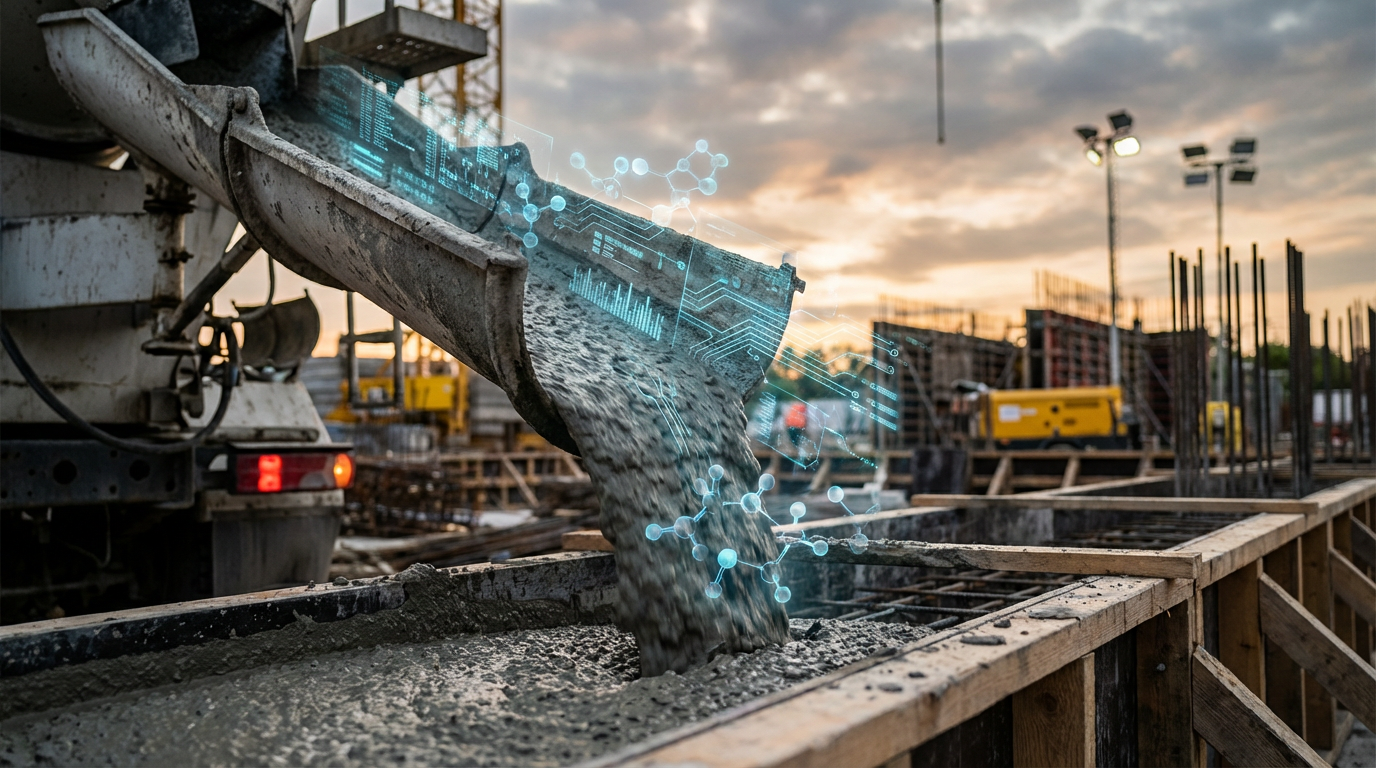
Concrete is the most consumed material on Earth after water. Humanity pours 20 billion tons of it every year — roughly 10 billion cubic yards. The cement that binds it together accounts for approximately 8% of all global CO₂ emissions, according to the International Energy Agency. That’s more than aviation. More than shipping. More than any single country except China and the United States. And for decades, the recipe for concrete barely changed: Portland cement, water, sand, gravel, and a prayer that it cures properly. Now AI is rewriting the recipe — and the results are staggering.
The Overdesign Problem
Here’s the dirty secret of concrete production: most mixes use far more cement than they need to. Ready-mix producers design conservatively because the penalty for a batch that fails its 28-day strength test is catastrophic — rejected loads, torn-up slabs, lawsuits. So they over-spec the cement content by 10–20% as insurance. Multiply that safety margin across 10 billion cubic yards, and you get hundreds of millions of tons of excess CO₂ that exists purely because of uncertainty.
AI eliminates the uncertainty. By training on thousands of historical mix designs, strength test results, and local material data, machine learning models can predict the exact compressive strength a given mix will achieve — and then dial back the cement to the minimum that meets spec. No guesswork. No safety-margin padding. Just math.
Concrete Copilot: $5 Saved on Every Cubic Yard
Los Angeles-based Concrete.ai, a spinout from the University of California, Los Angeles, launched Concrete Copilot — a generative AI platform that ingests a producer’s proprietary mix data and generates millions of optimized formulations tailored to specific performance targets. During field testing with U.S. concrete producers across more than 2 million cubic yards, the platform delivered an average of $5.04 in savings per cubic yard and an average 30% carbon reduction — all within the first month of deployment.
“Using our own data and local materials, the tool efficiently streamlined our mix design process, allowing us to maximize materials cost savings and deploy the optimized mix designs into production faster.”
— Chris Rapp, VP & GM, VCNA Prairie Materials
The company’s ambition is massive: reduce the annual global emissions impact of concrete by 500 million tons of CO₂ solely through mix optimization. Not through exotic new materials. Not through carbon capture. Just by using the cement that’s already being produced more intelligently.
CarbonCure: Injecting CO₂ Into the Mix
CarbonCure Technologies, based in Halifax, Nova Scotia, takes a different approach. Instead of just reducing cement, their system injects captured CO₂ directly into fresh concrete during mixing. The CO₂ reacts with calcium ions to form calcium carbonate nanoparticles — essentially turning a greenhouse gas into a mineral that actually increases compressive strength. Less cement needed. Carbon permanently sequestered. Stronger concrete.
Operating in over 30 countries and backed by more than $80 million in equity funding from Breakthrough Energy Ventures, Amazon’s Climate Pledge Fund, Microsoft’s Climate Innovation Fund, and Samsung Ventures, CarbonCure has the scale to matter. Their AI-driven dosing system optimizes the CO₂ injection rate for each batch based on the specific mix design, ambient conditions, and target strength — a calibration that would be impossible to do manually in real time.
SmartMix: Testing in Real Time
Ottawa-based Giatec Scientific attacks the problem from the testing side. Their SmartMix platform uses AI trained on concrete testing data to optimize mixes in real time, predicting properties and proactively detecting anomalies in performance. In early deployments, customer Angelle Materials reported a 27% reduction in cement usage and 13% cost savings from their very first SmartMix-optimized batch.
Giatec’s ambition mirrors Concrete.ai’s: lower global GHG emissions from concrete production by 400 million tons annually — equivalent to taking 110 million cars off the road. Combined with their SmartRock and SmartMix Marcotte batch integration sensors, the system creates a closed-loop feedback cycle: pour, test, learn, optimize, repeat.
Meta’s Open-Source Approach
Even Big Tech is getting into concrete. Meta developed an open-source AI tool using Bayesian optimization (powered by their BoTorch and Ax frameworks) in collaboration with cement manufacturer Amrize and the University of Illinois Urbana-Champaign. The tool optimizes concrete formulations for multiple objectives simultaneously — strength, sustainability, curing speed, and surface quality. It’s already been deployed at Meta’s Rosemount, Minnesota data center, where the AI-optimized green concrete mix exceeded the performance targets of the standard low-carbon specification.
By open-sourcing the tool, Meta is essentially giving the entire construction industry a free AI concrete optimizer. The motivation is partly self-interested — data centers consume enormous volumes of concrete, and embodied carbon in their foundations is a growing liability in sustainability reporting — but the downstream impact could be enormous.
What This Means for Your Foundation
Residential concrete is the low-hanging fruit. A typical home foundation uses 50–80 cubic yards of concrete. At $5 savings per yard, AI mix optimization saves the builder $250–$400 on a single pour — modest individually, but across America’s 1.4 million annual housing starts, that’s $350–$560 million in industry savings per year and a corresponding 20–30% drop in foundation carbon footprint.
Ask your builder about their concrete supplier. If they’re still ordering “3,000 PSI with a 5-inch slump” the way their grandfather did, they’re overpaying for cement and over-emitting CO₂. The producers using Concrete.ai, CarbonCure, or Giatec are already delivering stronger concrete with less environmental damage — at a lower price.
California’s Buy Clean Act is just the beginning. As of July 2024, California requires embodied carbon limits on construction materials for state projects. Colorado, New York, and Oregon are following. Federal EPA incentives through the Inflation Reduction Act are further rewarding low-embodied-carbon concrete. The regulatory pressure is only going one direction, and AI mix optimization is the fastest way for producers to comply without raising prices.
Concrete is civilization’s skeleton. It holds up every home, every bridge, every data center. The fact that an algorithm can make that skeleton 30% less destructive to the atmosphere — without changing its strength, without exotic materials, without any sacrifice at all — may be the most impactful application of AI in construction. No robot required. Just better math.