Thirty pieces of construction equipment are stolen every single day in the United States. That’s 11,000 incidents per year, costing the industry an estimated $300 million to $1 billion annually in equipment alone, according to the National Equipment Register and the National Insurance Crime Bureau. Add $1 billion in annual copper theft — per the Department of Energy — and you’re looking at a $2 billion problem that’s been stubbornly consistent for decades.
The recovery numbers are even worse than the theft numbers. Only about 20% of stolen heavy equipment is ever found. For individual tools and materials, it’s below 7%. Most thefts happen on weekends and holidays — discovered Monday morning when the crew shows up to an empty lot and a cut padlock. By then, the excavator is on a flatbed two states away, the serial numbers are ground off, and the insurance adjuster is already calculating the $6,000–$30,000 average loss per incident.
Traditional security — chain-link fences, padlocks, a guard who drives by twice a night — hasn’t moved the needle in 30 years. AI-powered cameras are finally changing the equation.
The New Perimeter: AI That Sees Threats, Not Motion
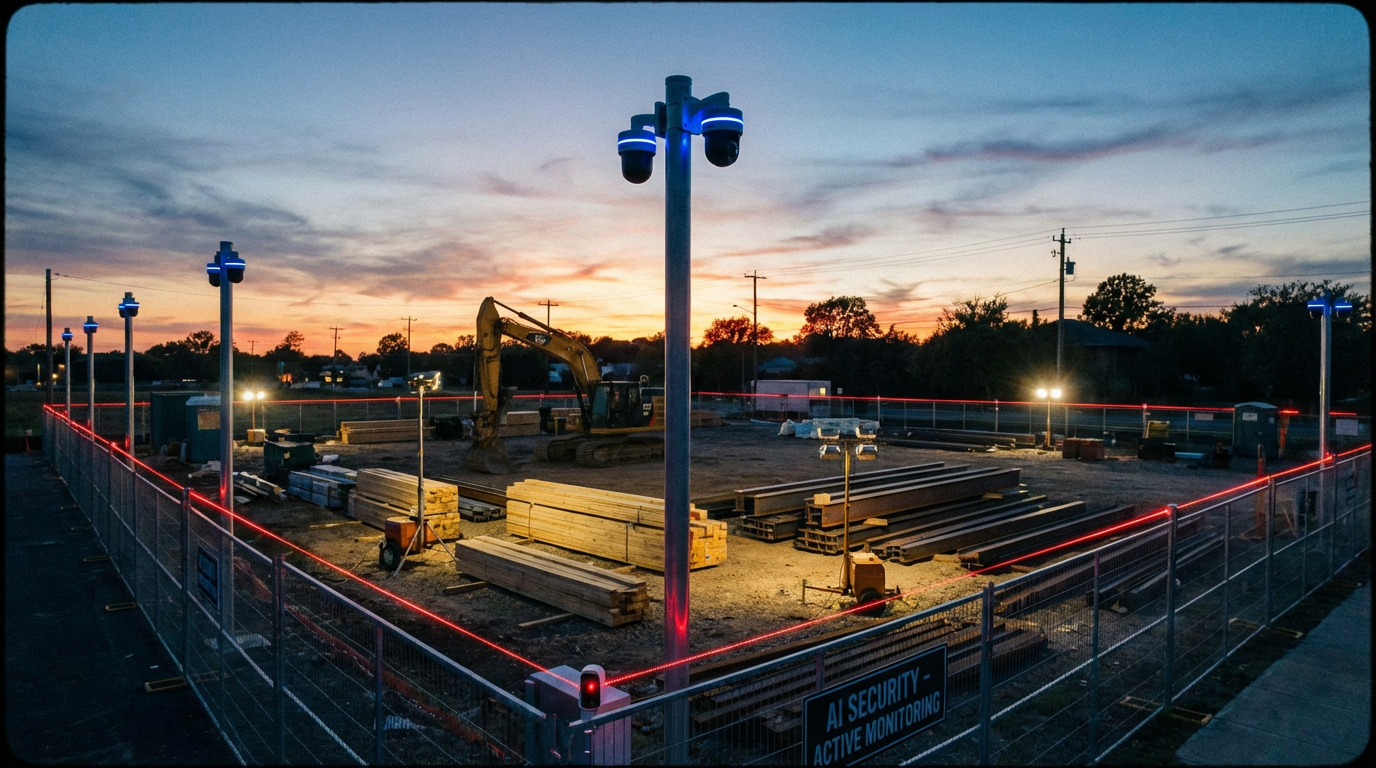
Coram AI (formerly Verkada competitor, now the fastest-growing construction security platform) deploys solar-powered camera trailers that require zero electrical hookup — critical for active job sites where power isn’t available at the perimeter. Their edge AI distinguishes between a raccoon triggering a motion sensor and a human climbing a fence at 2 AM. When it detects a genuine intrusion, it fires a real-time alert to a monitoring center within 15 seconds, triggers a 110dB siren and strobe, and starts recording evidence-grade 5MP footage.
Spot AI takes a different approach: retrofit existing wired cameras with an AI-powered Network Video Recorder that adds natural language search (“show me everyone who entered Gate 3 after 8 PM”), automatic safety violation detection (no hard hat, unauthorized zone entry), and anomaly alerts. Their construction-specific models recognize equipment types, so the system knows the difference between your excavator driving to a new position and someone else’s flatbed backing up to it.
Rhombus Systems rolled out four new cameras in early 2026 with on-device AI processing — no cloud round-trip needed for threat classification. Their R800 PTZ offers 4K resolution with 30× optical zoom, meaning a single camera can cover an entire residential construction site while still capturing license plate detail at the gate.
“We went from losing $40,000–$60,000 in materials per year across our sites to essentially zero theft incidents in 14 months. The cameras paid for themselves in the first quarter.”
The Numbers That Matter for Home Builders
Theft adds an estimated 1–5% to overall project costs through direct losses, insurance premium increases, schedule delays (waiting for replacement equipment), and administrative overhead for police reports and claims. On a $500,000 custom home, that’s $5,000–$25,000 in theft-related costs that get baked into the price the homeowner pays.
Copper theft is particularly devastating for residential builders. A typical new-construction home contains 400–450 pounds of copper in wiring, plumbing, and HVAC lines. At today’s copper prices (~$4.50/lb), that’s $1,800–$2,000 in raw material. But the replacement cost after the wiring is already roughed in? $8,000–$15,000 once you factor in labor to re-pull through walls, re-inspect, and the schedule delay of 1–2 weeks waiting for electrical inspection slots.
A solar-powered AI camera trailer costs $300–$600/month to lease for a single-family build site. A permanent installation (hardwired, with NVR) runs $3,000–$8,000 for a multi-camera system. Against the potential losses, the ROI is immediate.
From Job Site Security to Smart Home Handoff
Here’s where the construction angle gets interesting: the same infrastructure that protects the job site during the build can become the home’s permanent security system.
Forward-thinking builders are now running Cat6A ethernet and low-voltage conduit to camera mounting points during the rough-in phase — eaves, garage, front door, rear yard. Cost during framing: $200–$400 for the wiring. Cost to retrofit after the home is finished: $2,000–$4,000 with drywall patching, attic fishing, and exterior drilling.
The cameras that watched the lumber pile during construction get repositioned to permanent mounts, the NVR box stays in the utility closet, and the homeowner inherits a professional-grade AI security system that cost them effectively nothing because the builder was already paying for site security.
Lennar and Meritage Homes have both begun pre-wiring for security cameras as a standard feature in new communities. The marginal cost — maybe $300 in wire and labor during rough-in — becomes a marketing differentiator: “Your home comes with AI security.” The same story played out with smart thermostats five years ago. Once the cost delta at rough-in was trivial, it stopped being an upgrade and started being a standard feature.
What AI Actually Catches
The difference between a $200 motion-activated camera and an AI security system isn’t resolution. It’s signal-to-noise ratio. A motion camera on a construction site generates 50–200 false alerts per night from wind-blown tarps, animals, shadows, and headlights. Nobody watches the footage because nobody can sort through the noise.
AI models trained on construction environments reduce false positives by 95%+. They classify movement by type (human, vehicle, animal, debris), by behavior (walking vs. running vs. climbing), and by context (authorized worker entering at 7 AM vs. unknown person at 2 AM). The system that fires an alert is the same system that already decided the alert is worth firing.
Some platforms now integrate license plate recognition at site entrances, automatically logging every vehicle and flagging any that aren’t on the approved contractor list. Others use geofencing around high-value material staging areas, triggering escalating alerts as an intruder moves from the perimeter toward the copper stack.
Construction site theft has been a $1–2 billion annual problem for as long as anyone can remember. The locks, the fences, the weekend guard drives — none of it worked. AI cameras that actually understand what they’re looking at might be the first thing that does. And the builders smart enough to wire the infrastructure in during framing are handing their buyers a security system that would have cost $5,000+ to install after move-in — for the price of a few hundred feet of Cat6.