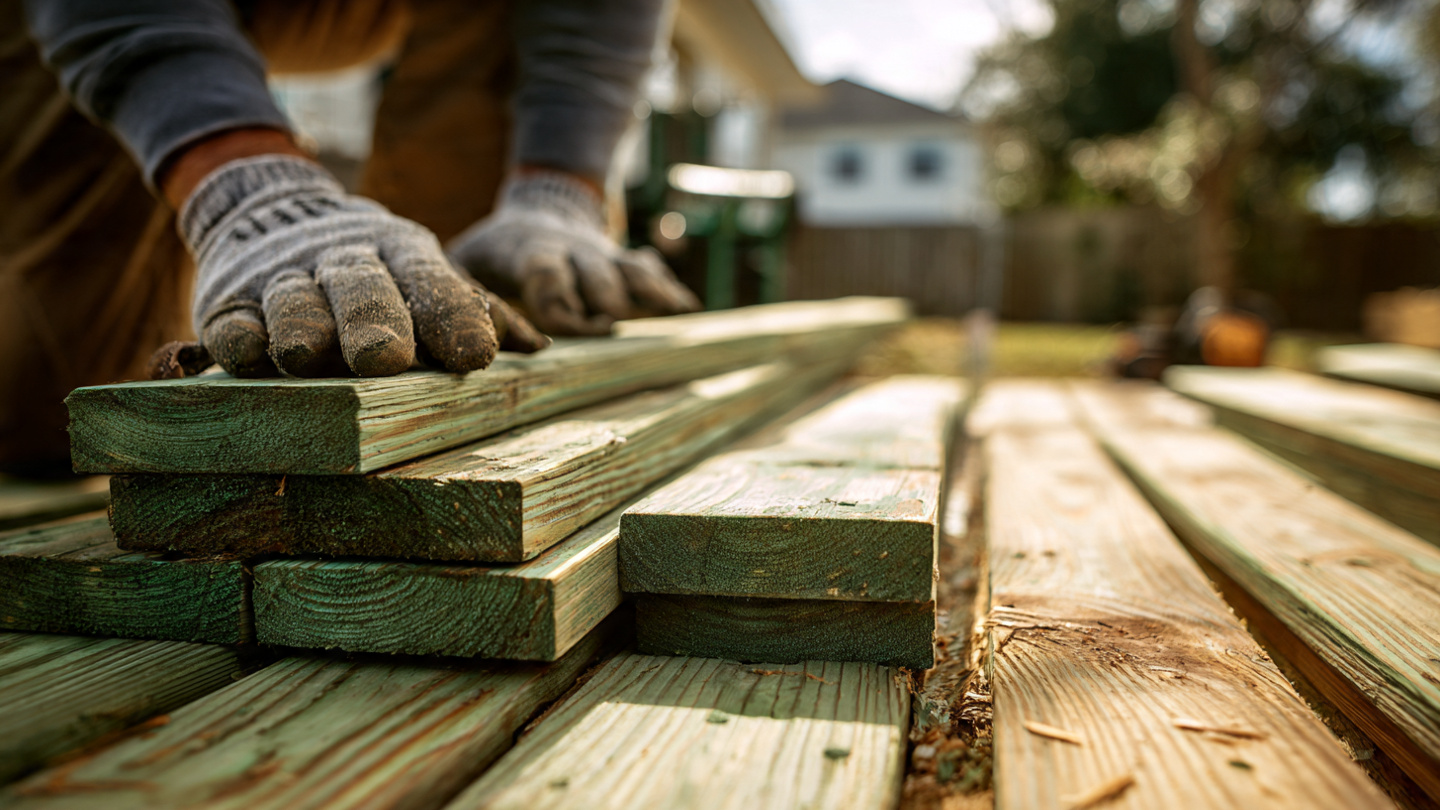
Sometime in the late 1990s, a contractor built your deck using pressure-treated lumber with a faint greenish cast. He stacked the boards, nailed them down, collected a check. Nobody mentioned that the preservative soaking those fibers was chromated copper arsenate, a cocktail of chromium, copper, and arsenic designed to stop rot by making the wood mildly toxic to everything that touches it.
Including your children, who played on it barefoot for a decade.
In 2004, the EPA and the lumber industry agreed to phase CCA out of residential settings. Playsets, decks, fences, picnic tables, landscaping timbers, all off limits for new construction. But structures already standing were grandfathered in, and nobody was required to remove them. Official reasoning held that existing installations posed manageable risk with precautions like hand washing and periodic sealing.
Twenty-two years later, those structures are reaching end of life: decks rot, fences lean, homeowners renovate. Now the lumber gets ripped out and tossed into a dumpster alongside clean framing scraps and drywall chunks, and it all rides the same truck to a facility that probably does not sort it.
What Happens When You Cannot Tell the Difference
Wood is one of the heaviest components of residential construction waste. An EPA study of 15 houses found an average of 6.14 pounds of waste generated per square foot of new construction, with wood comprising a major share. Nationally, the EPA reports that 12.2 million tons of wood went to landfill in 2018 from municipal solid waste alone, separate from the much larger C&D debris stream. Only 17.1% of wood waste got recycled.
Clean wood has value as biomass fuel, mulch, oriented strand board feedstock, or animal bedding. Contaminated wood has negative value because CCA-treated lumber cannot be burned safely, as incineration releases arsenic compounds into the air, and it cannot be chipped for garden mulch because the arsenic leaches into soil. It cannot be composted or repurposed. It can only be landfilled, ideally in a lined cell designed for hazardous materials.
When contaminated and clean wood get mixed, which is what happens on nearly every residential demolition job in America, the entire load is effectively contaminated. Clean wood loses its recycling value. Contaminated wood avoids proper handling. Everybody loses except the landfill operator collecting tipping fees.
A Camera That Spots What Your Eyes Miss
Researchers at Monash University and Charles Darwin University published a study in Resources, Conservation & Recycling in 2025 that changes the calculation. They built the first real-world image dataset of contaminated construction and demolition wood waste, then trained convolutional neural networks and vision transformer models to classify what they saw.
Six contamination types: paint, chemical treatment, metal fasteners, adhesive residues, surface coatings, and composite contamination, all classified from standard RGB camera images without specialized sensors, infrared, or chemical analysis.
Accuracy: 91%.
"This new system could be deployed via camera-enabled sorting lines, drones, or handheld tools to support on-site decision-making," said Madini De Alwis, the PhD candidate who led the study under Associate Professor Mehrdad Arashpour at Monash's Department of Civil and Environmental Engineering.
That deployment flexibility is the part that matters for residential construction. A sorting line at a transfer station is useful but distant from the demolition site. A phone app that a contractor points at a pile of ripped-out deck boards before loading the dumpster is transformative. Both published datasets and model architectures are described in the paper. Building the app is an engineering problem, not a research problem.
Industrial Scale Already Exists
At the facility level, AI-powered waste sorting is not theoretical. ZenRobotics, now owned by Terex, launched its 4.0 generation of sorting robots in 2024. Terex's Heavy Picker handles items up to 40 kg at 2,300 picks per hour. Its Fast Picker runs at 80 picks per minute for lighter material. Both recognize over 500 waste categories using pretrained AI models, and they explicitly handle C&D waste streams including wood, metals, and rigid plastics.
These systems work in municipal recycling facilities and commercial C&D transfer stations. They do not work on a residential job site, and probably never will. A $500,000 robotic sorting cell does not make economic sense for a $40,000 kitchen renovation. But the intelligence running those robots, the visual classification that distinguishes treated pine from clean Douglas fir at conveyor-belt speed, is the same intelligence the Monash team proved can run on a camera.
The Disposal Cost Nobody Quotes
Residential contractors typically pay tipping fees of $40 to $80 per ton for mixed C&D waste at a transfer station, according to county-level fee schedules published by facilities across the US. Clean, source-separated wood costs less, often $20 to $35 per ton at facilities that accept it for biomass or mulch. Contaminated wood requiring special handling can cost $120 to $200 per ton depending on the jurisdiction and facility permits.
For a typical deck demolition producing 1 to 3 tons of lumber waste, the difference between source-separated clean disposal and mixed-load disposal can reach $60 to $200. Between mixed-load and properly handled contaminated wood, the delta can be $300 to $500 per job. Pressure-treated wood decks typically last 15 to 20 years according to the National Association of Home Builders, meaning structures built in the late 1990s through 2003, the final years of residential CCA use, are entering replacement age right now.
A contractor who can identify contaminated wood before loading saves on disposal, avoids liability, and diverts the clean fraction to recycling. One who cannot, or does not care, contaminates the clean wood, overpays for mixed disposal, and sends recyclable material to a landfill where it occupies space for centuries.
What You Should Do Before Any Renovation
Own a home built before 2004 with an outdoor wood structure? Assume the deck, fence, playset, or landscaping timbers are CCA-treated unless you have documentation proving otherwise. Over time, the greenish tint fades. Bare wood that looks gray and weathered may still contain arsenic, chromium, and copper. CCA test kits run $25 to $40 at hardware stores, or send a sample to a lab for $30 to $50.
Planning a demolition or renovation? Tell your contractor to separate wood waste by type on site. Two piles: known or suspected contaminated in one, clean framing lumber in the other. This adds maybe 20 minutes to a demolition day and can save $200 or more in disposal costs while keeping clean wood out of landfill.
Hiring a waste hauler? Ask whether they sort C&D wood at the transfer station. Most do not. Some progressive facilities now use AI-assisted sorting. Paying slightly more for a hauler that delivers to a facility with sorting capability means your clean wood has a chance at a second life and the contaminated wood gets handled properly.
A general contractor doing multiple renovation projects? Track the Monash University dataset and the startups building on it. A phone-based contamination scanner is coming. When it arrives, the contractor who adopts it first gains a real competitive advantage in disposal cost, regulatory compliance, and liability protection. Published research and working models back that claim.
Honest Limitations
That 91% accuracy figure comes from a controlled research environment using curated images of wood waste. Real-world accuracy on a cluttered demolition site, with mud-caked boards, partial views, and mixed lighting, will be lower. How much lower depends on deployment conditions that have not been tested. Monash's team acknowledges this: the study is a proof of concept, not a product.
CCA is also not the only wood contaminant that matters. Creosote-treated railroad ties repurposed as garden borders, pentachlorophenol-treated utility poles used in rural fencing, and lead paint on old siding all pose distinct risks that may or may not fall within the six contamination categories the model was trained on. A comprehensive wood contamination scanner would need a broader training set.
ZenRobotics systems process industrial volumes of waste at facilities equipped with conveyors, lighting, and sensor arrays. Translating that performance to a handheld tool operating in variable outdoor conditions is not guaranteed. Industrial AI and consumer AI have different failure modes.
And there is a behavioral problem that no technology solves. Demolition contractors who do not sort wood waste today are not failing because they lack a contamination scanner. They are failing because sorting takes time, mixed loads are accepted at most facilities, and enforcement of C&D disposal regulations in residential work is functionally nonexistent in most jurisdictions. Giving a contractor a better tool does not change the incentive structure. Enforcement does.
Sources
- Monash University / CDU, Resources, Conservation & Recycling, 2025 : First real-world image dataset of contaminated C&D wood waste. Deep learning models (CNNs + Transformers) achieve 91% accuracy across six contamination types using RGB images.
- National Pesticide Information Center (NPIC) : CCA health risks, EPA residential phase-out effective 2004, arsenic leaching range of 6 inches to 8 feet into surrounding soil.
- EPA, Sustainable Management of C&D Materials, 2018 : 600 million tons C&D debris generated annually. 143 million tons landfilled. Demolition represents 90%+ of total C&D volume.
- EPA, Wood Material-Specific Data, 2018 : 18.1 million tons wood generated in MSW, 12.2 million tons landfilled, 17.1% recycling rate.
- Pennsylvania DEP, Construction Waste : EPA 15-house study finding average waste generation of 6.14 lbs/sq ft. Disposal costs up to 6% of project cost.
- ZenRobotics / Terex, 2024 : Fourth-generation AI waste sorting robots. Heavy Picker 4.0 (2,300 picks/hr, 40 kg max), Fast Picker 4.0 (80 picks/min), 500+ waste categories including C&D streams.
- CDC / ATSDR, Toxicological Profile for Arsenic : Long-term low-level arsenic ingestion increases risk of skin, bladder, liver, and lung cancer.