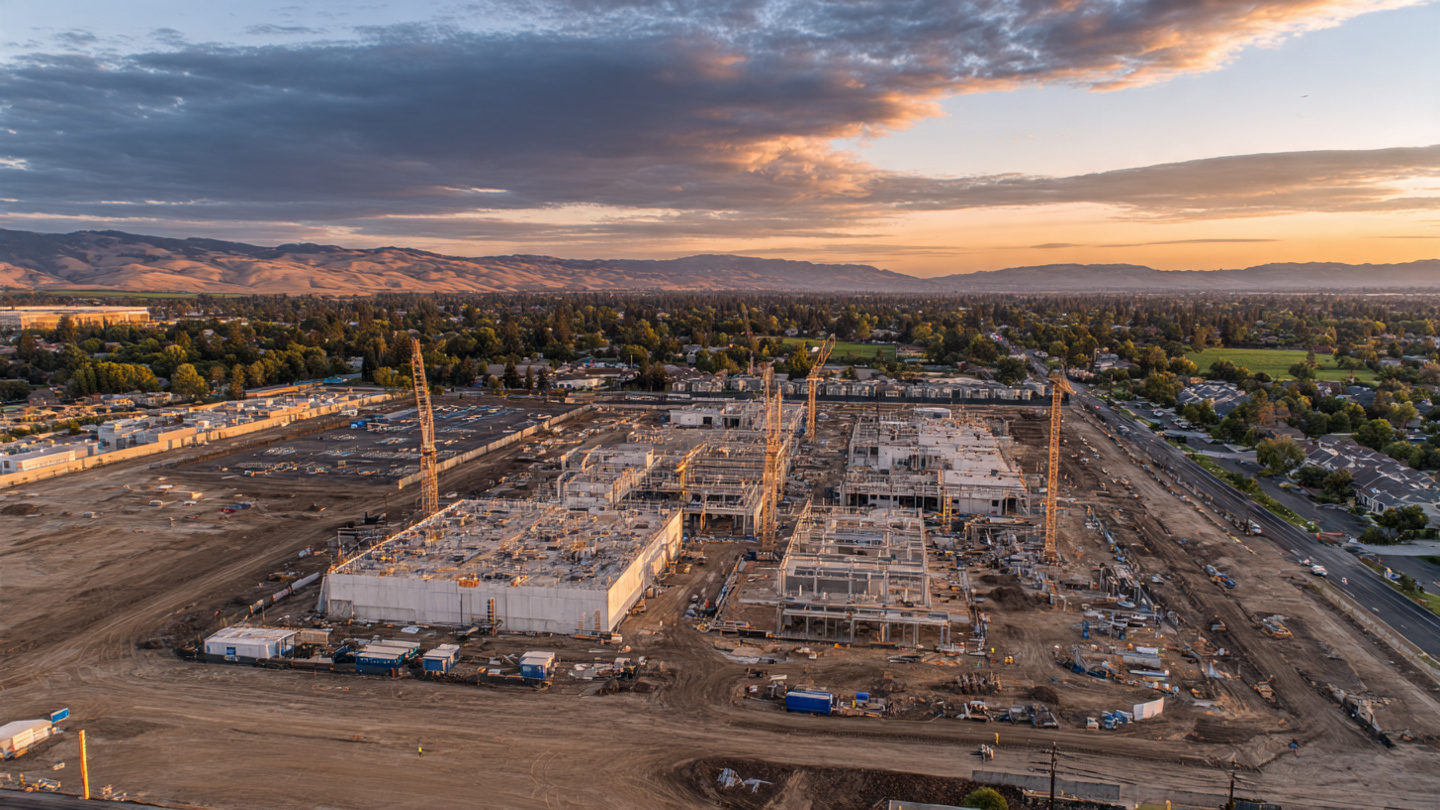
Prineville, Oregon used to be a ranching town. Population 11,000, three stoplights, a lumber mill that closed in 2008. Then Facebook arrived in 2011, Apple followed, and within a decade the town had more square footage of data center floor space than retail. By 2024, roughly 500 construction workers flooded Prineville during peak build phases, according to The Bulletin. Rental vacancy hit zero, seventeen percent of hotel rooms were booked long-term, and workers pitched tents at campgrounds because there was nowhere else to sleep. The companies that hired them started building workforce housing that looked, according to one plumber who spoke to Data Center Knowledge, "exactly like an oil field camp, except the pay was better."
Those workers did not materialize from thin air; they came from residential construction, from rewiring jobs and panel upgrades and new-build rough-ins in suburbs where the framing crew was already short-handed before Prineville ever broke ground.
The Numbers Nobody Is Connecting
Two studies published within months of each other in 2025 describe the same crisis from opposite ends, and neither cites the other.
The first, from the Center for Strategic and International Studies, modeled the data center buildout's workforce requirements and concluded that 75,000 to 140,000 incremental skilled trades positions would be needed beyond current industry capacity by 2030, not total workers but incremental positions, meaning workers the economy does not currently have and cannot train fast enough to produce. William Self, a partner at Mercer, told a Marsh webinar in March 2026 that "the single biggest constraint of this entire buildout is the labor needed, not capital, land, or even energy."
The second study, from the Home Builders Institute, NAHB, and the University of Denver, calculated the cost of skilled labor shortages to residential construction, and their answer was staggering: $10.806 billion per year. That figure includes 19,000 single-family homes that simply did not get built in 2024 because there were not enough workers to frame, wire, plumb, and finish them. Average delay for homes that did get built: 1.98 months. Higher carrying costs from those delays added another $2.663 billion annually.
Nobody had cross-referenced these two datasets, so I did.
If 140,000 workers are being pulled into data center construction, and 19,000 homes went unbuilt due to labor shortages in 2024, then every data center worker absorbed from the broader skilled trades pool represents approximately 0.136 unbuilt homes (19,000 divided by 140,000). Invert that: it takes about 7.4 data center workers to account for one home that never gets built. But that assumes the 140,000 figure and the 19,000 figure are independent measurements of the same labor pool, which they approximately are, because electricians, HVAC installers, and pipefitters are the exact trades that both industries need and neither can find.
Where the Workers Went
Follow the money, because that is exactly what the workers did. Residential building workers earned $33.51 per hour on average in September 2024, according to the Bureau of Labor Statistics. That figure had already jumped 9.9 percent year-over-year, the largest increase in the entire data series going back to 1990, per NAHB analysis. And it still was not enough, because data center electrical contractors like Rosendin Electric deploy 300 to 400 electricians to a single site and can afford to pay premiums that a custom homebuilder running a three-person crew cannot match.
Randstad's analysis of over 50 million job postings in 2026 shows what that demand looks like at scale. Robotics technician postings rose 107 percent, HVAC engineers climbed 67 percent, electricians were up 18 percent, and construction roles overall increased 30 percent, with skilled trades demand growing three times faster than professional roles. Perhaps the most telling data point: time-to-hire for trades positions (56 days) now exceeds professional roles (54 days). Randstad called this the "labor flip," the first time in their tracking history that finding a welder took longer than finding an accountant.
Geographic disruption compounds the wage problem. Data center construction has expanded well beyond traditional hubs like Northern Virginia, Phoenix, and Dallas into rural areas that never had a skilled trades surplus to begin with: Columbus, Ohio. South Bend, Indiana. Abilene, Texas. Rural Louisiana. When a data center project drops into a town of 20,000 people and needs 600 electricians for 18 months, there is no local supply to draw from. Workers relocate, and the communities they leave behind lose their contractors, their HVAC techs, their plumbers, often in markets where the next qualified replacement is a two-hour drive away.
And the pipeline is not refilling, because for every 100 young people entering manufacturing and trades, 102 leave, according to the CSIS study, producing a net negative flow into the profession at the exact moment the economy needs tens of thousands more. A quarter of the current skilled trades workforce globally is approaching retirement age. The data center boom did not create the residential labor shortage; it detonated a bomb in a building that was already on fire.
What This Costs You
If you are building a home in 2026, here is how the data center labor drain shows up on your project.
| Impact | Data | Source |
|---|---|---|
| Average construction delay | 1.98 months per home | HBI/NAHB/Univ. Denver 2025 |
| Residential wage growth | 9.9% YoY (Sept 2024) | BLS/NAHB |
| Open construction positions (Jan 2026) | 231,000 | BLS JOLTS |
| Unfilled rate | 2.7% | BLS JOLTS |
| Annual cost to industry | $10.8 billion | HBI/NAHB/Univ. Denver 2025 |
A two-month delay on a $500,000 build, carrying a construction loan at 8 percent interest, adds roughly $6,600 in interest alone. That does not include extended general conditions (dumpster rental, portable toilet, site supervision, insurance), which typically run $3,000 to $5,000 per month on a mid-range residential project. Total cost of a labor-induced two-month delay: $12,600 to $16,600, paid by the homeowner, caused by a market force they never knew existed.
GCs are absorbing some of this through higher bids. A framing sub who quoted $22 per square foot in 2023 is quoting $26 in 2026. An electrical rough-in that cost $8,000 two years ago now costs $10,500. The labor premium is baked in whether or not you can see it, and builders who cannot absorb the increase are declining projects altogether. That is how 19,000 homes vanish from the pipeline without anyone noticing.
The Strongest Counterargument
Data center construction is cyclical, and the current buildout, unprecedented as it is, will compress. Hyperscalers will overbuild, some projects will stall, and the labor market will rebalance as construction phases shift to lower-intensity operations and maintenance staffing. The CSIS model's high-end 140,000-worker figure assumes aggressive build timelines that may not hold if permitting delays, power grid constraints, or economic slowdowns intervene. Some labor economists argue the residential shortage predates the data center boom by a decade and reflects deeper structural problems with vocational training, immigration policy, and the cultural devaluation of trades work that no single demand shock can explain.
All of this is true. And none of it helps the family in Columbus whose electrician just left for a Meta data center in New Albany paying 40 percent more, leaving their panel upgrade unfinished for six weeks until the GC can find a replacement.
What You Can Do
If you are a homeowner starting a build: lock your subs early. Get signed contracts with start dates, not handshake agreements, because the electrician who verbally committed to your project in March will take a data center gig in April if the money is right. Budget an extra two months into your timeline and carry the financing costs in your proforma. Do not be surprised. Be ready.
If you are a GC: raise your rates or lose your workers. Residential builders have historically competed on thin margins, but thin margins cannot retain talent against an industry that spent $726 billion in a single year. Build retention into your cost structure through year-round employment guarantees, benefits packages, and apprenticeship programs that bind trainees to your company for 24 to 36 months after certification. The math favors investing in your people over perpetually recruiting replacements, because the replacements are leaving for data centers too.
If you are a buyer comparing builders: ask about their labor model. Do they employ trades in-house, or sub everything out? Builders with W-2 electrical and HVAC crews will deliver your home faster and with fewer change orders than those relying on subcontractors who are simultaneously fielding calls from Rosendin. This is now a meaningful selection criterion, not a curiosity.
Limitations of This Analysis
The 7.4-homes-per-worker calculation is a rough cross-reference of two independent datasets that measure overlapping but not identical labor pools. The CSIS 140,000-worker figure is a projection through 2030, not a count of workers already poached. The NAHB's 19,000 unbuilt homes figure covers all labor shortages, not only data-center-driven ones. No study isolates the fraction of the residential shortage attributable specifically to data center construction, and direct causal attribution is not possible with available data. Wage comparisons between residential and data center trades use aggregate BLS data rather than matched-pair analysis of identical workers in both industries. Prineville housing data is from The Bulletin's reporting and has not been independently verified. Carrying cost calculations assume 8 percent construction loan rates and typical general conditions for mid-range residential projects in the continental United States; actual costs vary by market, lender, and project scope.