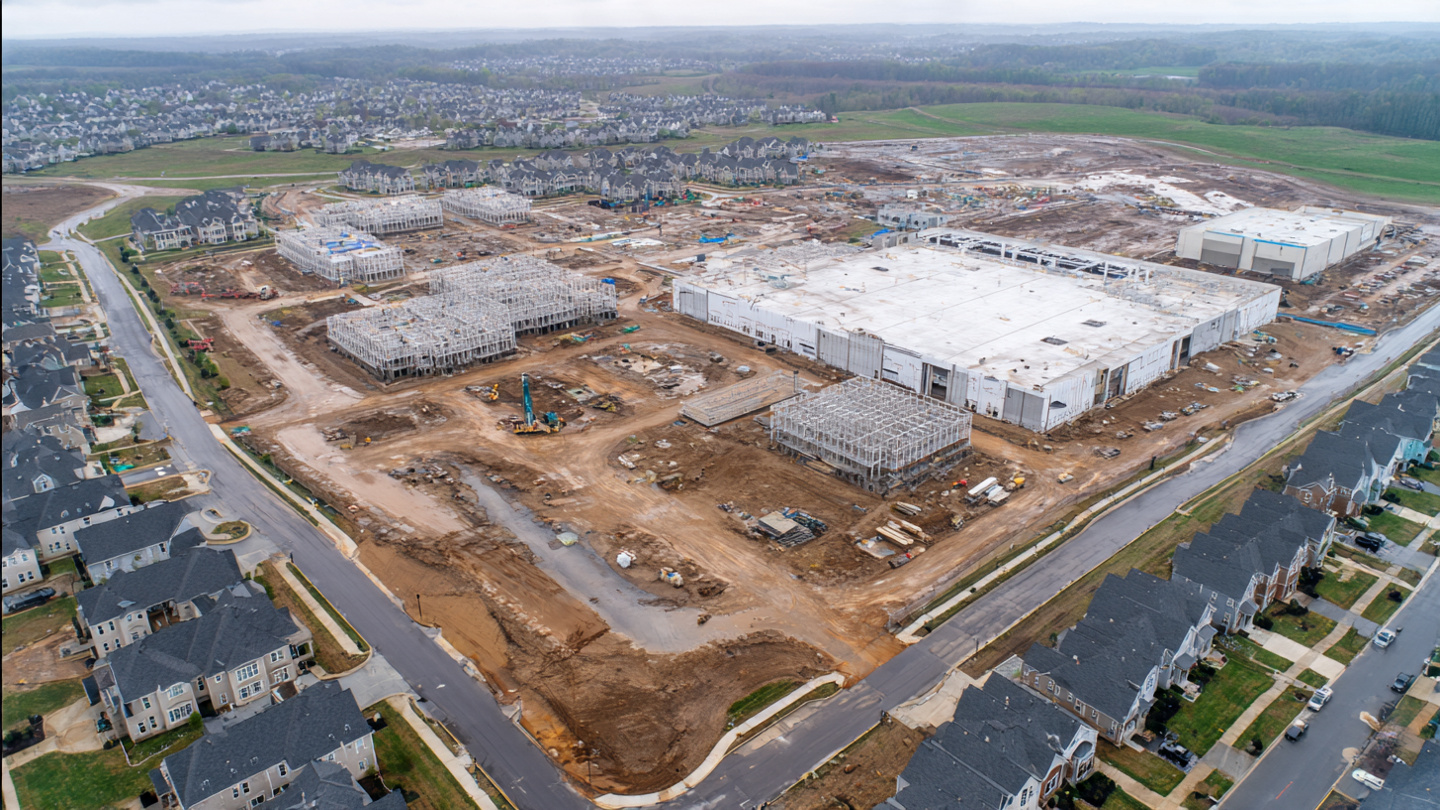
A general contractor in central Texas told me last month that he lost his best electrician, not to retirement or a competing builder or a career change, but to a data center forty miles down the highway where OpenAI is building one of the largest AI training facilities on the planet.
The man had been wiring custom homes for eleven years, the kind of sub you build a schedule around because when he says Tuesday he means Tuesday, and then a recruiter from a mechanical contractor working on one of OpenAI’s Stargate facilities in Abilene offered him $48 an hour plus per diem, a 73% raise over his residential rate of $27.50. He took the job on a Friday and started the following Monday.
Nobody blames him, because you cannot ask a person to turn down a 73% raise out of loyalty to your kitchen remodel.
How Big Is the Drain
OpenAI told the White House last year that building its AI infrastructure will require 20% of the nation’s current skilled trades workforce over the next five years. That is not a rounding error or a PR embellishment designed to make data centers sound important. It is an estimate drawn from the company’s own construction plans: six data centers under the Stargate project spanning Texas, New Mexico, Ohio, and Wisconsin, representing roughly 7 gigawatts of planned capacity and over $400 billion in investment.
Twenty percent of the entire skilled trades workforce, drawn from a labor pool that is already hemorrhaging workers faster than it can replace them.
Randstad’s global labor analysis, drawing from over 50 million job postings, measured what happened to trade demand after generative AI went mainstream in late 2022. Robotics technicians, 107%. HVAC engineers, 67%. Electricians, 18%, and construction roles overall, 30%, a pattern so pronounced that skilled trades hiring is growing three times faster than professional white-collar roles, a reversal nobody in workforce planning expected and for which nobody built a pipeline.
For the first time in Randstad’s tracking history, it now takes longer to hire a skilled tradesperson (56 days) than a desk-based professional (54 days). That gap will widen because the demographic math is vicious: for every 100 young people entering manufacturing, 102 leave. Net negative, with one in four construction workers nearing retirement age and no mechanism to replace them at the rate they are leaving.
A Pay Gap That Works Like Gravity
Residential electricians in the United States earn a median of roughly $25 per hour. Data center electricians earn a median total compensation of $91,000 per year, which works out to approximately $44 per hour base before overtime and bonuses push it higher. Rosendin, one of the largest electrical contractors in the data center space, posts ranges of $34 to $48 per hour for journeymen.
That is not a wage premium so much as a different economy altogether, one where the floor for skilled electrical work starts above the ceiling in residential.
HVAC technicians see a similar spread. Data center cooling systems, which dissipate tens of megawatts of heat from GPU clusters packed at densities residential HVAC techs have never encountered, pay accordingly. Welders are up 25%, and even general laborers on data center sites command premiums because the scale of concrete, structural steel, and electrical conduit dwarfs anything a residential job site has ever demanded of them.
And the work is steadier. Data center contractors carry 10.6 months of backlog compared to 8.3 months for the rest of the industry. When your backlog stretches nearly a year, you can guarantee continuous employment in a trade that has historically meant feast-or-famine cycles between projects. A residential framer might work 40 hours one week and 12 the next depending on weather, inspections, and the builder’s draw schedule. A data center electrician works 50 hours a week for 18 months straight.
What the Numbers Mean for Your House
The NAHB/HBI study released in June 2025, conducted by the University of Denver, put hard numbers on what the labor shortage costs homeowners. Findings were blunt: 19,000 single-family homes were not built in 2024 because there were not enough workers to build them. Construction timelines have stretched by an average of 1.98 months due to subcontractor unavailability. Direct carrying costs from those delays total $2.663 billion annually across the industry. Aggregate economic impact: $10.8 billion per year.
And that was before data center construction entered its exponential growth phase, absorbing the most skilled tradespeople from every adjacent sector at wages residential builders cannot match.
The AGC/NCCER workforce survey found that 92% of construction firms actively hiring cannot find qualified workers. Forty-five percent report that labor shortages are the leading cause of project delays. Among those firms, 57% say available candidates lack the skills or licensing for the positions they need to fill.
If you are a homeowner waiting three months for an electrician to wire your addition, or a builder whose HVAC sub keeps rescheduling because he is double-booked across six jobs, this is why. Your electrician did not vanish into thin air. He moved to a data center in Abilene, or Round Rock, or Columbus, or Racine, because someone offered him nearly double his rate to install 4,000-amp switchgear instead of 200-amp residential panels, and the project guarantees him continuous work for the next year and a half while your subdivision offers him six weeks at best.
An Irony Worth Naming
Consider what is happening. AI companies are promising that their technology will eventually automate construction scheduling, optimize crew allocation, predict material needs, and reduce waste on residential job sites, but right now, today, those same companies cannot build their own data centers without consuming the human workforce that residential construction desperately needs, and nobody involved in this contradiction seems troubled by it.
Run the arithmetic. OpenAI estimates 20% of the skilled trades workforce. Residential construction employs roughly 30% of all construction workers, according to BLS sector data. If the data center buildout draws proportionally from all construction segments, and there is every reason to believe residential takes a disproportionate hit because it pays less and offers shorter project commitments, the AI infrastructure boom could absorb the equivalent of two-thirds of residential construction’s labor capacity over five years.
That math does not close. ABC estimates the industry needs 349,000 net new workers in 2026 and 456,000 in 2027. Randstad’s data shows the pipeline is net negative. Immigration enforcement has already affected 28% of construction firms, with 20% reporting that subcontractors lost workers. Foreign-born workers represent roughly a quarter of construction payroll employment and a third of craft workers.
You cannot lose a quarter of your workforce to immigration policy, lose another fifth to data centers, and expect the remaining half to build 1.5 million homes a year.
Why This Narrative Might Be Wrong
Data center construction is not evenly distributed. It is concentrated in a handful of markets: northern Virginia, central Texas, central Ohio, parts of the Southeast. A residential builder in Maine or Montana is not competing with Stargate for electricians. Geographically specific, the labor drain is real, and extrapolating national crisis from regional hotspots overstates the problem for most markets.
Higher wages also expand the labor pool over time. When electricians can earn $48 an hour, more people pursue electrical apprenticeships. Trade school enrollment has been rising, and programs in states with heavy data center activity are reporting increased interest. OpenAI itself is launching a Certifications and Jobs Platform in partnership with community colleges near its Stargate sites, explicitly to train new workers rather than just poach existing ones.
And the NAHB’s 19,000-homes-not-built figure, while striking, represents less than 2% of the roughly 1.4 million housing starts in 2024. Labor shortages create a cost and delay problem more than an absolute production cap. Houses still get built. Slowly. Expensively. But they get built, which is a different kind of crisis than a total shutdown, and a less photogenic one, and therefore one that policymakers are slower to address.
What Builders Can Do Right Now
If you are a residential GC running $1-5M custom projects, three moves improve your position in a tightening labor market.
Lock subcontractors with annual commitments. A one-project relationship cannot compete with an 18-month data center contract. Offer your best subs a guaranteed volume of work across your pipeline. Most residential builders operate project-to-project. Builders who retain subs in this market will be the ones who think in annual terms.
Pay faster. Net-30 or net-60 payment terms are standard in residential, but data center general contractors often pay net-15 or offer progress billing. If your electrician has to choose between a builder who pays in 45 days and a data center that pays in 14, the builder loses regardless of per-hour rate, and in practice this is how residential contractors bleed their most reliable subs one invoice at a time.
Use AI scheduling tools to reduce idle time. Platforms like Buildertrend, Procore, and Contractor Workflow optimize task sequencing so that when your electrician shows up, the framing is done, the inspection is passed, and the rough-in can start immediately. Every wasted day on a residential job site is a day your sub could have spent on a data center. Make your project the one where nobody waits.
What I Did Not Prove
I have not demonstrated that a specific number of residential electricians or HVAC techs have moved to data center work. Documented wage gaps and anecdotal migration, based on conversations with Texas and Ohio contractors, not a longitudinal workforce tracking study. OpenAI’s 20% figure is self-reported and comes from an advocacy document submitted to the White House, not an independent analysis. Randstad’s job posting data captures demand, not hires, and postings do not always convert to filled positions. My two-thirds labor capacity calculation combines OpenAI’s 20% estimate with BLS residential employment share, and it assumes proportional draw across sectors, which is an oversimplification. Geographic concentration means the national impact is uneven. NAHB carrying-cost figures aggregate across all builder sizes and markets, and smaller builders in high-demand metro areas experience delays far worse than the 1.98-month average.
What is clear: the construction labor market was already in crisis before the AI infrastructure boom. Data centers are not the sole cause of residential delays, but they are an accelerant applied to an existing fire, and the people writing the checks for those data centers are the same ones promising that AI will eventually solve the very problem their construction is making worse.
Sources
- OpenAI, OSTP RFI Submission, “Building an American AI Infrastructure,” October 2025
- Randstad, “AI Can’t Build Data Centers: Global Demand for Skilled Trades Soars,” 2026
- AGC/NCCER, 2025 Workforce Survey: “Construction Workforce Shortages Are Leading Cause of Project Delays”
- ABC, “Construction Industry Must Attract 349,000 Workers in 2026,” January 2026
- NAHB/HBI/University of Denver, “Economic Impact of Housing Industry Labor Shortage,” June 2025
- Amtec Staffing, “U.S. Construction Workforce Data & Benchmarks (2025–2026),” April 2026
- Bureau of Labor Statistics, Industries at a Glance: Construction (NAICS 23)
- PayScale, Electrician with Residential Skills Hourly Pay, 2026
- Glassdoor, Data Center Electrician Average Salary, 2026
- NFPA, 2026 State of the Skilled Trades Report (via Occupational Health & Safety)