Foundation failure is the most expensive thing that can happen to a house. Not a leaky roof. Not a cracked sewer line. Not even a fire, which insurance actually covers well. A foundation that settles unevenly, cracks the slab, and racks the framing costs $5,000 to $100,000+ to repair—and the average homeowner pays around $4,500 before they even know the full scope. In 2025, the U.S. foundation repair market hit $4.9 billion. That’s $4.9 billion spent fixing a problem that starts in the dirt before a single wall goes up.
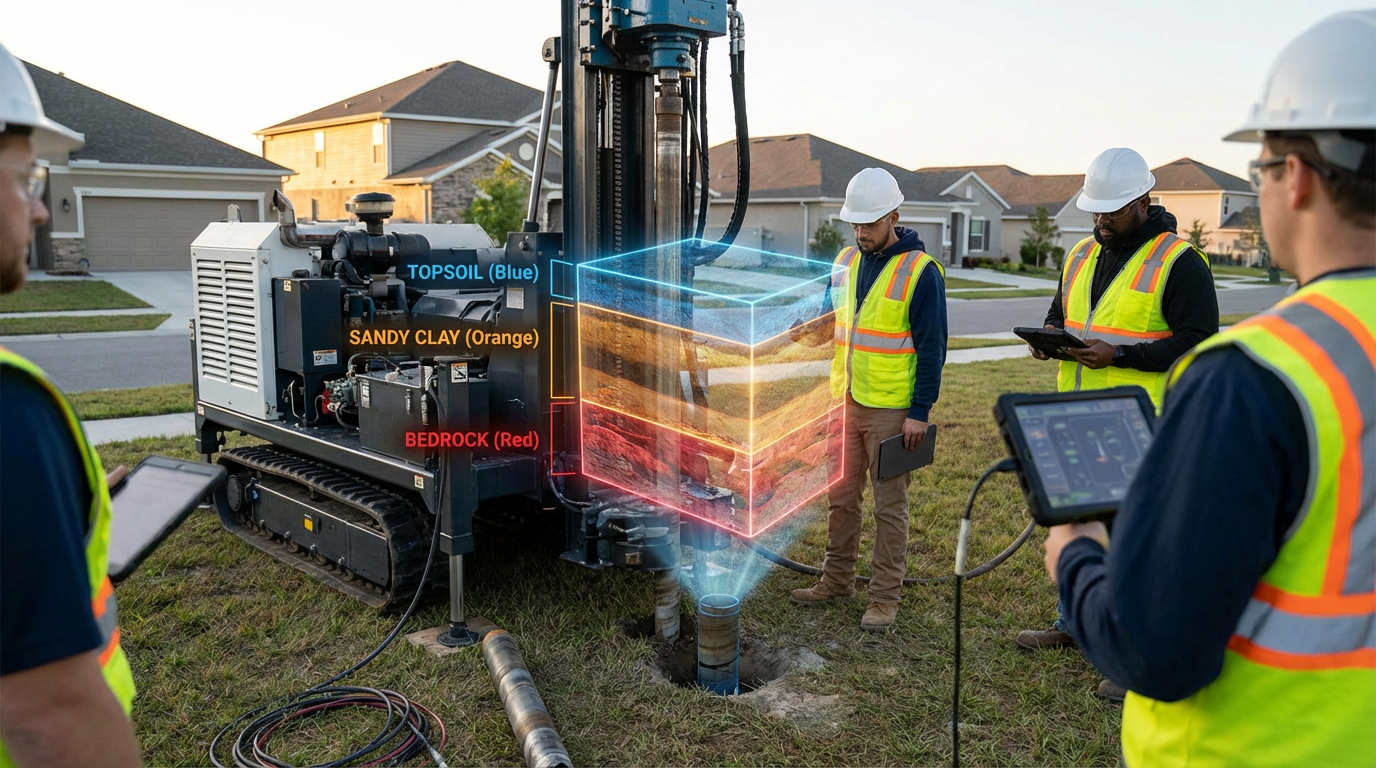
The root cause is almost always the same: somebody didn’t understand the soil well enough. A standard residential geotechnical investigation costs $3,000–$15,000, involves drilling 2–4 boreholes across the lot, pulling core samples, and sending them to a lab. Two weeks later, you get a report that says something like “moderately expansive clay, bearing capacity 2,000 psf, recommend post-tensioned slab.” The engineer extrapolates from a handful of data points to predict what the entire footprint of soil will do under load for the next 50 years.
It’s educated guessing. And AI is about to replace the guessing part.
From Three Boreholes to 10,000 Simulations
Foundaxis, a startup building AI-powered structural foundation design software, is attacking the problem from the design side. Its platform integrates directly with SAP2000, ETABS, and STAAD Pro—the structural analysis tools engineers already use—and applies machine learning to automatically select, model, and optimize isolated, strip, and raft foundations. It handles multi-layered soil profiles, generates ACI-318 compliant reinforcement designs, and exports BIM-ready models for Revit and Tekla in a single click.
The AI doesn’t just speed up the calculation. It explores the design space. Where a human engineer might test 3–5 footing configurations and pick the one that satisfies code, the AI evaluates thousands of combinations—varying footing width, depth, reinforcement spacing, and concrete strength against actual soil variability—to find the design that uses the least material while maintaining the highest safety margin.
“The most innovative aspect is the direct soil–structure interaction within a very user-friendly interface. It proposes foundation alternatives that require minimal adjustment.” — Mario López, Structural Engineer, TNA Engineering
The Soil Lab Goes Digital
Fugro, one of the world’s largest geotechnical firms, announced in 2025 that it had increased laboratory testing capacity by 50% and is deploying AI across its soil analysis pipeline. Machine learning models now automate the interpretation of cone penetration tests (CPT), standard penetration tests (SPT), and borehole logs—classifying soil types, predicting bearing capacity, and flagging anomalies that a human technician reviewing hundreds of pages of data might miss.
The acceleration matters because time kills residential projects. A traditional geotechnical report takes 2–4 weeks from drilling to final PDF. AI-assisted interpretation is compressing that to days. Fugro’s automated workflows use neural networks trained on thousands of prior investigations to recognize soil behavior patterns, predict settlement curves, and generate engineering recommendations without waiting for every wet-lab test to finish.
Predicting Settlement Before Digging
McKinsey’s research on AI in construction found that predictive analytics can reduce project cost overruns by up to 30% through early identification of potential issues. In foundation work, that means AI systems analyzing geological surveys, municipal records, neighboring property data, and historical construction information to build comprehensive risk profiles for specific sites.
The approach is fundamentally different from traditional geotechnical practice. Instead of drilling a few holes and extrapolating, AI models ingest regional soil databases—USDA Web Soil Survey, state geological surveys, FEMA flood maps, and historical building performance data—to create a probabilistic model of what’s under your lot before anyone drives a drill rig onto it. The physical investigation then validates and refines the model rather than serving as the sole data source.
Seequent’s GeoStudio, widely used for slope stability and seepage analysis, is integrating ML-powered modules that predict foundation settlement patterns from historical data. When a new site presents soil conditions similar to past projects that experienced differential settlement, the system flags the risk immediately—allowing engineers to specify deeper footings or ground improvement before excavation reveals the problem the hard way.
The Residential Gap
Here’s the construction angle: most of these tools were built for commercial and infrastructure projects. A 40-story tower justifies a $200,000 geotechnical program. A single-family home does not. The standard residential geotech budget is $3,000–$7,000—enough for a few boreholes and a formulaic report, not enough for advanced modeling.
AI closes that gap. When the interpretation and design optimization are automated, the cost of sophisticated analysis drops to where it makes sense for a $500,000 house. A builder ordering 50 lots in a subdivision can run AI-assisted soil analysis on the entire parcel for marginally more than traditional testing on a handful of lots, catching the one site with a buried clay lens or perched water table that would have gone undetected in a conventional three-borehole program.
Ground-penetrating radar (GPR) paired with AI image recognition is another frontier. Handheld GPR units that cost $15,000–$30,000 can now scan a residential lot in hours, and AI algorithms classify subsurface features—voids, buried utilities, soil layer transitions, bedrock depth—from the radar returns. It’s not a replacement for drilling, but it fills in the gaps between boreholes with continuous data instead of interpolation.
“If it can’t survive a job site, it doesn’t belong on one. But these AI tools run on the same laptops my engineers already carry. No special hardware, no cloud dependency for the basic analysis. The report just comes out faster and catches things we’d have missed.”
What a $500,000 House Deserves
The average new single-family home in the U.S. sells for $495,000 (Census Bureau, Q4 2025). The foundation represents 8–15% of total construction cost—roughly $40,000–$75,000. Getting it wrong is catastrophic. Getting it overdesigned wastes $5,000–$15,000 in unnecessary concrete and steel.
AI optimization sits in the middle. By accurately predicting soil behavior and optimizing the structural design to match, it avoids both failure and waste. The same $3,000 geotech budget buys dramatically more insight when the interpretation is automated, the design is optimized across thousands of scenarios, and the report is generated in days instead of weeks.
The ground under your house is the one thing you can’t change after you build. Everything else—the roof, the HVAC, the plumbing, the wiring—can be replaced. The foundation can’t. It’s the most consequential engineering decision in the entire project, and for 60 years we’ve been making it with three holes and a best guess. AI isn’t making the decision less important. It’s making the data behind it worthy of the stakes.