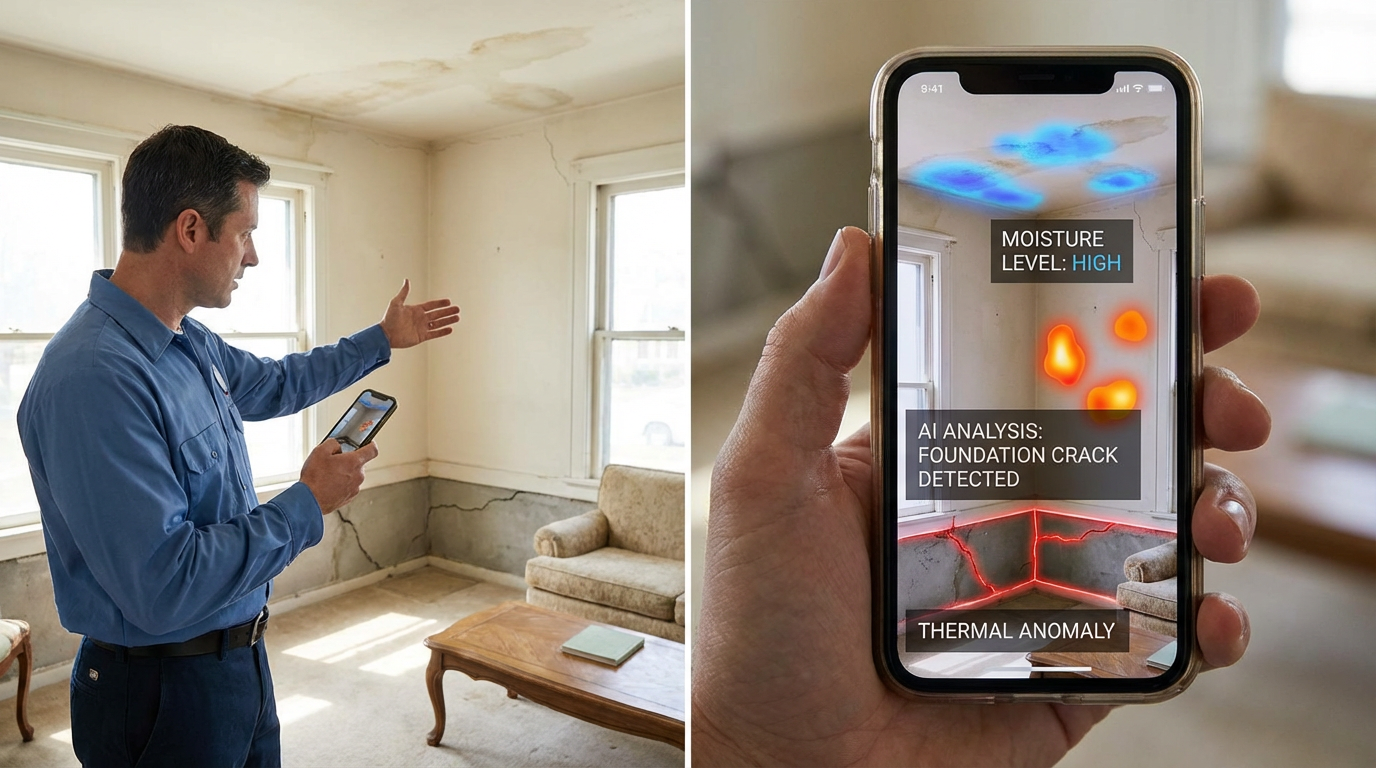
Two million home inspections happen in the United States every year. Each one follows roughly the same script: a licensed inspector spends two to three hours walking a property, eyeballing the roof from ground level, running the faucets, flipping the breakers, and writing a report that costs the buyer $300 to $600. The buyer reads it, panics about three things, negotiates, and closes. Nobody goes back to check whether the inspector was right.
Somebody finally checked.
A 2019 peer-reviewed study published in the Journal of Real Estate Research sent multiple inspectors through the same properties. Their accuracy on identifying code violations landed around 26%. Not a typo. Three out of four code violations walked right past the clipboard.
Consumer Reports ran a parallel investigation and found wild variation in inspector quality—some flagged 30+ issues on a property where others found eight. The profession is licensed in 44 states, but the bar is shockingly low in most of them. In some states, you need more training hours to cut hair than to tell someone their $495,000 purchase is structurally sound.
The Phone Sees What the Inspector Doesn’t
HomeVision AI asks buyers to do something radical: take photos of the house with their phone before the inspector even shows up. The platform analyzes 25+ exterior components from those images—roof condition, gutter damage, siding deterioration, grading problems, foundation cracks visible from the surface. It won’t replace a crawl-under-the-house inspection. But it catches things the inspector would have driven past on the way to the front door.
The tool works because exterior defects are pattern-recognition problems, and pattern recognition is where computer vision embarrasses humans. A stain on vinyl siding that an inspector chalks up to dirt? The algorithm has seen 40,000 stains and knows which ones correlate with failed flashing behind the wall.
Then there’s thermal imaging. Traditional inspectors who use FLIR cameras—and most don’t, since a decent unit costs $400 to $2,000—still rely on their own eyes to interpret the thermal image. FLIR’s newer building diagnostic cameras and InfiRay’s smartphone thermal modules now ship with AI anomaly detection that highlights moisture intrusion, insulation voids, and electrical hotspots automatically. Research from building science labs has shown AI-assisted thermal analysis catches roughly 40% more moisture intrusion than visual-only inspection.
The Insurance Companies Got There First
While the home inspection industry debated whether AI was a threat, insurers quietly built the tools.
Betterview uses aerial and satellite imagery plus AI to assess roof condition, tree overhang risk, and property maintenance for insurance underwriting. Cape Analytics does similar work—analyzing geospatial imagery to score property condition at scale. Hover generates 3D property models from smartphone photos that contractors, insurers, and now home buyers can use to measure and assess a structure without climbing on the roof.
These tools were built for underwriting. But the same AI that tells an insurer “this roof has two years left” can tell a buyer the same thing—before they make an offer.
Google got even more ambitious. Project Bellwether, a research initiative using Street View imagery and machine learning, demonstrated the ability to assess property condition at neighborhood scale. The implication: before you even schedule a showing, an AI has already rated every house on the block.
The Inspector Isn’t Going Anywhere (Yet)
None of these tools crawl into attics. None of them test the water heater’s pressure relief valve or run the dishwasher through a cycle. The physical inspection still matters.
But the tools around the inspector are getting smarter. Palm-Tech, Spectora, and HomeGauge—the three dominant inspection reporting platforms—are all integrating AI features: auto-generated defect descriptions from photos, severity scoring, and predictive maintenance timelines. Inspectify built a marketplace that standardizes and AI-parses inspection reports so buyers can actually compare them.
The American Society of Home Inspectors (ASHI) hasn’t issued an official position on AI integration. They should. Because the liability question is real: if an AI-assisted inspector misses a $40,000 foundation problem, does the E&O insurance cover the algorithm’s mistake? Nobody has tested this in court yet. But the NAIC’s 2024 study on AI in insurance flagged this exact liability gap across multiple property-related AI applications.
What a Buyer Should Actually Do
Right now, today, for under $100:
Before you hire an inspector: Run the property through HomeVision AI or a similar exterior assessment. Snap thermal images with a $200 InfiRay smartphone attachment. You’ll walk into the professional inspection already knowing the exterior story.
During the inspection: Choose an inspector using a platform like Spectora or Inspectify that generates structured, AI-parseable reports—not handwritten PDFs. Ask whether they use thermal imaging. If they don’t, bring your own.
After the inspection: Cross-reference the report against Betterview or Cape Analytics data if your agent has access. Check Google Street View historical imagery to see how the property has changed over time—sometimes the most revealing defect is the one that appeared between 2019 and 2023.
The home inspection isn’t broken because inspectors are lazy. It’s broken because we’re asking one person with a flashlight to evaluate a $500,000 machine in three hours. AI doesn’t fix that. But it gives the buyer a second pair of eyes that never gets tired, never rushes to make the next appointment, and has seen a hundred thousand roofs instead of a hundred.
Sources: Journal of Real Estate Research — Home Inspector Accuracy Study (2019) · Consumer Reports — How to Find a Good Home Inspector · National Association of Realtors — Transaction Data · FLIR Building Diagnostics · Betterview — Property Intelligence Platform · Cape Analytics — AI Property Assessment · Hover — 3D Property Models · Google Research — Property Condition Assessment from Street View (arXiv, 2023) · Palm-Tech Home Inspection Software · Spectora · HomeGauge · Inspectify — Home Inspection Marketplace · ASHI — American Society of Home Inspectors · NAIC — AI in Insurance Study (2024)