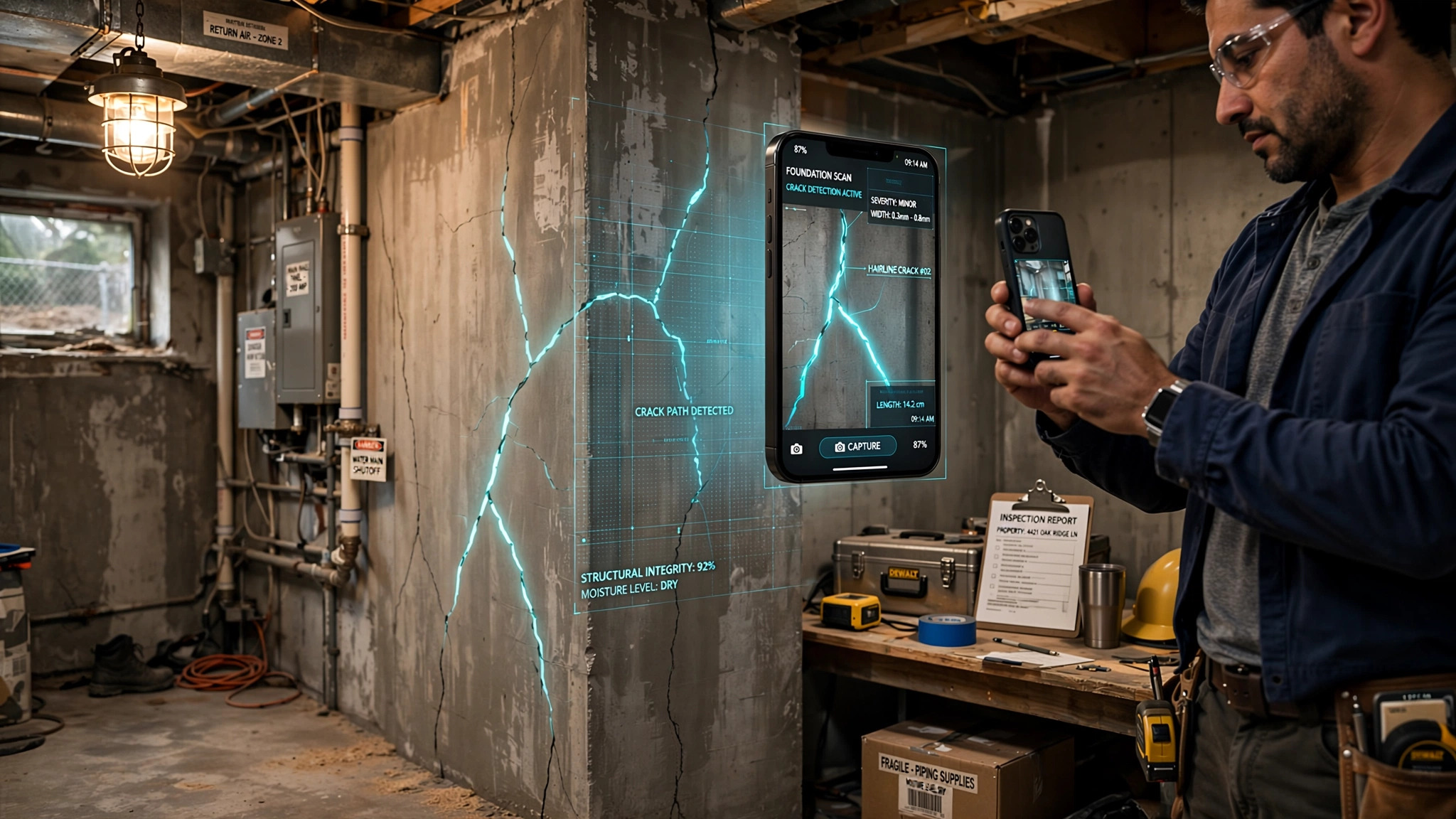
A home inspection takes about three hours. Your inspector walks 1,500 to 3,000 square feet of house, opens every cabinet, runs every faucet, toggles every breaker, climbs into the attic if the access isn't blocked by the homeowner's Christmas storage, and takes somewhere between 150 and 300 photographs. Then they go home, spend another two to four hours writing the report, and send you an 80-page PDF full of photos annotated with phrases like "monitor for changes" and "recommend further evaluation by a licensed contractor."
You pay $333 for this, which is the national median, and about 2.1 million of these happen every year across the United States, each one a compressed bet that three hours of human attention is enough to protect a $400,000 purchase. And the inspector misses things.
Not because they're incompetent, but because they're human, they're tired, and they just looked at 200 photos in a house where 55% of the doors stick and 54% of the exterior caulk is gone and 48% of the outlets near water don't have GFCI protection, all data points surfaced in Repair Pricer's analysis of 50,000 inspection reports. When everything needs attention, the important things blur into the noise.
What the Camera Saw That He Didn't
In November 2025, Inspection Support Network shipped an AI Image Defect Detector built directly into its report-writing software, used by thousands of inspectors across North America. Upload a photo, and the system scans for visible issues: hairline cracks, moisture staining, efflorescence, worn sealant, rust streaks, damaged flashing, generating a suggested comment for each detected defect that includes a description and, when relevant, a recommended action. Inspectors review the suggestions, edit if needed, and drop the comments into the report without typing a sentence from scratch.
Palmtech followed three months later with an identical feature in Palmtech 11, running the same workflow through its own software ecosystem, and the underlying logic is the same in both cases: the photo you already took now does more work than the inspector who took it, because the algorithm doesn't get tired at 3 PM on its fourth inspection of the day, and it doesn't unconsciously deprioritize a hairline crack in the garage slab because the HVAC system in the attic already consumed 40 minutes of attention.
Binsr Inspect, reviewed by Inman last fall, takes a different approach: instead of analyzing uploaded photos after the fact, it pre-loads standardized comments based on the inspection category and lets the inspector dictate a short voice prompt that the AI expands into a full, descriptive report comment. "We want less tapping, more inspecting," said Binsr CEO Tom Garcia, and the bottleneck he's describing isn't the inspector's knowledge or competence but rather the hours they spend tapping screens and writing sentences while the house gets cold and the buyer's agent starts texting.
Where the Miss Rate Becomes a Dollar Amount
Data from industrial quality control, where computer vision has been deployed for over a decade, puts human visual inspection defect detection at 80 to 85%, meaning inspectors catch four out of five problems and the fifth one walks out the door. In manufacturing, that fifth defect becomes a warranty claim or a recall. In home inspection, it becomes a $12,000 mold remediation bill that shows up eight months after closing, after the buyer discovers that the "minor staining" in the basement was actually an active water intrusion path behind the finished wall that the inspector couldn't see and the AI wouldn't have caught either, because neither of them has X-ray vision.
But here's the number that matters for the tools that do exist: Repair Pricer's 50,000-report analysis found that the average home inspection surfaces over $11,000 in needed repairs, and if inspectors miss 15% of visible defects, the average missed-defect exposure per transaction is roughly $1,650, which means at a $333 inspection fee, the buyer is paying $1 for every $5 of missed risk that a better process would have caught.
A peer-reviewed study published in Discover Artificial Intelligence in 2026 tested an integrated AI inspection pipeline called BuildCaption against both commercial software and foundation-model approaches, and the results were striking: 96.5% mean average precision on defect detection, 95.1% intersection-over-union on segmentation, and inspectors completing tasks 2.3 times faster than with existing commercial tools, not because the AI replaced the inspector but because it did the writing while the inspector kept inspecting.
What's Shipping Right Now
This market is fragmenting fast, and the tools range from serious to half-baked:
| Tool | What It Does | Who It's For |
|---|---|---|
| ISN Image Defect Detector | Scans photos for cracks, moisture, wear. Generates editable comments. | Inspectors using ISN Report Writer |
| Palmtech 11 | Same concept, built into Palmtech workflow. | Solo inspectors, small teams |
| Binsr Inspect | Voice-to-text AI comments, color-coded reports, pre-loaded descriptions. | High-volume inspectors |
| Paraspot | Mobile CV for property conditions. Auto-categorizes by room. Enables remote self-inspection. | Multifamily, SFR portfolios, property managers |
| InspectReply-AI | Uploads inspection report, generates localized repair cost estimates and contractor referrals in 10 minutes. | Inspectors seeking referral revenue |
| Inspect Genie | Voice and photo to professional reports. Works offline. | Field inspectors, facility managers |
| AvidWarranty | Trained on 1.4M warranty claims. Predicts common defects, automates builder responses. | Production homebuilders |
None of these replace the inspector, but every one of them replaces the clipboard.
Why False Positives Might Cost You More Than Missed Cracks
An AI that flags a hairline settlement crack in a 30-year-old foundation as a "structural concern" might be technically correct, because concrete cracks and every foundation in America has them, but the question is whether that crack is active, whether it's growing, whether it admits water, and whether the building has compensated for it over three decades of seasonal movement without any functional consequence whatsoever.
A human inspector knows this because they've looked at 4,000 foundations and can tell the difference between a shrinkage crack that appeared six months after the pour and a crack pattern that indicates differential settlement, a distinction that requires not just pattern recognition but spatial reasoning and the accumulated judgment of years spent crawling through basements in January. An algorithm sees pixels that match a training label called "crack" and generates a comment, and if that comment says "recommend evaluation by a structural engineer," the buyer now has a $2,000 to $5,000 engineering evaluation on their to-do list for a non-issue, the seller's agent is furious, and the deal is at risk over a problem that isn't one.
This is not hypothetical. Only 2.3% of all inspection findings are structural, according to ASHI's 2022 report-item taxonomy analysis, but structural concerns drive the most deal-killing negotiations. An AI system that increases the false positive rate on structural flags, even slightly, will cost more money in blown deals and unnecessary engineering evaluations than it saves by catching actual defects, and nobody has published data on AI false positive rates in residential inspection specifically, which should worry anyone paying attention.
What AvidWarranty Knows That Your Inspector Doesn't
ECI Software Solutions launched AvidWarranty at the 2025 International Builders' Show with a dataset that dwarfs anything available to individual inspectors: 1.4 million homeowner warranty claims, each one a data point about what actually broke after the buyer moved in. Its platform uses that data to predict which defects will surface in which types of homes, how quickly they'll escalate, and what the resolution will cost, and while it's built for production builders managing thousands of homes rather than for the solo inspector doing four inspections a day, the underlying insight applies everywhere in the industry.
Warranty data reveals what inspections miss because it captures what actually breaks after the buyer moves in, sometimes years later. A pre-purchase inspector sees the house for three hours; a warranty system sees it for ten years. If specific HVAC configurations fail at higher rates in specific climate zones, or if certain window manufacturers produce units that develop seal failures within 36 months, that pattern is invisible to the inspector standing in the living room but visible in a dataset of 1.4 million claims, and closing that gap between observable conditions and statistical reality is where AI is best positioned to help, not by making the inspector's eyes sharper but by telling them where to look before they walk through the door.
What the Liability Landscape Looks Like
Eighteen percent of home inspectors report having been sued or threatened with a lawsuit, a figure from industry data compiled by Gitnux that likely understates the exposure because most claims settle below the reporting threshold. Many inspection contracts cap liability at the inspection fee, which means in a state where the median fee is $333, the inspector's maximum exposure for missing a $35,000 foundation problem is $333, and the buyer absorbs everything above that amount.
AI doesn't change the liability cap, but it changes the standard of care argument in ways that should concern every inspector who isn't using these tools. If an inspector using ISN's defect detector can demonstrate that AI reviewed every photo and flagged no structural concerns, that's a stronger defense than "I looked at it and it seemed fine." Conversely, if an inspector doesn't use available AI tools and misses a defect that the tool would have caught, a plaintiff's attorney will eventually argue that the standard of care now includes AI-assisted review, and while that argument hasn't won in court yet, it will, because the precedent from medical malpractice is clear: when a diagnostic tool becomes standard practice, failure to use it becomes negligence.
What This Means If You're Buying a Home
Ask your inspector what software they use, because this is not a gotcha question but the equivalent of asking your surgeon whether they use robotic assistance, and the answer tells you something about the quality of the process, not just the person performing it.
If your inspector is still writing reports by hand or using software from 2018, you're getting a process that depends entirely on one person's attention span at 4 PM on a Friday. If they're using ISN, Palmtech 11, or Binsr with AI features enabled, you're getting a second set of eyes on every photo, eyes that are imperfect, context-blind, and prone to false positives on cosmetic issues, but also tireless, consistent, and trained on more images of residential defects than any single inspector will see in a career.
An inspection is still a $333 snapshot, not a guarantee, and no technology changes that fundamental constraint. But the question of whether your snapshot was taken by someone whose tools actually analyze all 200 photos, or by someone who glances at them while typing "recommend further evaluation" for the fortieth time that week, is worth asking before you write the check.
What This Article Did Not Prove
Most of these accuracy claims deserve scrutiny: the 15% miss rate and 80-85% detection rate figures come from manufacturing quality control benchmarks, not residential home inspection studies, and no peer-reviewed research has directly compared AI-assisted versus traditional home inspection outcomes in a controlled residential setting. My $1,650 missed-defect exposure calculation is an estimate derived from multiplying the miss rate against the average repair value, which involves assumptions about the distribution and severity of missed versus caught defects that the underlying data doesn't resolve. BuildCaption tested an academic framework, not a commercially available home inspection product, and AvidWarranty's 1.4 million claims give it statistical power for builder warranty management, not buyer-side inspection augmentation. My false positive concern is based on structural reasoning and conversations with inspectors, not on published data, because no one has published that data yet.
Every AI tool described here is new, with ISN and Palmtech shipping within the last eight months and Binsr and Paraspot reviewed less than a year ago, and whether they actually reduce post-purchase defect discovery rates, lower warranty claim volumes, or change inspection liability outcomes is an empirical question that won't have a real answer for two to three years at minimum. What we know right now is that the tools exist, they're being adopted, and the inspection process hasn't meaningfully changed since home inspections became standard practice in the 1970s. Something was going to break the pattern. It turns out to be a camera that reads its own photos.