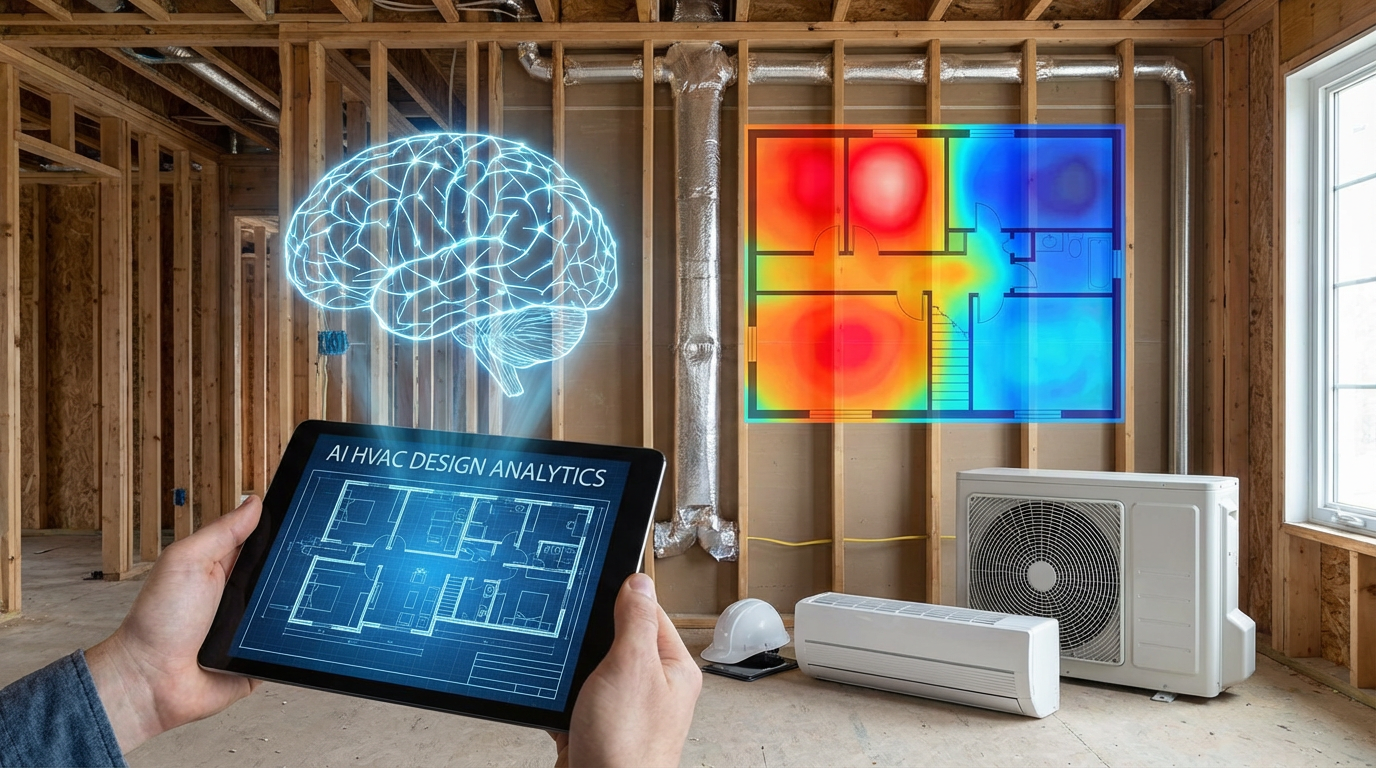
Here’s a dirty secret the HVAC industry would rather you didn’t think too hard about: roughly half of all residential HVAC systems in the United States are oversized. Not by a little. By 20 to 50 percent. That means the most expensive mechanical system in your home — the one that accounts for 40% of your energy bill — is burning money every single cycle because somebody guessed instead of calculated.
The root cause isn’t incompetence. It’s economics. A proper Manual J load calculation — the ACCA-standard method for sizing heating and cooling equipment — takes 30 to 60 minutes of painstaking data entry per home. Room dimensions, window orientations, insulation R-values, infiltration rates, duct losses. Most HVAC contractors do 8 to 12 estimates a day. The math doesn’t work. So they do what the industry has done for decades: they round up, add a “safety factor,” and install a system one or two sizes too big.
Why Oversizing Kills Comfort and Cash
An oversized air conditioner doesn’t just waste electricity — it actively makes your house less comfortable. The system cools too fast, hitting the thermostat setpoint before it has time to dehumidify the air. The result: clammy 72°F rooms, constant short-cycling that wears out the compressor, and energy costs 20 to 30 percent higher than a properly sized system. On a $200/month utility bill, that’s $480 to $720 wasted every year.
In humid climates like Houston, Miami, and Atlanta, the problem compounds. Short-cycling prevents the evaporator coil from reaching the sustained low temperatures needed to wring moisture from the air. Homeowners end up running the AC and a standalone dehumidifier — paying twice to solve a problem that correct sizing would have prevented.
60 Seconds to Replace 60 Minutes
AutoHVAC is attacking the load calculation bottleneck with GPT-4 Vision. Upload a PDF floor plan from your phone, and the system’s computer vision extracts room dimensions, identifies windows and doors, detects insulation types, and runs a full ACCA-compliant Manual J calculation in approximately 60 seconds. No data entry. No returning to the office. No losing the bid to the contractor who just eyeballed it.
The AI doesn’t just read the blueprint — it understands spatial relationships. It identifies which walls are exterior (and therefore thermal boundaries), estimates window-to-wall ratios for solar heat gain, and applies climate data for the specific ZIP code. The output is a permit-ready load calculation report.
“We were spending 45 minutes per Manual J, doing maybe six a day. Now it’s 60 seconds. We do the calculation on-site while the homeowner is still talking. That changes everything about how you close a deal.” — HVAC contractor, Texas
Traditional tools like Wrightsoft ($200+/month) and CoolCalc ($150+/month) still require extensive manual measurement input. AutoHVAC’s $99/month price point and phone-first workflow are targeting the vast middle of the market — the hundreds of thousands of contractors who should be doing load calculations but aren’t, because the time cost kills the economics.
The New Construction Opportunity
Where AI HVAC design gets genuinely transformative is in new construction, before the drywall goes up. At the framing stage, every variable that matters for load calculations is visible: wall thickness, insulation batt depth, window rough openings, orientation. An AI system with access to the architectural plans and a few jobsite photos can produce not just equipment sizing but optimal duct routing — the single biggest source of energy loss in residential HVAC.
The Department of Energy estimates that duct losses account for 25 to 40 percent of heating and cooling energy in a typical home. AI optimization of duct layout — shorter runs, fewer bends, better trunk sizing — could claw back a meaningful fraction of that. For a home spending $2,400/year on climate control, even a 15% duct efficiency improvement saves $360 annually, compounding over the system’s 15-to-20-year lifespan.
The Moen Connection: HVAC Meets Smart Water
Here’s an angle most people miss: HVAC failures are one of the leading causes of residential water damage. Condensate drain clogs, frozen evaporator coils, and cracked drain pans account for a significant share of that $13 billion insurers pay out annually in water damage claims. Properly sized equipment that runs longer, steadier cycles instead of rapid short-cycling produces more predictable condensate flow — easier for drain lines to handle, less likely to overflow.
Flo by Moen’s AI water monitoring can detect the slow leak from a failing HVAC drain pan — its sensors caught previously unknown leaks in 60% of adopting homes within 30 days. But the better solution is designing the HVAC system correctly from the start so the failure mode never materializes.
What’s Still Missing
AI can size the equipment and optimize the duct layout. What it can’t yet do is ensure proper installation. The best Manual J calculation in the world is worthless if the installer crimps flex duct, skips the mastic sealant, or drops the unit on an unlevel pad. The next frontier is AI-powered commissioning — using thermal cameras and airflow sensors to verify that the installed system actually performs to spec.
A handful of startups are working on exactly this. Ecobee and Nest already track runtime, cycle frequency, and temperature differential — data that could flag installation defects within the first 48 hours of operation. The pieces are there. Nobody has assembled them yet.
For now, the immediate win is simple: make load calculations so fast and cheap that nobody has an excuse to skip them. At 60 seconds per home, the “we don’t have time for Manual J” excuse is dead. The 50% oversizing rate should start dropping. Your energy bill will thank the algorithm.