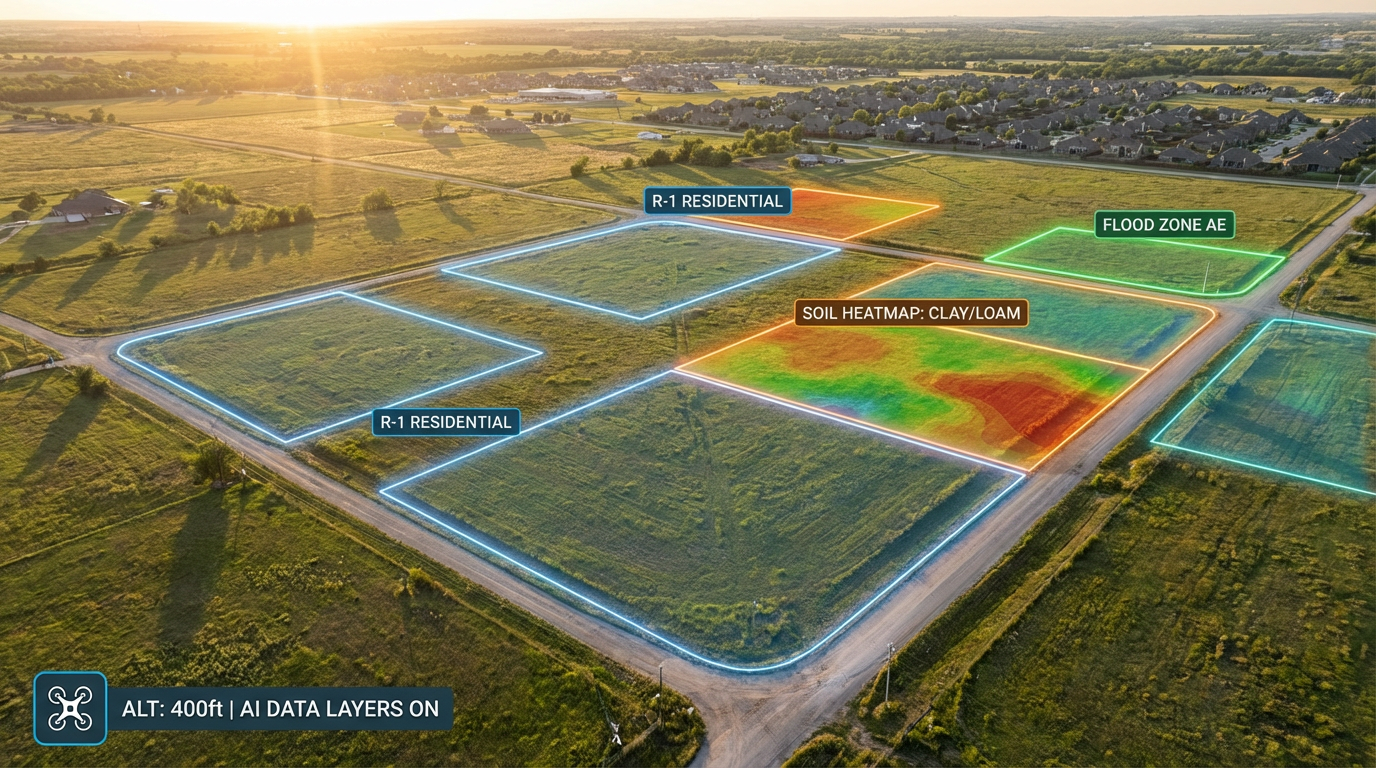
Before a single nail gets driven, someone has to find the dirt. And in residential construction, finding the right dirt — the right parcel, in the right zone, with the right soil, flood profile, and utility access — has always been one of the most expensive, time-consuming phases of any project. According to the National Association of Home Builders, land costs now represent 20–25% of the price of a new home, averaging roughly $100,000 on a $450,000 build. Getting this wrong doesn’t just delay a project. It kills it.
I’ve watched land acquisition teams spend 40 to 80 hours of due diligence on a single parcel — pulling zoning records, ordering soil reports, checking FEMA flood maps, driving the site, talking to neighbors. Multiply that by the dozens of lots a production builder evaluates each quarter, and you start to understand why AI is hitting this part of the industry first and hardest.
30 Seconds Instead of 30 Hours
D.R. Horton, America’s largest homebuilder with over 90,000 homes delivered annually, built an internal AI tool called Prophetic that compresses land feasibility analysis from hours to roughly 30 seconds. The system ingests zoning data, parcel boundaries, environmental constraints, and comparable sales, then generates a scored feasibility report that land acquisition managers used to assemble by hand across half a dozen spreadsheets.
The competitive advantage is obvious. In hot markets where buildable lots disappear in days, the builder who can evaluate a parcel in 30 seconds and make a confident offer beats the one still waiting on a Phase I environmental review. D.R. Horton isn’t talking publicly about Prophetic’s details — it’s a proprietary edge — but the approach is spreading fast across the industry.
The Platforms Democratizing Land Intelligence
Deepblocks is bringing similar capabilities to mid-size developers and even individual buyers. The platform uses AI to perform zoning and feasibility analysis across more than 200 U.S. cities, generating instant pro forma financial models for any parcel. Enter an address, and Deepblocks returns what you can legally build, how many units the zoning allows, estimated construction costs, and projected returns — all in minutes. For a developer evaluating 50 parcels to find two worth pursuing, this is the difference between a week of analyst time and an afternoon.
Acres takes a consumer-facing approach, offering an AI-powered lot search platform that lets buyers and small builders filter available land by zoning classification, utility availability, flood zone status, soil type, and even topography. Think Zillow, but for raw land — a category that traditional real estate platforms have badly underserved.
“Every delay has a root cause. In land acquisition, the root cause is almost always information asymmetry. AI closes that gap.”
Why This Matters for the Housing Shortage
The United States is short an estimated 4.7 million housing units. A significant chunk of that deficit isn’t caused by a lack of capital or labor — it’s caused by the sheer friction of finding and entitled buildable land. Municipalities with complex zoning codes, overlay districts, and environmental review requirements make parcel evaluation so expensive that smaller builders simply don’t attempt it.
AI land tools lower that barrier. A custom home builder who previously evaluated three or four lots per quarter can now screen 200. A buyer looking for acreage outside city limits can filter for parcels with confirmed septic viability and road access instead of discovering those problems after spending $5,000 on surveys.
What to Ask Your Builder
If you’re buying a lot or hiring a builder who’s selecting one for you, ask how they evaluate land. The builders using AI aren’t just faster — they’re catching risks that manual processes miss. Flood zone reclassifications, zoning variance histories, soil bearing capacity flags — these are the details that turn a dream lot into a money pit.
The best lot for your home might not be the one your builder’s land guy found while driving around on a Tuesday. It might be the one an algorithm scored at 94 out of 100 at 6 AM, cross-referencing soil data, school districts, and municipal sewer capacity — before anyone else even knew it was for sale.