The average custom home in the United States takes 14.3 months to build, according to the Census Bureau's Survey of Construction. That number has been climbing for a decade — up from 11.7 months in 2014. Material delays, labor shortages, permit backlogs, and coordination failures between dozens of subcontractors have turned home construction into a masterclass in Murphy's Law.
A new generation of AI project management tools says it can fix this. And the early data suggests they're not bluffing.
The Scheduling Problem
Construction scheduling is, at its core, a constraint satisfaction problem of staggering complexity. A typical custom home build involves 25-40 subcontractors, each with their own availability windows, dependencies on prior work, weather sensitivity, and material lead times. A single delay — say, the framing crew runs two days late — cascades through electrical rough-in, plumbing, insulation, drywall, and everything downstream.
Traditionally, project managers handle this with Gantt charts, gut instinct, and a phone full of contractor relationships. It works, barely. The construction industry's on-time completion rate is under 30%, according to KPMG's Global Construction Survey. Over 80% of projects exceed their original budget.
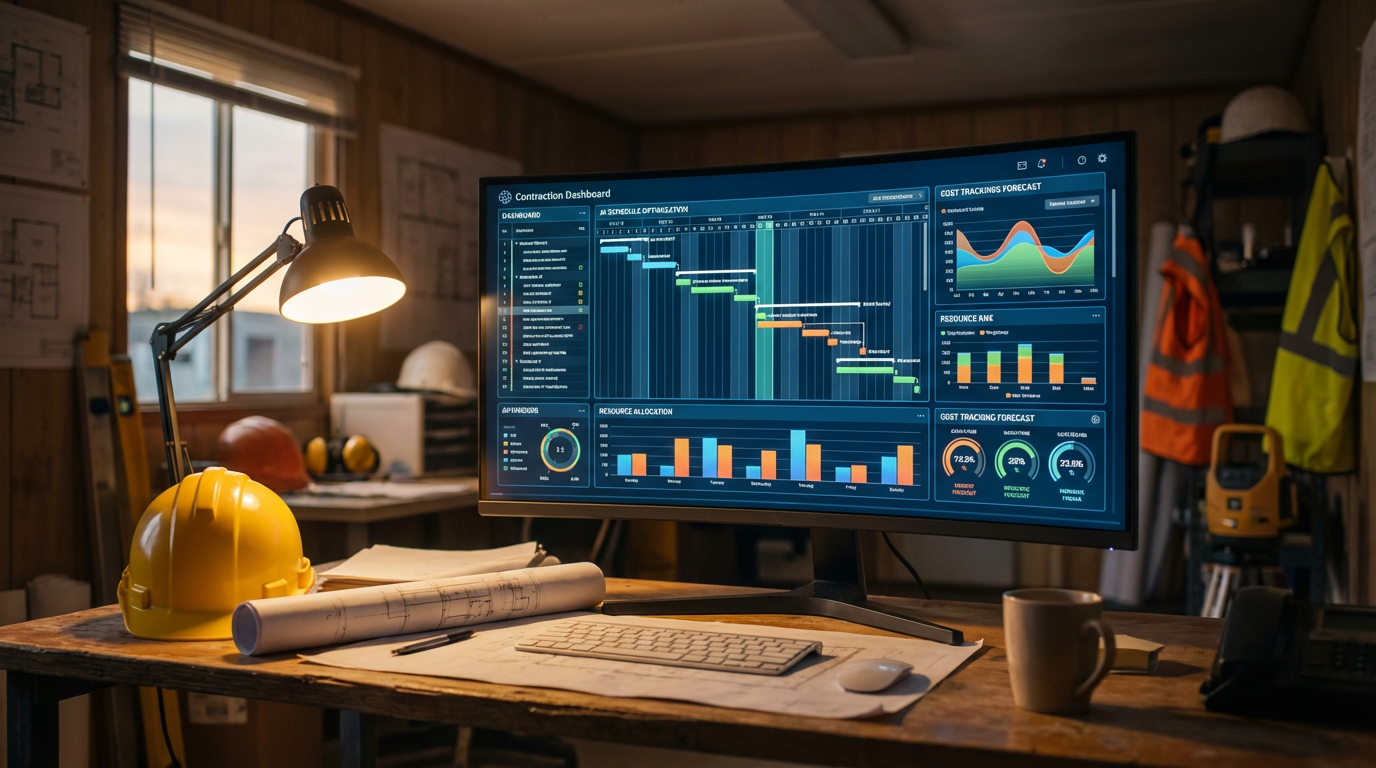
ALICE Technologies, a Stanford spinoff, attacks this with optimization algorithms borrowed from operations research. ALICE's platform ingests a project's full scope — tasks, dependencies, resource constraints, crew sizes, site logistics — and generates an optimized schedule. Not a single schedule: thousands of scenarios, ranked by total duration, cost, and risk. The system claims schedule compression of 10-30% depending on project complexity.
The Watchers: Computer Vision on Job Sites
Scheduling is one thing. Knowing what's actually happening on site is another. This is where Buildots and Doxel come in.
Buildots uses hardhat-mounted 360° cameras that workers wear during their normal routines. The video feed is processed by computer vision models that compare what's been built against the BIM (Building Information Model) — essentially, comparing reality to the plan. Deviations are flagged automatically: this wall is 3 inches off-plan, that electrical box wasn't installed, the HVAC duct is routed differently than specified.
Doxel takes a similar approach with autonomous rovers and drones that scan job sites daily. Their AI tracks physical progress at the task level — not "framing is 60% done" based on a superintendent's estimate, but "742 of 1,186 framing members are installed, verified by LiDAR." Doxel's published case studies show cost overrun reductions of 11% and progress reporting accuracy improvements from roughly 60% to 95%.
Procore's AI Play
Procore, the construction management platform used on over a million projects worldwide, has been layering AI into its core product. Their predictive analytics module analyzes historical project data — hundreds of thousands of completed builds — to flag risk factors. A project that matches the profile of historically delayed builds gets early warnings: "Projects with this combination of scope, location, and season experience a 3.2-week average delay at the drywall stage."
It's not prescient. It's pattern-matching at scale. But when the baseline for construction project management is a spreadsheet and optimism, pattern-matching at scale is a revolution.
The Permit Bottleneck
One area where AI is making quiet but significant progress: permit processing. Cities like San Jose and Dubai have piloted AI-assisted plan review systems that check building plans against code requirements automatically. San Jose's system reduced plan check times from 4-6 weeks to under 4 days for qualifying projects.
For homebuilders, the permit stage is often the single longest delay in the entire build process — sometimes longer than actual construction. AI that compresses permitting by even 50% would shave months off the national average.
The Reality Check
None of this is magic. AI project management tools are only as good as the data they ingest, and construction data is notoriously messy. Subcontractors who don't update their status in the system, change orders that aren't logged in real time, material substitutions that nobody tells the BIM coordinator about. Garbage in, garbage out — except the garbage is concrete.
But the trajectory is clear. The builders who adopt these tools are delivering faster, closer to budget, and with fewer surprises. The builders who don't are still calling their framing crew on a flip phone and hoping for the best.
From 14 months to 10 isn't a fantasy. It's a Tuesday for the teams that embraced this two years ago.
Sources: NAHB Eye on Housing — Census Bureau Survey of Construction (build times) · KPMG — 2023 Global Construction Survey · ALICE Technologies — AI Construction Scheduling · Insight Partners — Behind the Investment: Doxel · PropTech Connect — Buildots Secures $45M · Procore — Q3 2025 Financial Results ($339M revenue)