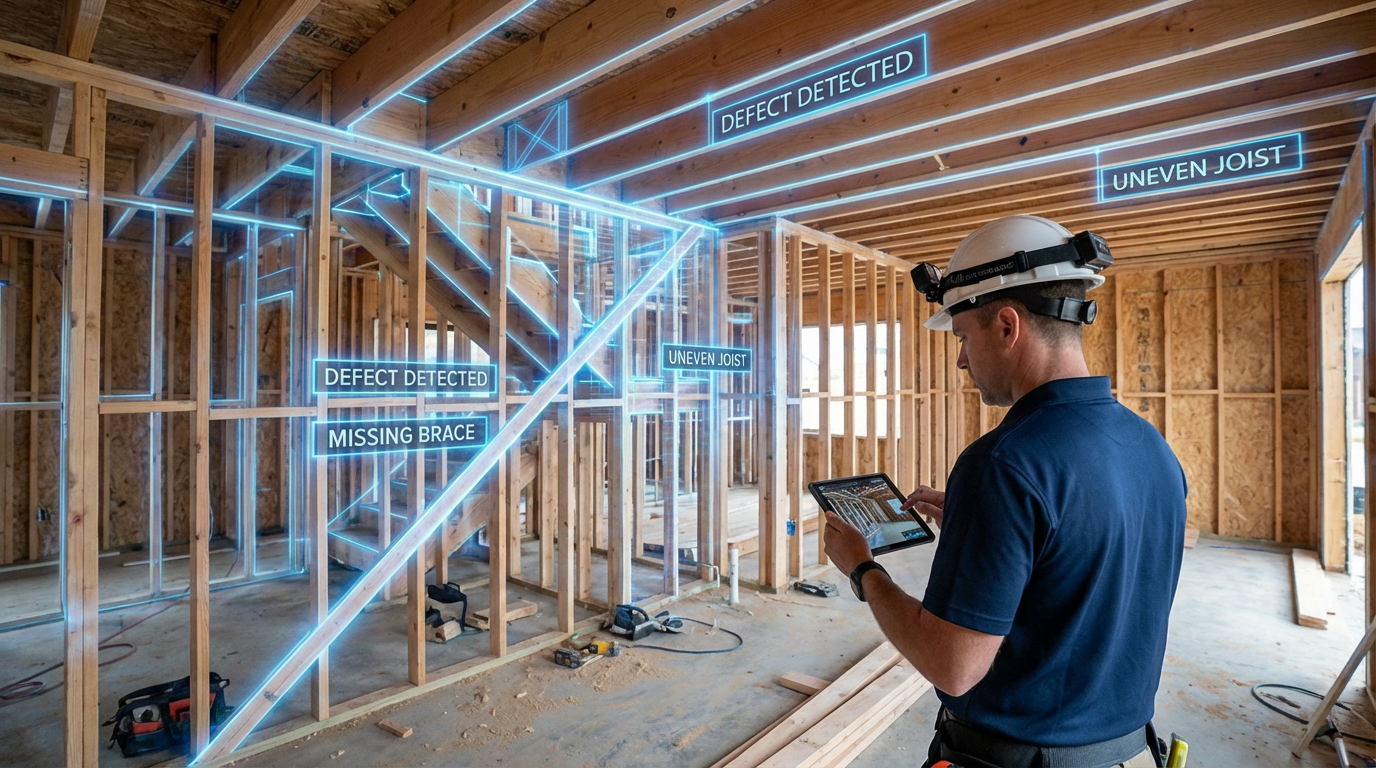
Rework eats construction alive. Industry-wide, fixing defects discovered after the fact consumes 5–8% of total project costs — on a $500,000 custom home, that’s $25,000 to $40,000 in avoidable waste. Construction defect litigation alone costs the U.S. industry $15.7 billion annually. The problem isn’t that builders are careless. It’s that human eyes scanning thousands of connections, penetrations, and finishes across a multi-month build inevitably miss things. Now a new class of AI-powered visual inspection tools is doing what clipboard-wielding superintendents physically cannot: documenting every square inch and flagging deviations before drywall covers them up forever.
360° Capture Meets Computer Vision
The category leader is OpenSpace, which has documented over 2.3 billion square feet of construction across 10,000+ projects worldwide. The concept is deceptively simple: a worker walks the job site wearing a 360° camera clipped to their hard hat. The platform automatically stitches the footage into a navigable visual record tied to the floor plan — think Google Street View for your house mid-construction.
But the real value isn’t the photos. It’s what the AI does with them. OpenSpace’s machine learning models compare captured images against BIM models and design documents, automatically flagging discrepancies. A fire block missing above a penetration. A stud spacing that’s 18 inches instead of 16. An HVAC duct routed through a structural member. Projects using the platform report 20% fewer RFIs (requests for information) — a direct proxy for catching problems early instead of discovering them during inspections.
“The camera doesn’t get tired at 3 PM. It doesn’t skip the basement because it’s raining. It captures everything, every time, and the AI remembers what it saw last Tuesday.”
Hard-Hat Cameras That Compare Against the Blueprint
Buildots takes the concept further with purpose-built hard-hat cameras that create a continuous visual record and automatically compare what’s built against the BIM model. Their AI classifies the construction status of every element — framing, MEP rough-in, insulation, drywall — and flags deviations in real time. Builders using Buildots have reported 75% fewer defects reaching the punch list stage.
For concrete work, companies like ICON and Versatile are deploying crane-mounted sensors that monitor pours in real time — tracking volume, placement accuracy, and curing conditions. A bad pour caught during placement costs hundreds to fix. The same defect found after curing costs tens of thousands.
What This Means for Your Home Build
Here’s the homeowner math. A typical new-construction home inspection costs $2,400 to $5,000 — and that inspector visits maybe three or four times during the build. They see snapshots. AI visual inspection sees the entire movie.
Ask your builder about documentation. Even if they’re not using OpenSpace or Buildots, a builder who photographs every wall cavity before drywall, every rough-in before finish, and every foundation pour before backfill is giving you something invaluable: a permanent, searchable record of what’s inside your walls. If a pipe leaks in year five, you’ll know exactly where everything runs without cutting exploratory holes.
The technology is approaching residential scale. OpenSpace’s basic plans are accessible to mid-size builders, and several startups are building smartphone-based inspection tools that don’t require specialized cameras at all. iFactoryApp and StructionSite offer mobile-first platforms where a superintendent walks with their phone and the AI does the rest.
Insurance companies are paying attention. Several major carriers now offer premium discounts for builders using AI-documented quality assurance. If your builder can prove every connection was inspected and documented, the warranty claim math changes dramatically — in your favor.
The Inspection Gap
Municipal building inspectors are overwhelmed. Most jurisdictions have a single inspector covering dozens of active permits. They visit your site for minutes, check a list, and move on. AI inspection doesn’t replace them — it fills the enormous gap between their visits with continuous, documented oversight.
The builders who survive the next decade will be the ones who can prove what they built, not just promise it. The camera doesn’t lie, and the AI doesn’t forget. For homeowners, that’s the best warranty money can buy.
Sources: Autodesk — 100+ Construction Industry Statistics (defect litigation costs) · Engineering.com — OpenSpace Enhances Construction Capabilities · PropTech Connect — Buildots $45M Funding (50% delay reduction) · IEEE Spectrum — Doxel AI LiDAR Construction Monitoring · VentureBeat — OpenSpace (1B+ sqft captured)