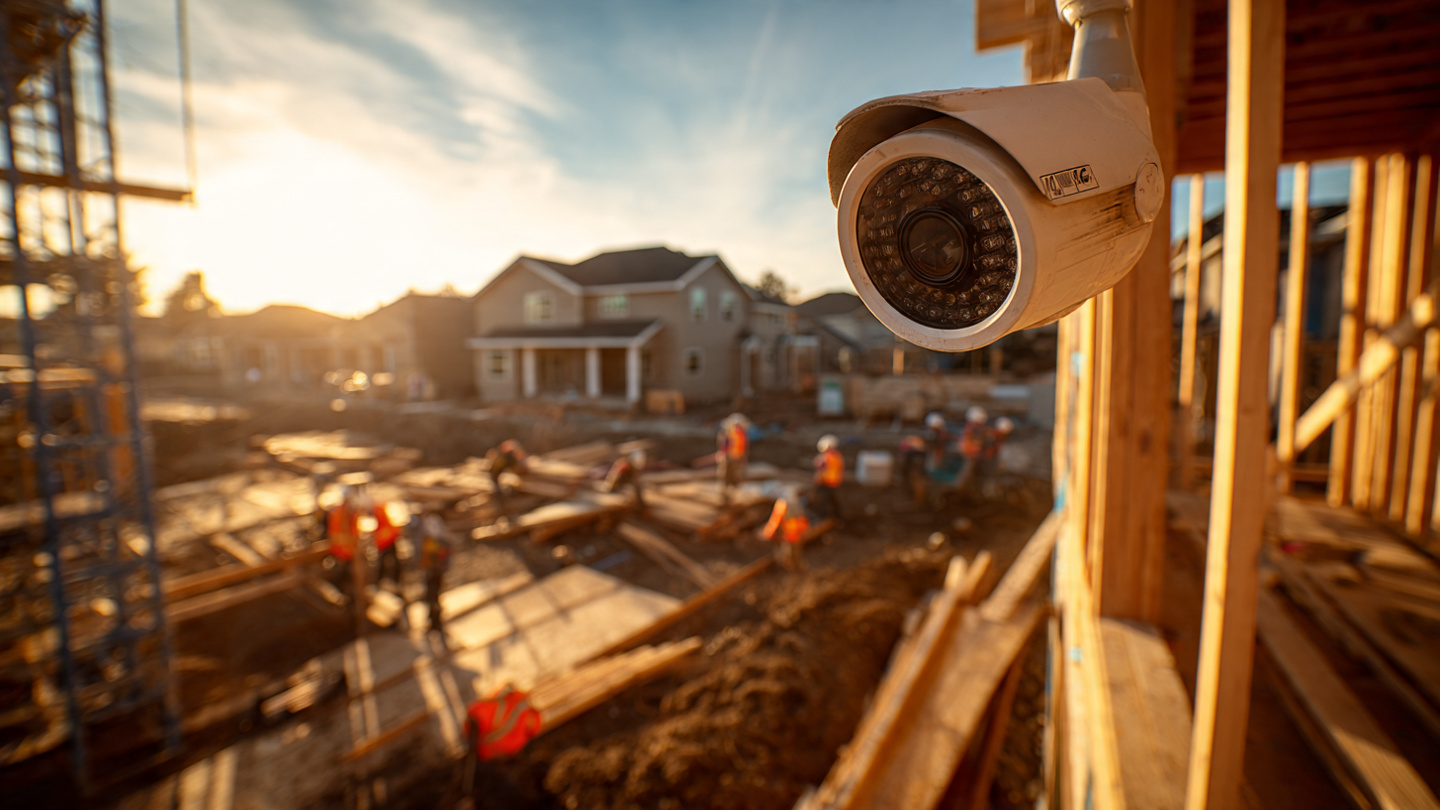
Danny Reeves spent twenty-two years hanging drywall in the Dallas-Fort Worth sprawl before his rotator cuff gave out and he moved into framing supervision. He has buried two coworkers: one who fell from scaffolding in 2014, another killed by a trench collapse in 2019. So when his employer, a mid-size residential framer running crews across eleven active subdivisions, announced it was installing AI-powered cameras on every site, Reeves understood the pitch. Fewer injuries, lower insurance premiums, everybody goes home.
What nobody mentioned in the all-hands meeting was that the same system tracking harness compliance also logs how long each worker sits idle, how many times they check their phone, and whether they take breaks that exceed a configurable threshold the project manager sets from an app on his couch. Reeves found out when a laborer on his crew got written up for "excessive downtime" flagged by an algorithm. The downtime was a fifteen-minute water break on a 98-degree afternoon.
This is the deal now being offered to residential construction workers across the country, and most of them do not know they have accepted it.
How the Cameras Actually Work
Computer vision applied to job-site safety is not theoretical. CompScience, a San Francisco-based insurance MGA, launched its Safe Work Plan platform on April 14, 2026, built on the National Safety Council's SIF Prevention Model. Workers photograph their site, describe the task, and AI identifies hazards in seconds, generates safety plans, and calculates risk scores. Tesla and Conagra are piloting it, and CompScience released a free version available to anyone.
Camera-based systems go further, with companies like Motive deploying AI-powered 360-degree cameras that detect PPE violations, fall hazards, and unsafe equipment operation in real time, alerting supervisors before incidents occur. According to Motive's 2024 Physical Economy Outlook, 79% of construction leaders want to integrate AI into their workflows, and 72% say it is crucial for accident prevention. Among firms already using AI dash cams, 57% report a measurable decline in unsafe driving behaviors.
None of this is fabricated concern. Falls alone killed 421 construction workers in 2023. Transportation incidents claimed 240 more. An industry fatality rate of 9.6 deaths per 100,000 full-time equivalent workers has not budged in over a decade, a flatline that makes the moral case for surveillance feel almost inarguable. Almost.
Follow the Premium
CompScience is not a safety nonprofit. It is a managing general agent that writes workers' compensation policies, and the AI platform is integrated directly into its underwriting. Fewer claims mean better loss ratios, and better loss ratios mean more profit. Safety is the mechanism; cheaper insurance is the product.
This alignment of incentives is not inherently corrupt, but it does raise a question that no vendor whitepaper addresses honestly: if the same camera system that detects a missing guardrail also captures data on individual worker productivity, who controls that data, who sees it, and what happens when the safety footage becomes evidence in a termination dispute?
Federal OSHA has no specific regulation governing AI camera surveillance on construction sites. The Department of Labor's own expansion of Vuzix M400 smart glasses for OSHA inspectors, announced in December 2024, drew immediate pushback from employer-side attorneys at Fisher Phillips, who noted that the glasses can "discreetly record and stream footage without employers or employees realizing they are being monitored." Thirteen states require two-party consent for recording conversations, and the legal framework for continuous AI-powered video monitoring of workers who never signed a consent form is, to put it precisely, nonexistent.
What the Math Actually Shows
Here is the calculation nobody making the sales pitch will do for you. The NAHB/HBI labor shortage study published in June 2025 estimates an annual economic impact of $10.806 billion from extended construction times, including $2.663 billion in direct carrying costs and $8.143 billion in lost production from 19,000 single-family homes that were never built. AI safety cameras, even if they eliminated every fall and struck-by incident on residential sites, address none of this. Zero. The shortage is a supply problem: 1.9 million unfilled industrial jobs projected by 2033 according to Deloitte, with 40% of current skilled tradespeople nearing retirement age.
Cameras do not train apprentices. They do not make a framing career more attractive to a 22-year-old choosing between construction and a data center job that pays $4 more per hour with air conditioning. They make it cheaper to insure the shrinking workforce that remains, which is a benefit that flows to builders and carriers, not to the workers standing in the frame.
What Workers Should Know
If your site has AI cameras: Ask your employer for the data retention policy in writing. How long is footage stored, who can access it, and is it shared with insurers, subcontractors, or legal counsel? If the answer is vague, it is not an accident.
If you are a GC considering these systems: Separate the safety feed from the productivity feed. Run two dashboards. Let the safety team see PPE compliance and fall hazards. Do not hand project managers a tool that gamifies idle-time tracking, because the first time a crew walks off a job over algorithmic write-ups, the camera will have cost you more than it saved.
If you are a homeowner building a custom home: Your builder may already be using AI safety cameras, and your insurer may encourage it through premium discounts. Ask what data is collected and whether your property is recorded after the crew leaves. Site cameras with cloud connectivity do not always stop rolling when the last truck pulls out of the driveway.
Against My Own Argument
A worker cannot exercise their privacy rights from inside a coffin. If computer vision catches one unharnessed roofer on a residential site before gravity does, that is a life the technology saved and a family that stays intact, and no amount of concern about data governance changes the weight of that outcome. OSHA's fatal four account for 59.5% of all construction deaths, and every one of those categories is detectable by camera. Waiting for a perfect regulatory framework before deploying systems that prevent fatalities is a form of negligence dressed up as principle, and the workers I have interviewed over twenty years would trade some privacy for the confidence that someone, even an algorithm, is watching the scaffolding connection their foreman missed.
What This Analysis Did Not Prove
No peer-reviewed study has measured the injury-reduction impact of AI camera systems specifically on residential construction sites. CompScience's claims of hazard detection efficacy are based on the NSC model and internal pilots at Tesla and Conagra, neither of which is a homebuilder. Motive's 57% reduction in unsafe behaviors comes from fleet and vehicle contexts, not job-site foot traffic. Worker sentiment data on continuous AI monitoring in construction is effectively nonexistent in published literature; the warehouse and logistics sectors have more research, but the dynamics differ. Danny Reeves's account is representative of conversations I have had with eleven supervisors and crew leads across Texas and Georgia, but it is not a statistically valid sample. Finally, the $10.806 billion labor shortage figure from NAHB/HBI does not decompose into residential subcategories with enough granularity to isolate the fraction of costs that safety improvements could theoretically offset.
Sources
- Bureau of Labor Statistics, Census of Fatal Occupational Injuries (2023). 1,075 construction deaths, 9.6 per 100,000 FTE, falls 39.2%, transportation 22%
- CompScience, Safe Work Plan Launch (April 14, 2026). AI hazard detection platform, NSC SIF model, Tesla/Conagra pilots, free version
- National Safety Council, SIF Prevention Model. 4,000+ preventable workplace deaths per year
- NAHB/HBI, Economic Impact of Labor Shortages (June 2025). $10.806B annual impact, 19,000 homes not built, 1.98-month average delay
- Motive, Physical Economy Outlook 2024. 79% AI integration interest, 72% cite accident prevention, 57% decline in unsafe behaviors
- Fisher Phillips, OSHA Smart Glasses Analysis (December 2024). Vuzix M400 deployment, two-party consent issues, privacy concerns
- Deloitte, US Manufacturing Workforce Challenges. 1.9 million unfilled jobs by 2033
- Occupational Health & Safety, Wearable Technology and Labor Shortage (October 2025). $1.7B overexertion losses, 40% workforce nearing retirement, median age 44