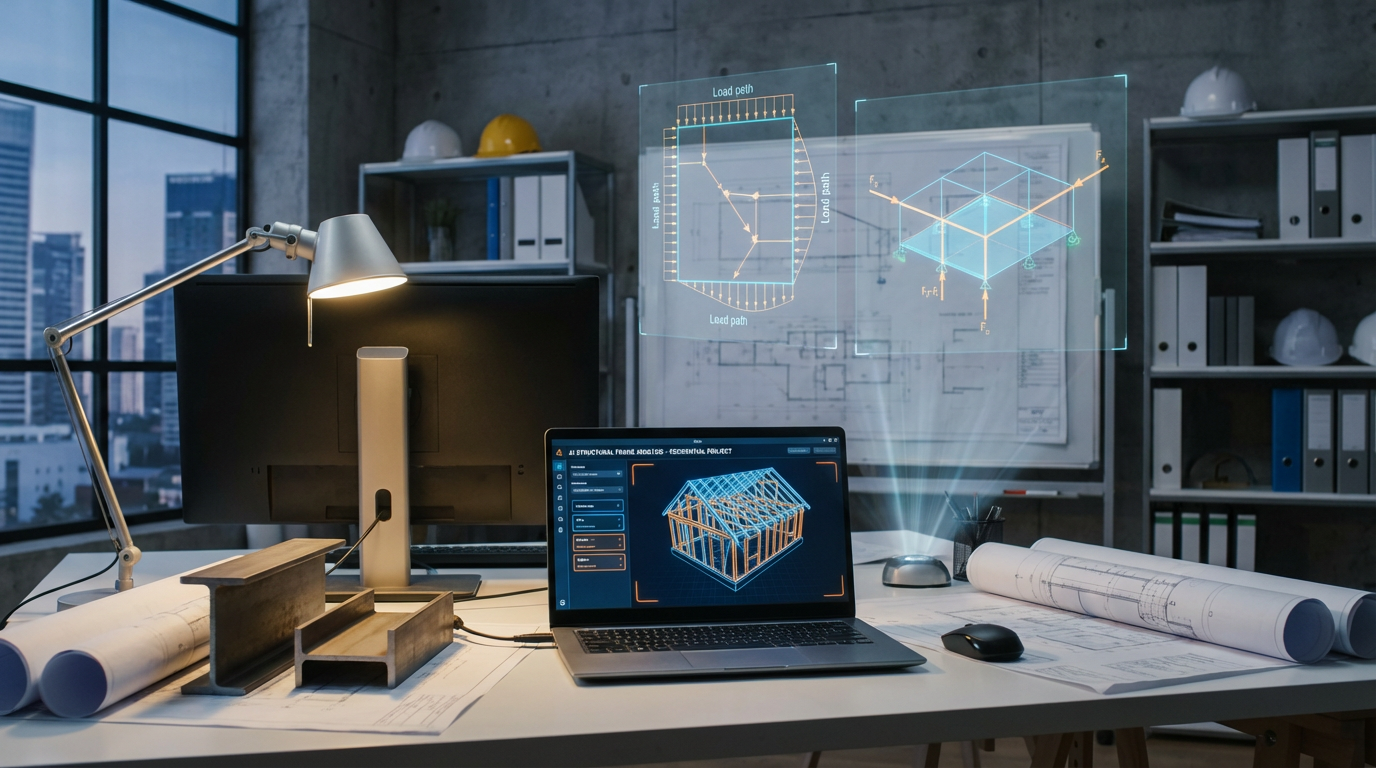
Every residential structure in America is overbuilt. Not by accident — by tradition. Structural engineers designing homes apply safety factors, round up member sizes, and default to conservative load assumptions because the penalty for underdesign is a collapsed roof, and the penalty for overdesign is a slightly higher materials invoice that nobody notices. The result: most homes carry 20–30% more structural material than they actually need. Across 1.4 million annual housing starts, that’s billions of dollars in unnecessary steel, lumber, and concrete — and millions of tons of embodied carbon that exists purely because of engineering conservatism.
AI is about to end the guessing.
The $350–$800 Bottleneck
A structural engineer’s basic inspection runs $350–$800 for a residential project. Full engineering plans for new construction hit $5,000–$7,500 — typically 2–3% of the total build budget. That fee buys you a licensed professional who calculates load paths, sizes beams, specifies foundations, and stamps drawings that satisfy the building department. What it doesn’t buy you is optimization.
Most residential structural engineers use the same sizing tables and rules of thumb they learned in school. A 2×10 floor joist at 16″ on center handles the span? Good enough. A W8×31 steel beam carries the point load? Move on. The economics don’t reward spending three extra hours running finite element analysis to prove you could use a W8×24 instead — the savings on that one beam might be $80, and the engineer’s time costs $150/hour. So the conservative choice wins, every time.
Until AI makes that optimization free.
Thornton Tomasetti’s Asterisk: Structural AI at Scale
Thornton Tomasetti, one of the world’s largest structural engineering firms, built Asterisk — a computational structural design platform that emerged from their CORE research studio. Asterisk uses AI trained on Thornton Tomasetti’s decades of project data to instantly generate optimized structural solutions. Feed it geometry, loading criteria, wind and seismic parameters, and material preferences — and it returns member sizes, structural quantities, and embodied carbon takeoffs in a single live interactive interface.
The tool already integrates with TestFit, the real estate feasibility platform used by developers to test building configurations. An architect sketching a parking garage in TestFit can now get instant column sizing from Asterisk’s embedded AI — no emails to the structural engineer, no two-week wait for calculations, no back-and-forth over load assumptions.
“Asterisk allows the engineer to immediately capture outputs such as member sizes, structural quantity, and embodied carbon takeoffs — connecting geometry, wind and seismic loading criteria, vibration criteria, and material customization into a single live interactive interface.”
— Thornton Tomasetti CORE Studio
The residential application is obvious. If an AI can size every beam in a parking garage in seconds, it can size every joist, header, and foundation footing in a house. The difference is that residential projects have historically been too small to justify this kind of computational firepower. AI eliminates that cost barrier.
Augmenta: Fully Automated Building Design
Dublin-based Augmenta takes it further. Their cloud-native platform uses generative AI to automate the entire building design process — electrical, plumbing, mechanical, and structural systems — simultaneously. The AI generates multiple design alternatives, each optimized for different tradeoffs between cost, sustainability, and constructibility, and the engineer picks the best one.
Augmenta claims their platform can save up to 30% of new construction materials that would otherwise go to waste — not from recycling or jobsite sorting, but from simply designing the building correctly the first time. Fewer oversized beams. Fewer unnecessary columns. Fewer rebar cages spec’d at #5 when #4 would carry the load. The AI runs the numbers on thousands of configurations before a single piece of steel gets ordered.
For residential builders, this means the structural package — traditionally the one part of the house nobody questions — becomes a variable to optimize rather than a fixed cost to absorb.
Topology Optimization: Nature’s Engineering
The most visually striking application of AI structural design is topology optimization — algorithms that sculpt material into organic, bone-like shapes that carry loads with maximum efficiency and minimum material. The technique originated in aerospace (Airbus famously used it to redesign a cabin partition, saving 45% of its weight), and it’s now trickling into construction.
In a topology-optimized foundation, concrete isn’t poured in a uniform slab. It’s distributed along the actual load paths — thicker where forces concentrate, thinner where they don’t. The result looks alien compared to a traditional footing, but it uses 30–50% less material while meeting identical strength requirements. Combined with 3D printing (which can produce these complex geometries without formwork), topology optimization represents a genuinely new way to build the bones of a house.
The Structural Engineering Shortage
There’s a workforce angle too. The NAHB estimates a $10.8 billion annual economic impact from the construction labor shortage, and structural engineers aren’t exempt. Every hour a licensed SE spends doing routine beam-sizing calculations is an hour they’re not spending on the complex judgment calls — seismic retrofits, unusual geometries, forensic investigations — that actually require human expertise.
AI handles the routine. The structural engineer at a 200-person firm who currently spends 60% of their time on residential beam calcs could spend that time on the tricky commercial projects where their judgment is irreplaceable. The homeowner gets a better-optimized structure. The engineer gets more interesting work. The builder saves on materials. Everyone wins except the safety-factor padding.
What This Means for Your Home
Ask your structural engineer about optimization. If they’re still sizing every beam from span tables and rules of thumb, they’re almost certainly specifying more material than your house needs. An AI-optimized structural package on a $500,000 home could save $5,000–$15,000 in material costs — steel, lumber, concrete — while reducing the home’s embodied carbon by a corresponding 20–30%.
Embodied carbon regulations are coming. California’s Buy Clean Act already mandates carbon limits on structural steel and concrete for state projects. As these requirements spread to residential construction, overdesigned structures won’t just cost more money — they’ll cost compliance.
The irony is beautiful. For decades, “overbuilt” was a compliment in construction — a synonym for quality, durability, peace of mind. But overbuilt was never optimal. It was just the best we could do when the calculations were expensive. Now that an algorithm can run ten thousand structural configurations before the engineer finishes their coffee, we can finally build homes that are exactly strong enough — and not a pound more.
Sources: TestFit — Integration with Thornton Tomasetti's Asterisk · AEC Magazine — Asterisk Structural AI (CORE Studio) · Augmenta — AI Building Design (30% material waste reduction) · NAHB/HBI — $10.8B Annual Economic Impact of Construction Labor Shortage · U.S. Census Bureau — New Residential Construction (1.4M annual starts)