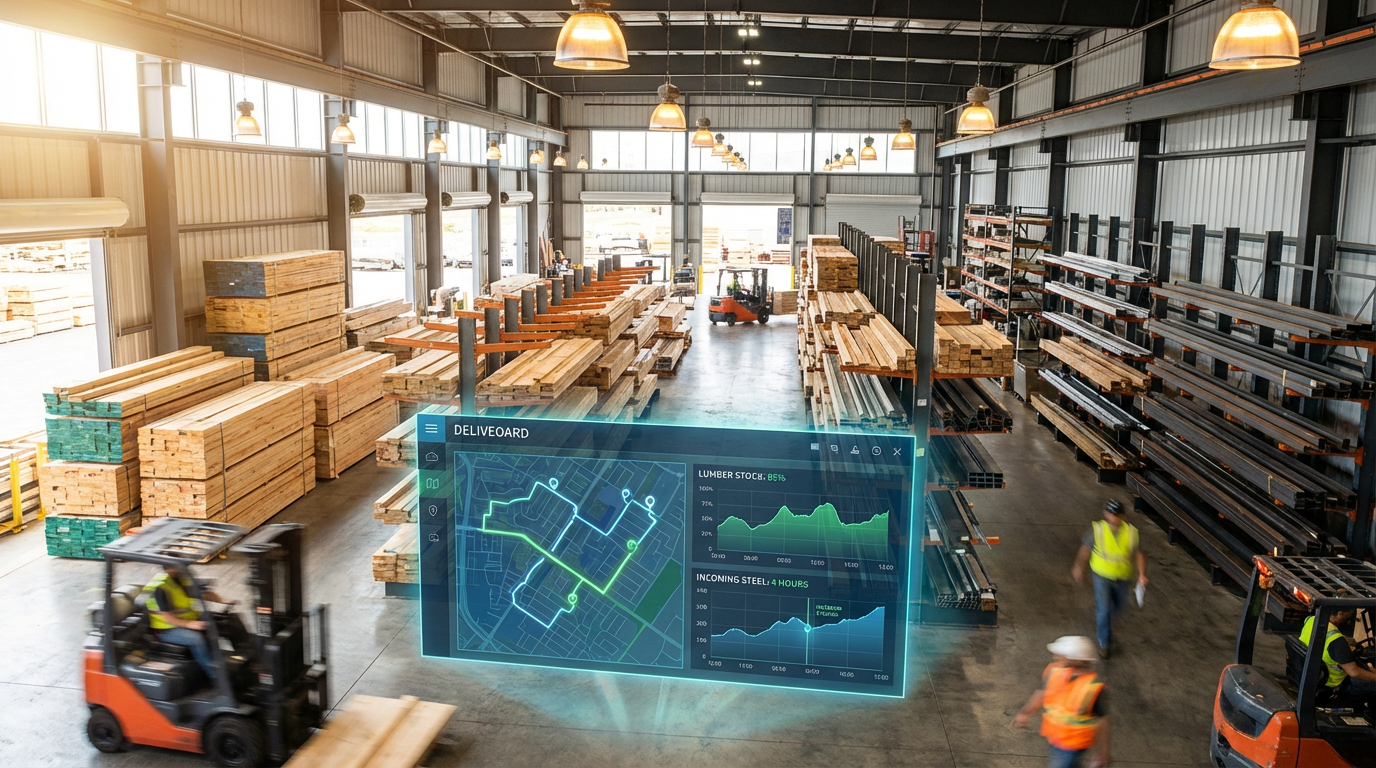
Last year, 90% of home builders reported significant material delays on at least one project. Not weather delays. Not permitting hold-ups. Materials — the lumber, the drywall, the windows, the HVAC units — just didn’t show up when they were supposed to. I’ve been on job sites where a $400,000 custom home sat idle for three weeks because a shipment of engineered floor joists got rerouted to the wrong distribution center. The crew got reassigned. The homeowner got a change order. Everyone lost money.
Construction materials account for up to 40% of a residential project’s total budget. And the industry wastes an estimated $160 billion annually on material overordering, spoilage, theft, and misallocation. That’s not a rounding error — that’s a structural failure in how we move stuff from factories to foundations.
The Lumber Price Trauma
If you built a home between 2020 and 2023, you don’t need me to tell you about supply chain chaos. Lumber prices swung over 300% in 18 months. A framing package that cost $35,000 in January 2020 hit $120,000 by May 2021. Builders who locked in fixed-price contracts ate the difference. Builders who didn’t lost clients.
That trauma is exactly why AI-powered procurement tools are finding a receptive audience. When your margins depend on guessing future material prices correctly, having a machine learning model that tracks commodity futures, supplier inventory levels, and regional demand patterns starts to feel less like a luxury and more like survival gear.
What the New Tools Actually Do
Kojo is the furthest along in residential construction. Their AI Intelligence Layer, built on GPT-4 and Hugging Face transformer models, has powered over 10,000 projects across 47 states. The numbers are hard to argue with: $22 million saved on materials orders, 90% reduction in job-site waste, and 75% less manual data entry for procurement teams. Kojo answers the three questions that haunt every project manager: Who has what I need in stock right now? What did I pay for this last time? And how much of this did I actually use on a similar project?
“Every delay has a root cause. AI just finds it faster. In procurement, the root cause is almost always that someone ordered the wrong quantity, from the wrong supplier, at the wrong time.”
Voyage Control tackles the logistics layer — tracking materials from manufacturer to job site with real-time GPS, automated delivery scheduling, and exception alerts when shipments fall behind. Think of it as air traffic control for your lumber deliveries.
Join takes a different angle, using AI to optimize when materials get ordered relative to the construction schedule. Order too early and you’re paying for storage and risking weather damage. Order too late and the crew stands idle. Join’s scheduling AI balances these constraints across every trade on the project simultaneously — something a human PM tracking 40 line items on a spreadsheet simply cannot do at scale.
What This Means for Homeowners
If you’re building a home in 2026, here’s what to ask your general contractor:
1. “How do you track material orders?” If the answer involves a whiteboard or a spreadsheet, that’s a red flag. Modern builders use digital procurement platforms.
2. “What’s your plan for price volatility?” AI tools can lock in pricing windows and suggest alternative materials when costs spike. A builder using them can give you a more honest fixed-price contract.
3. “How do you handle material waste?” The industry average is 10–15% material waste on residential projects. AI-optimized ordering can cut that to 3–5%. On a $400K build, that’s $20,000–$40,000 that either goes back in your pocket or never leaves it.
The Bigger Picture
The construction supply chain is a $1.85 trillion global machine that still runs largely on phone calls, faxes, and personal relationships. AI isn’t replacing the relationships — your framing supplier who answers the phone at 6 AM is still invaluable. But it’s replacing the guesswork that makes those relationships harder than they need to be.
Procore and Oracle are integrating AI supply chain visibility into their construction management platforms. Smaller players like Ofbusiness and ALICE Technologies are building predictive models that forecast material needs weeks before the PM even thinks to place the order. The convergence is unmistakable: within five years, a builder who doesn’t use AI-assisted procurement will be as conspicuous as one who doesn’t use email.
“I spent 20 years calling suppliers at 5 AM to check stock. Now the system tells me what I need before I know I need it. I spend that hour on the job site instead.”
The supply chain isn’t sexy. Nobody walks through their new home and admires the procurement workflow. But when your project finishes on time and on budget, there’s a good chance an algorithm had something to do with it.