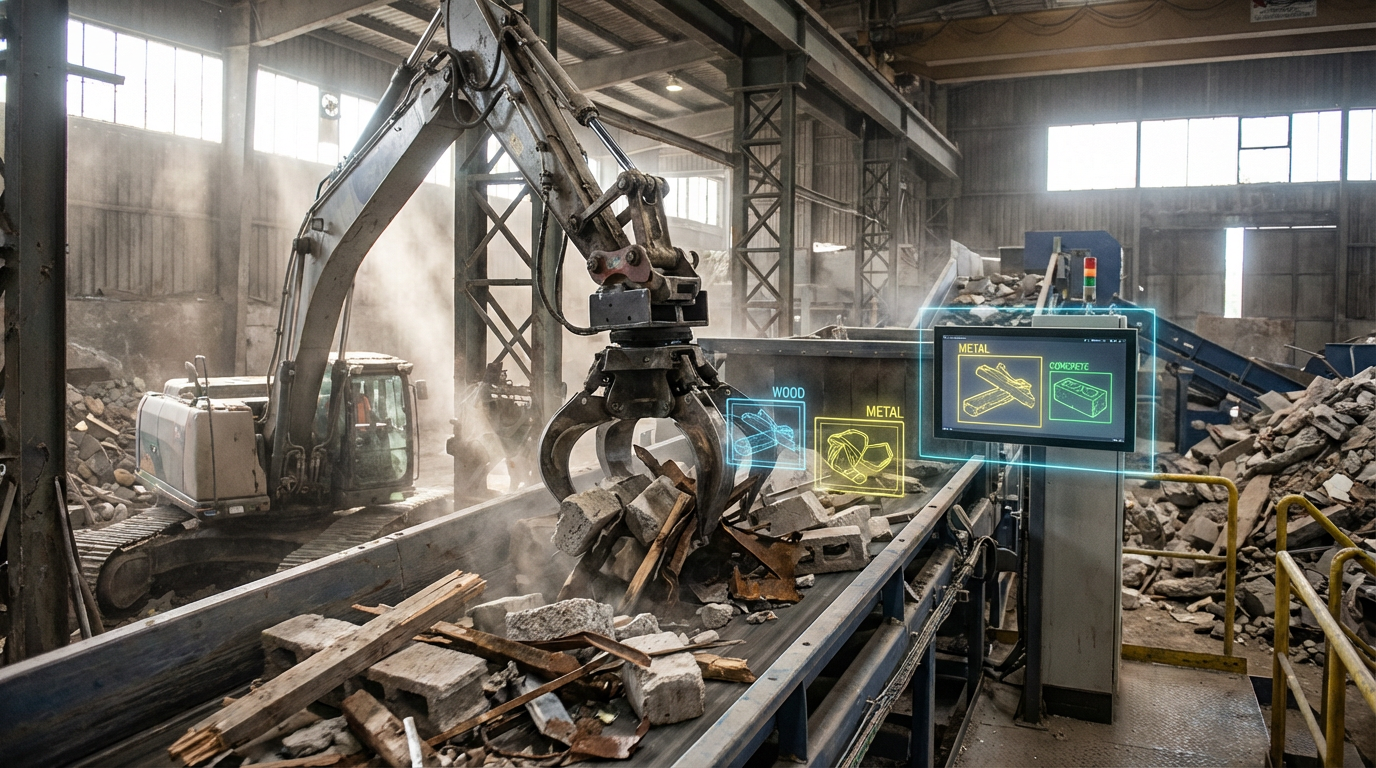
Every year, the United States generates 600 million tons of construction and demolition waste — more than twice the volume of all municipal garbage combined. Concrete alone accounts for 67.5% of it. Wood, metal, drywall, asphalt shingles, and brick make up most of the rest. The EPA’s own data shows only about 5.5% comes from new construction; the overwhelming majority — 567 million tons — is demolition debris. When a house comes down, its materials don’t disappear. They become someone else’s landfill problem. Now AI-powered sorting robots and digital material passport platforms are turning that rubble into a supply chain.
The Robot That Sees What You Threw Away
AMP Robotics, which raised $91 million in Series D funding led by Congruent Ventures and Sequoia Capital, has built AI-powered sorting systems that use deep learning to identify, classify, and physically separate materials on a conveyor belt at industrial speed. Their robots recognize distinct patterns and surface characteristics — distinguishing dimensional lumber from oriented strand board, copper pipe from galvanized steel, clean concrete from contaminated fill — with the kind of granularity that human sorters working 10-hour shifts in dusty facilities simply can’t maintain.
The economics are straightforward. Mixed C&D debris headed for landfill costs the hauler $40–$80 per ton in tipping fees. Sorted materials — clean wood, ferrous metal, aggregate-grade concrete — are commodities. Reclaimed structural steel sells for $200–$400 per ton. Clean dimensional lumber can be resold or chipped for engineered wood products. The sorting robot doesn’t take breaks, doesn’t develop repetitive strain injuries, and gets better at identification with every ton it processes.
“We are investing in a state-of-the-art sorting plant aimed at construction waste which cannot be sorted out well enough at construction sites. Using robotic technology, we want to ensure that valuable waste resources end up higher in the waste hierarchy.”
— Rasmus Brødsgaard Buch, COO, RGS Nordic
9,200 Picks per Hour, Around the Clock
In Copenhagen, Denmark-based waste processor RGS Nordic — which handles a third of Denmark’s total construction waste — recently installed a fully automated sorting line built by ZenRobotics (now part of Terex Corporation). The facility’s robots make up to 9,200 picks per hour, handling objects weighing up to 40 kilograms, and they run around the clock. Workers no longer stand over conveyor belts breathing dust; the AI handles the sorting while humans supervise from control rooms.
The system continuously improves. Each pick teaches the neural network to better distinguish a cedar shake from a composite shingle, a copper fitting from a brass valve. ZenRobotics reports that their AI adapts to local waste streams — what comes out of a demolished Victorian in San Francisco looks nothing like debris from a tract home in Phoenix, and the model learns the difference.
Material Passports: Your Home’s Ingredient List
Sorting demolition debris is solving the back end. Material passports are solving the front end — documenting what goes into a building so you know what you can get back out. Madaster, a Dutch platform now expanding to the UK and beyond, integrates with BIM (Building Information Modeling) files to create digital registries of every material in a structure: the grade of steel in the beams, the species of wood in the framing, the manufacturer of the insulation batts.
British Land’s 1 Broadgate development in London became the UK’s first large-scale use of Madaster material passports, earning an innovation credit from the Building Research Establishment. The platform doesn’t just inventory materials — it calculates their residual value. When the building eventually comes down in 40 or 60 years, whoever demolishes it will have a manifest of exactly what’s inside and what it’s worth.
The Reuse Marketplace Gap
Rheaply, a Chicago-based startup, is building the other missing piece: a marketplace where organizations can buy, sell, and exchange reusable building materials, furniture, and fixtures. Think of it as a materials-specific Craigslist with verified quality data. Government agencies and large corporations list surplus materials; smaller builders and nonprofits buy them at a fraction of new cost.
The circular construction market is worth an estimated $7.4 billion today and growing fast. The EU’s 850 million tons of annual C&D waste has pushed regulations like the EU Waste Framework Directive, which targets 70% recovery of non-hazardous C&D waste. The UK generates 67.8 million tons per year. Governments are realizing that the cheapest ton of concrete is the one you never pour — and AI is making reuse economically competitive with virgin materials for the first time.
What This Means for Your Next Home
Ask about deconstruction, not demolition. A wrecking ball turns materials into mixed rubble. Selective deconstruction — increasingly guided by AI material identification — salvages reusable components before mechanical demolition begins. The upfront cost is higher, but material credits offset 30–50% of it, and several states now offer tax deductions for donated salvaged materials.
Look for reclaimed materials. Reclaimed hardwood flooring, salvaged brick, and reused steel beams aren’t just environmentally virtuous — they’re often higher quality than what’s available new. Old-growth Douglas fir studs from a 1920s bungalow have tighter grain and more strength than anything coming out of a modern lumber mill.
Demand a material passport. If your builder uses BIM (and in 2026, most custom builders do), ask for a Madaster registration or equivalent digital material record. It costs almost nothing to generate from existing BIM data, it increases your home’s future salvage value, and it gives the next owner — or the demolition crew in 2086 — a complete map of what’s inside your walls.
The construction industry has spent a century treating materials as disposable. AI is proving they never were. The only thing that was missing was the intelligence to sort them fast enough to matter.
Sources: EPA — Construction and Demolition Debris (600M+ tons) · BusinessWire — AMP Robotics $91M Series D Funding · Recovery Worldwide — RGS Nordic Robotic Sorting Plant · Terex/ZenRobotics — AI Sorting Robots (9,200 picks/hr) · Madaster — British Land 1 Broadgate Material Passport · Waste Dive — Rheaply Materials Marketplace