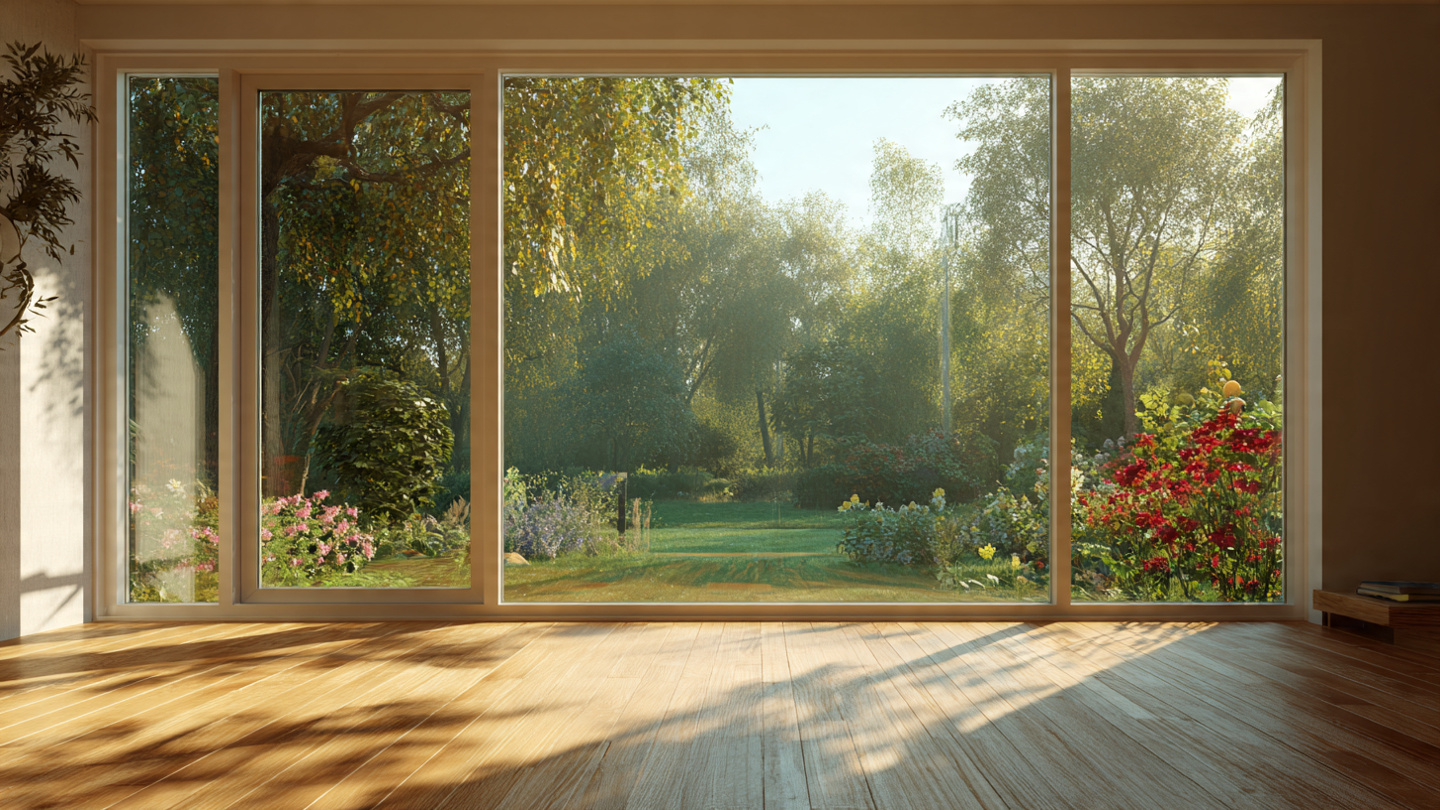
Picture the algorithm's ideal south-facing window. Vertically elongated, roughly 20 percent of the wall area, centered on the facade, sill sitting low at half a meter above the finished floor. According to a multi-objective optimization study published in Scientific Reports in 2026, that specific geometry reduces total energy consumption by 3.9 to 5.2 percent, slashes cooling demand by nearly a quarter, and improves useful daylight illuminance by 8 to 12 percent compared to typical residential configurations. It is, by every metric the simulation can measure, the correct window.
Now picture where your client actually wants glass.
She wants a wide, low-silled kitchen window facing west, not south, because that is where the backyard is and she needs to watch three children while prepping dinner. He wants a tall narrow bedroom window framing the neighbor's heritage oak, even though it sits on the north elevation where the algorithm would prefer solid wall. They both want a reading nook with a bay window that violates every energy guideline ever published, because the light in that corner at 4 PM in October is the reason they bought the lot in the first place.
None of these preferences appear in the objective function.
What the Algorithms Actually Found
Two peer-reviewed studies landed in Nature's Scientific Reports within weeks of each other in early 2026, both using the same open-source toolkit (Grasshopper parametric modeling with Ladybug Tools for energy and daylight simulation) and both converging on a similar conclusion: residential window design is a solvable multi-objective optimization problem, and the solutions are non-intuitive.
Ramezani, Taheri, and Sharajabian Gorgabi studied eight typical residential room configurations in Yazd, Iran, a hot-arid climate, optimizing window width, height, sill height, horizontal position, vertical position, and subdivision pattern simultaneously using the NSGA-II evolutionary algorithm. Their three competing objectives were minimizing cooling demand, minimizing heating demand, and maximizing Useful Daylight Illuminance. After running thousands of simulations validated against actual metered energy data from real apartments, they found that window-to-wall ratio, total window area, and window height dominate performance, with optimal configurations consistently favoring tall, narrow, centered, south-facing openings at approximately 20 percent WWR. Compared to the baseline apartments measured in their field survey, the optimized designs achieved a 19.7 to 23.2 percent reduction in cooling demand alongside meaningful daylight improvements.
Adel Nasab and Rabiei, working independently in Tehran, took a different computational approach: they trained an artificial neural network as a surrogate model for the full EnergyPlus simulation, then embedded that surrogate inside an evolutionary optimizer. Speed was the point. Their surrogate could evaluate a candidate window design in milliseconds instead of the minutes required for a full physics simulation, enabling exploration of far more design permutations. Their Pareto-optimal results confirmed what the Ramezani team found: intermediate window sizes beat both extremes, and the optimal trade-off between energy demand and thermal comfort sits in a surprisingly narrow band of geometries that most residential architects would never draw by instinct.
Fifty Dollars a Year
Let me do the math the papers do not.
The U.S. Energy Information Administration reports that the average American household spends roughly $2,000 per year on energy, with heating and cooling accounting for approximately half. The Department of Energy estimates that windows are responsible for 25 to 30 percent of that heating and cooling load, meaning windows drive roughly $250 to $300 in annual energy costs for a typical home.
Ramezani's team found that algorithmically optimized window geometry saves 3.9 to 5.2 percent of total energy consumption compared to conventional residential designs. Apply that 5 percent to the full $2,000 annual bill: $100. Apply the more conservative 3.9 percent: $78. But these figures come from a hot-arid climate where cooling dominates. In a mixed-humid U.S. climate zone (think Charlotte, Atlanta, Nashville), the total-energy savings from window geometry optimization are more modest, closer to 2 to 3 percent based on DOE modeling for ASHRAE 90.2 compliance. That puts the realistic penalty for a typical American home at $40 to $60 per year.
Call it $50.
Fifty dollars is the annual energy cost of placing your kitchen window where you can see the garden instead of where the algorithm says it should go. Over a 30-year mortgage, that accumulates to $1,500, less than the cost of one Energy Star replacement window. The algorithm is right about the physics. It is wrong about the question.
Where the Penalty Gets Real
In Phoenix, the math changes. Dramatically.
Cooling-dominant climates punish suboptimal glazing far harder than heating-dominant ones, because solar heat gain through poorly placed glass is immediate and expensive in a way that conductive heat loss through a north-facing wall is not. The Ramezani study found cooling demand reductions of 19.7 to 23.2 percent from optimized window placement alone. For a Phoenix household spending $350 to $450 per year on cooling (EIA data for the Mountain Census division), a 20 percent reduction from window optimization alone could save $70 to $90 annually, and the penalty for a west-facing picture window that catches the Arizona sunset climbs proportionally, potentially adding $150 to $200 per year in cooling costs compared to the algorithm's preferred south-facing configuration with appropriate shading.
Houston carries a similar penalty, and Miami an even steeper one. Climate zones 1 through 3, where cooling loads dominate and the sun is a relentless engineering adversary, are exactly where the optimization tools earn their keep. If you are building in those markets, the algorithms are not being pedantic. They are being correct, and ignoring them has consequences that compound annually.
What No Algorithm Measures
I have spent two decades drawing windows, and the dirty secret of residential architecture is that the best window placements have almost nothing to do with energy and almost everything to do with choreographing how a family moves through light over the course of a day. A kitchen window that catches morning sun so the counter glows while you make coffee. A bedroom window angled to avoid the streetlight but frame the moon when it tracks low in December. A stairwell window positioned so the landing floods with light at exactly the moment you ascend in the afternoon, transforming a transitional space into a brief, daily encounter with beauty.
These are not optimizable parameters, and they do not appear in the Grasshopper definition. They do not appear in the EnergyPlus weather file or the NSGA-II fitness function, and no amount of neural network training will teach a surrogate model that the view of a dying elm from a child's bedroom window matters more than a 2.3 percent reduction in heating demand because that tree is where the child's grandfather built a swing 40 years ago.
Production homebuilders, of course, have never cared about any of this. DR Horton and Lennar place windows where framing is cheapest and code compliance is easiest. Their homes already ship with suboptimal fenestration, not because architects made bad design choices, but because no architect was involved. If AI optimization tools were deployed at the production scale where 60 percent of new American homes are built, the energy savings would be real and the design loss would be zero, because there was no design intent to lose.
Custom homes are different, and that difference is where the tension lives. An architect choosing to center a window on a south elevation for energy performance is making a defensible, data-informed decision. An architect choosing instead to shift that same window 18 inches east to frame a distant ridgeline is making an equally defensible decision, one that no energy model will validate but every occupant will appreciate, every day, for the life of the building.
Using the Tools Without Surrendering to Them
If you are designing or commissioning a custom home, here is what I would actually recommend.
Run cove.tool or a Ladybug analysis early, during schematic design, when moving a window costs nothing. Both tools are accessible to architects without deep simulation expertise; cove.tool in particular was built for early-stage decisions, backed by Department of Energy research partnerships, and produces useful daylight and energy estimates within minutes. Let the optimization show you the energy-ideal configuration for each facade. Understand the cost of deviating from it. Then deviate consciously, knowing that the west-facing kitchen window costs $50 per year in a temperate climate or $150 per year in Phoenix, and deciding that the view of the garden is worth it.
For production builders running identical floor plans across hundreds of lots: deploy the optimization aggressively. There is no design intent to protect in a spec home, and a 5 percent energy reduction multiplied by 500 units is 2,500 percent more total savings than one custom home could ever achieve. Rotate the floor plan to orient the primary glazing within 15 degrees of true south where site constraints allow. Size windows to 18 to 22 percent WWR per the Ramezani findings. Use the algorithm where the algorithm belongs.
For homebuyers evaluating existing homes: ask your inspector about window orientation. South-facing principal rooms with moderate glazing ratios will have lower cooling bills. West-facing glass without exterior shading will punish you in summer. This is not speculation but physics, and the 2026 optimization studies quantify exactly how much.
Strongest Counterargument
A committed energy researcher would argue, correctly, that framing this as a $50 annual tradeoff understates the cumulative impact. Energy prices have risen 30 percent in real terms over the past decade. Climate change is increasing cooling degree-days in 43 of 48 contiguous U.S. states, per NOAA data, meaning the penalty for suboptimal window placement grows every year. Over a 50-year building lifespan with 3 percent annual energy price escalation, the present-value cost of a $50/year deviation balloons to approximately $3,400. In Phoenix, with a $150 starting deviation, that figure exceeds $10,000. Add the social cost of carbon and the gap widens further. A society-scale deployment of AI-optimized fenestration across all new residential construction could meaningfully bend the national energy curve, and individual aesthetic preferences should not override collective climate imperatives.
This argument is sound. It is also a prescription for a built environment where every window is correctly positioned and no window is lovingly placed, where buildings perform optimally and feel like nothing, where the energy model is satisfied and the occupant is merely housed rather than home. I suspect most people, given the numbers, would pay the $50.
Limitations
Both optimization studies were conducted in hot-arid Iranian climates (Yazd and Tehran). Their specific energy-savings percentages do not directly transfer to U.S. mixed-humid, marine, or cold climate zones, where heating loads dominate and window orientation affects performance differently. The $50-per-year estimate extrapolates from their findings using national-average EIA data and DOE window-loss percentages, which introduces meaningful uncertainty; actual savings vary by climate zone, insulation quality, HVAC system efficiency, glazing specification, and shading conditions. No optimization study I found accounts for view quality, privacy requirements, connection to outdoor living spaces, or emotional attachment to specific window placements; these variables are not modeled because they are not quantifiable, which is the point. Production home energy savings are estimated based on the assumption that current placement is essentially random from an optimization standpoint; I have not verified this against actual DR Horton or Lennar floor plans. The ASHRAE 90.2-2024 standard sets performance minimums rather than optimums, and code compliance alone does not ensure well-designed fenestration.