I watched an insulation crew wrap a two-story colonial in Rockland County last October. Closed-cell spray foam, R-21 walls, R-49 attic. Beautiful work. The energy model said the house would hit HERS 48. Six weeks later, after drywall, the blower door test came back at 4.1 ACH50.
Code requires 3.0.
Somewhere between the spray gun and the drywall screws, the house developed a leak path nobody could see. The energy model was correct. The house wasn’t built to spec. This happens constantly, and until recently, nobody had a reliable way to catch it before the walls closed up.
The Performance Gap Nobody Talks About
We have 57 articles on this site about AI designing, optimizing, and planning homes. This is the first about whether the home was actually built the way it was designed.
The International Partnership for Energy Efficiency Cooperation (IPEEC) put numbers to it in their 2019 global review: buildings consume an average of 25% more energy in operation than their design models predict. Some outliers hit 250%. A 2015 meta-analysis in Frontiers in Mechanical Engineering by de Wilde confirmed the pattern across hundreds of buildings in multiple countries — the gap is systemic, not anecdotal.
The causes break into three buckets, and only one of them is the homeowner’s fault:
| Cause | Share of Gap | Fixable During Construction? |
|---|---|---|
| Construction quality defects (insulation gaps, air sealing failures, thermal bridging) | ~40–50% | Yes — if you catch them |
| Design model assumptions (idealized occupancy, weather, equipment performance) | ~25–35% | Partially — better modeling helps |
| Occupant behavior (thermostat settings, window opening, plug loads) | ~20–30% | No |
That first bucket is the one that matters. Half the performance gap exists because the builder didn’t execute what the architect designed. The insulation has gaps. The air barrier has holes. The windows were shimmed wrong. And nobody caught it because the inspection process — a guy with a clipboard walking through once — can’t see infrared.
50% of New Homes Fail the Air Leakage Test
According to building science educator Eric Nelson, cited by the Pacific Northwest National Laboratory’s Building America Solution Center, roughly 50% of new construction homes fail their first blower door test when their state adopts a modern version of the IECC requiring 3 ACH50 or tighter. The primary culprits: bath fan penetrations, fire sprinkler heads, and fireplace inserts. Not exotic failures — commodity items installed by subcontractors who don’t think about air sealing.
A 50% first-time failure rate. On new homes. That’s not a quality problem — it’s a measurement problem. The failures were always there. Blower doors just started catching them when codes got stricter.
AI Thermal Imaging: From Pretty Pictures to Actionable Data
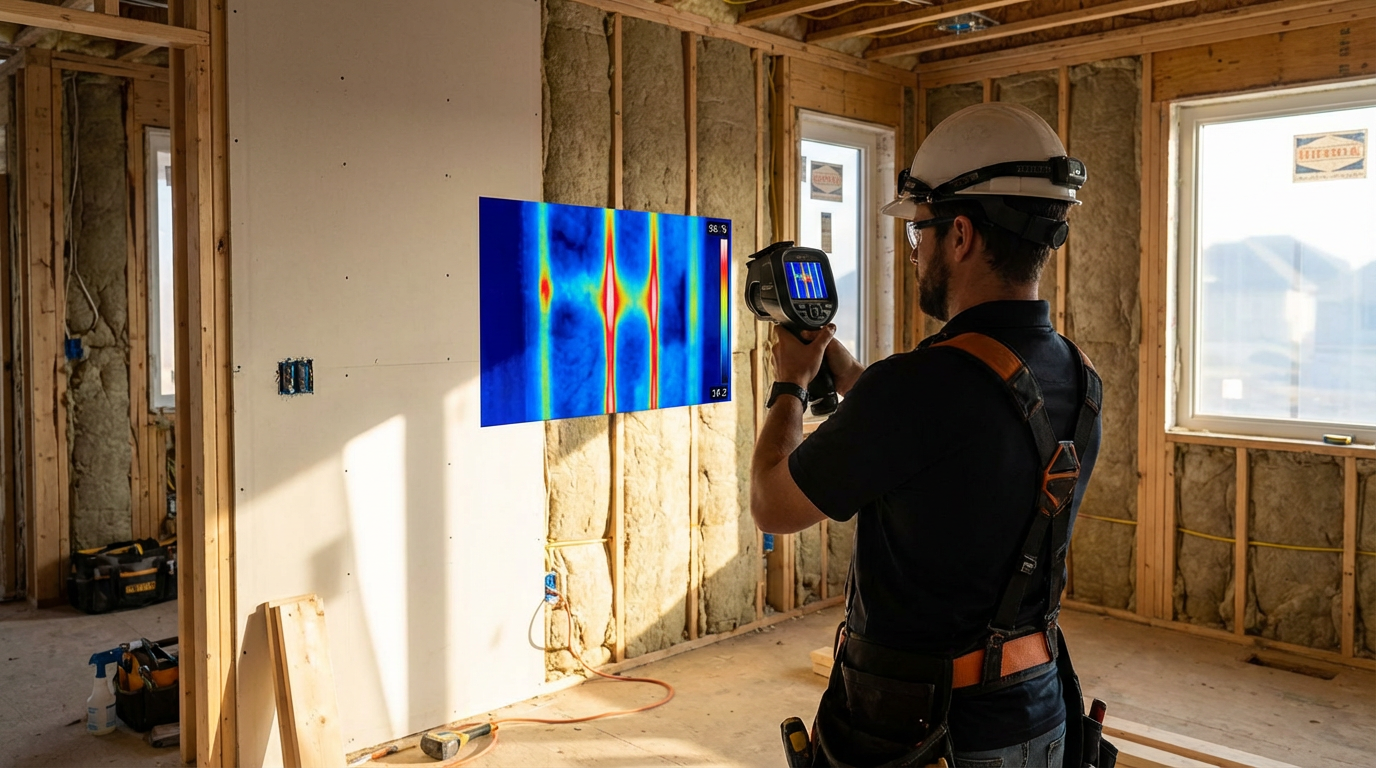
Thermal cameras have been on job sites for decades. The problem was always interpretation. An infrared image of a wall shows temperature gradients. A trained thermographer can read it. An untrained contractor sees colored blobs.
That’s changing. Build Test Solutions’ Heat3D system, using a FLIR One Pro smartphone camera, doesn’t just capture thermal images — it calculates actual U-values (heat transfer coefficients) for entire wall sections. ISO 9869-2 compliant. When they tested Westminster Abbey’s 13th-century stone walls, the predicted U-value was 2.0 W/m²K. The measured value was 0.9 — 55% better than assumed. That’s the kind of precision that turns a thermal camera from a diagnostic toy into a decision-making instrument.
For residential construction, the application is immediate. Scan every wall before drywall goes up. The AI identifies insulation voids, thermal bridges at studs, and air leakage paths by analyzing temperature differential patterns against ambient conditions.
An MDPI study (Buildings, Vol. 15, 2025) demonstrated deep learning semantic segmentation on thermal images achieving 92% precision and 88% recall for detecting building envelope anomalies — up from 72% with conventional methods. That’s not marginal. That’s the difference between catching 7 out of 10 defects and catching 9.
Computer Vision Meets Construction QA
Buildots raised $45 million in May 2025 at a $300 million valuation (Sustainable Construction Review) to do exactly this at commercial scale: helmet-mounted 360° cameras worn by site managers feed video into computer vision models that compare what’s actually built against the BIM model. Deviation alerts. Missing elements. Incorrect installations. All automated.
Their client list reads like a general contractor hall of fame — Turner, VINCI, Bouygues, Hochtief. Triple-digit revenue growth. The company claims a potential 50% reduction in project delays through early deviation detection. The catch: Buildots is commercial-scale. Nobody’s deploying helmet cameras on a three-bedroom ranch in Levittown.
But the technology trickles down. Inspekt AI runs drone-based thermal scans on building facades — 200+ buildings inspected, 120+ under active monitoring. Pair a drone thermal survey with AI anomaly detection and you have a tool that could scan a residential subdivision in an afternoon, flagging every house with envelope defects before the painters show up.
The Missing Piece: Mid-Construction Verification
The problem with current quality assurance is timing. The blower door test happens after drywall. The energy rating happens after certificate of occupancy. By then, the insulation is behind walls and the framing is covered. Fixing a leak path at that point means cutting drywall, and nobody’s doing that on a production home.
What AI thermal imaging enables is a new inspection checkpoint: scan after insulation, before drywall. A 30-minute thermal walkthrough with a $400 FLIR One Pro and an AI analysis app. The software flags anomalies. The insulation crew fixes them while they’re still accessible. The blower door test pass rate goes from 50% to something dramatically higher.
Nobody’s mandating this yet. The 2021 IECC doesn’t require pre-drywall thermal scans. RESNET’s HERS rating system doesn’t penalize you for skipping one. It’s pure risk mitigation — $200 for the scan versus $3,000 to rip out drywall and re-insulate after a failed blower door test.
Where I’m Skeptical
The technology works. The adoption won’t.
Production builders are optimized for speed and cost. Adding an inspection step — any inspection step — slows the schedule. The insulation sub doesn’t want to come back for a callback. The project manager doesn’t want to hold drywall for a scan. The incentive structure rewards getting to certificate of occupancy fast, not getting the envelope right.
Energy codes are tightening. The 2021 IECC dropped air leakage requirements to 3 ACH50 in climate zones 3–8. Some jurisdictions are pushing toward 2.0. At those thresholds, the 50% first-time failure rate won’t be a nuisance — it’ll be a project stopper. When enough builders get burned by failed tests, mid-construction thermal verification will become standard. Not because it’s smart. Because it’s cheaper than the alternative.
But we’re not there yet. The performance gap persists because fixing it requires changing when and how builders verify their work, and that’s a process problem, not a technology problem. AI can see through walls. Getting the guy with the drywall gun to wait 30 minutes? That’s the hard part.
Sources
- International Partnership for Energy Efficiency Cooperation (IPEEC) — The Building Energy Performance Gap: An International Review (December 2019)
- de Wilde, P. — “The Gap Between Predicted and Measured Energy Performance of Buildings” (Frontiers in Mechanical Engineering, 2015)
- MDPI Buildings, Vol. 15 (2025) — Building Envelope Thermal Anomaly Detection Using Integrated Deep Learning
- Build Test Solutions — Heat3D Infrared Thermography U-Value Measurement
- FLIR — FLIR One Pro Camera Aids Step-Change in Quantifying Thermal Performance of Buildings
- Sustainable Construction Review — “AI Pioneer Buildots Secures $45M, Valued at $300M” (May 2025)
- Inspekt AI — Building Thermal Imaging Platform
- Pacific Northwest National Laboratory — Building America Solution Center: Residential Air Leakage Testing
- CIM — “Closing the Gap Between Energy-Efficient Building Design and Actual Energy Performance”
- UNEP — Global Status Report for Buildings and Construction 2024/2025