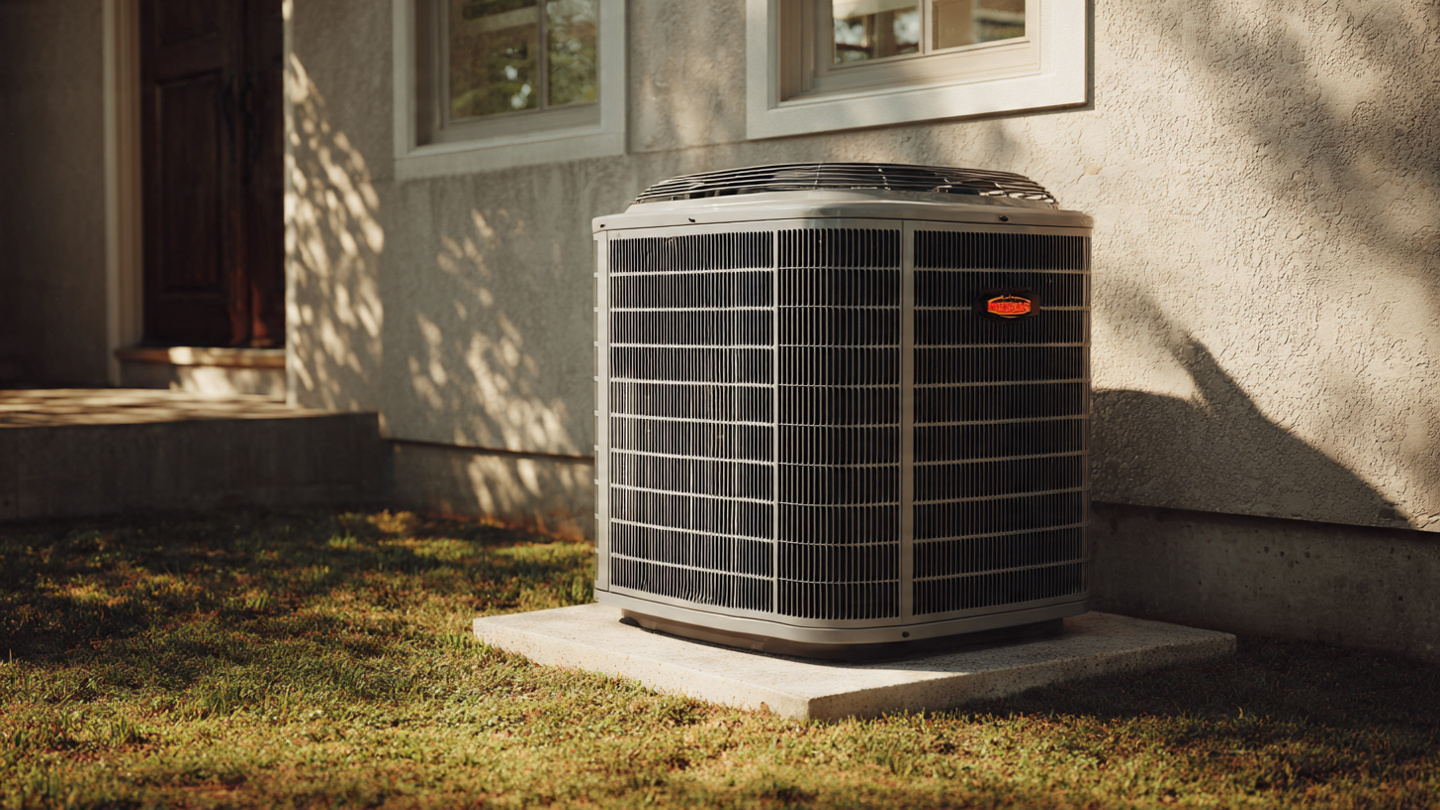
A Manual J calculation walked across my desk last month for a 2,400-square-foot home going up in Chandler, Arizona. Four-ton cooling system, standard single-stage compressor, R-410A refrigerant. The HVAC contractor had followed the procedure exactly. He pulled ASHRAE design temperatures, ran the load calc, selected equipment.
Every number was correct. Every number was also based on weather from 1999 to 2024.
That home will stand until 2100.
Twenty-Five Years in the Rearview Mirror
ASHRAE publishes climatic design data that most HVAC engineers treat as gospel. The 2021 Handbook update acknowledged something uncomfortable: "Globally there continues to be a persistent trend toward warming. This warming causes a knock-on effect: heating and cooling degree days decrease and rise, respectively, leading to changes in building energy use patterns."
ASHRAE knows the climate is shifting. It said so in print. Then it published design conditions based on 25-year historical averages anyway, because that is what the standard requires.
ACCA Manual J, the residential HVAC sizing standard used by virtually every contractor in America, inherits those same backward-looking numbers. No provision exists for forward-looking climate adjustment. The GAO flagged this in Report GAO-17-3, noting that standards-developing organizations "generally have not used forward-looking climate information, such as projected rainfall rates, in design standards, building codes, and voluntary certifications." That report is from 2017. Nothing has changed structurally since.
Ninety-Seven Percent of the Map Is Moving
Climate Central analyzed 240 U.S. locations and found 232 of them, a full 97%, have experienced rising cooling degree days since 1970. Nevada, Arizona, Utah, Texas, and Florida lead, but the trend reaches into the Midwest and Northeast. Minneapolis added 14 cooling degree days per decade over the past 50 years. That does not sound dramatic until you multiply it by three decades of home ownership and a compressor that was already running at 95% capacity on design days.
The EIA's Annual Energy Outlook puts a dollar figure on the trajectory: 71% more household cooling demand by 2050. Not globally. In the United States.
| Metric | Current Standard | 2050 Projection |
|---|---|---|
| Design data basis | 25-year historical average | Not used in residential codes |
| U.S. cooling demand growth | Baseline | +71% (EIA AEO) |
| Locations with rising CDD | 232 of 240 (Climate Central) | Accelerating |
| Duct retrofit cost | $2,000-4,000 during construction | $10,000-25,000 after |
AI Already Knows What 2060 Feels Like
EnergyPlus, the Department of Energy's open-source building energy simulation tool, can model a home against "morphed" weather files. These take IPCC climate projections for 2050 or 2080, layer them onto local historical weather patterns, and produce hour-by-hour data that any qualified energy modeler can run. A 2024 dataset published in Nature Scientific Data created typical and extreme future weather files for studying building resilience to climate change and heatwaves. The files exist. The simulation engine exists.
Almost nobody uses them for residential projects.
A 2025 review in Advanced Science documented how AI foundation models and generative systems are entering climate-adaptive building design, including predictive cooling load analysis that accounts for multi-decade temperature drift. These tools can show a builder in Houston that their 3.5-ton system will be undersized by 2042 and that a variable-speed 5-ton with oversized ductwork costs $3,800 more today but saves $22,000 in avoided retrofit and energy penalties over the mortgage term.
Running that analysis during design adds hours of work and a few hundred dollars. Retrofitting ductwork in a finished home with drywall, insulation, and occupied rooms costs $10,000 to $25,000. The math is not close.
Why Nobody Does This
Three reasons. First, building codes do not require it. The ICC updates codes on a three-year cycle, but those updates still reference ASHRAE's backward-looking data. A contractor who follows code is doing everything the law asks, even if the result is a home that will be chronically uncomfortable by 2045.
Second, builders are already fighting the oversizing problem. Single-stage HVAC systems that are too large short-cycle, fail to dehumidify properly, and wear out faster. The industry spent decades teaching contractors not to oversize. Telling them to now plan for higher future loads sounds contradictory unless you also explain that variable-speed equipment resolves the paradox. A variable-speed compressor running at 40% capacity in 2026 can ramp to 90% in 2050 without short-cycling.
Third, the AI-powered tools are still aimed at commercial and institutional projects. Residential energy modeling is a niche within a niche. Most custom home builders do not employ energy modelers. Production builders run the same Manual J template across hundreds of floor plans and call it done.
Strongest Counterargument
HVAC equipment has a 15- to 20-year lifespan. By 2045, a homeowner will replace their system regardless. At that point, they can right-size for the actual climate. Why spend extra now on a problem that self-corrects at the next replacement?
Because the ductwork does not get replaced with the equipment. Ductwork lasts 30 to 50 years. If the ducts are undersized for the load the home will need in 2050, the replacement HVAC system cannot deliver its rated capacity. You end up with a $12,000 variable-speed heat pump pushing air through ducts designed for a four-ton system in a climate that now demands six tons. Comfort suffers, efficiency drops, and the homeowner pays for a premium system that cannot perform.
Size the ducts for 2050. Size the equipment for 2026. Replace the equipment when it dies. That is the cheapest path.
What to Do About It
If you are building a new home: Ask your HVAC contractor whether they used current or forward-looking climate data. The answer will be "current." Request a 15-20% cooling capacity margin in the ductwork, not the equipment. Oversized ducts cost $2,000 to $4,000 more during construction. They accommodate any future system upgrade without tearing open walls.
If you are buying new construction: Ask the builder what climate data their HVAC sizing used. If they cannot answer, request the Manual J report and check the outdoor design temperature against ASHRAE 2021. Then check what that temperature will be in 2050 using Climate Central's local data. The gap tells you how much headroom you lack.
If you want the full analysis: Hire an energy modeler who runs EnergyPlus. Request a simulation using both current and 2050-morphed weather files. Compare annual cooling energy, peak demand, and equipment run hours. A competent modeler charges $500 to $1,500 for this analysis on a residential project. That is less than one month's summer electricity bill in Phoenix by 2045.
Regardless of location: Invest in envelope before tonnage. Better insulation, low-e windows, and radiant barriers cost $3,000 to $8,000 upfront and reduce cooling load under any climate scenario. A tight envelope with a right-sized variable-speed system beats an oversized single-stage unit in a leaky house every time.
Limitations
Climate projections carry uncertainty, particularly at local scales. The difference between RCP 4.5 and RCP 8.5 scenarios is substantial, and no one knows which path emissions will follow. HVAC technology will improve. Heat pumps are getting more efficient every product cycle. The 71% demand increase is a national aggregate that masks regional variation. A home in Portland, Oregon faces a different trajectory than one in Tucson. This article uses the best available projections, but projections are not predictions.
Sources
- ASHRAE, "Data from More Than 9,000 Climate Stations Included in 2021 Handbook Chapter," 2021. Link
- U.S. Government Accountability Office, "Climate Change: Information on Potential Economic Effects Could Help Guide Federal Efforts to Reduce Fiscal Exposure," GAO-17-3, November 2016. Link
- Climate Central, "Hotter Climate, Higher Cooling Demand," 2023. Link
- U.S. Energy Information Administration, Annual Energy Outlook 2023. Link
- Nature Scientific Data, "Typical and Extreme Weather Datasets for Studying Building Resilience to Climate Change and Heatwaves," 2024. Link
- Advanced Science (Wiley), "How AI Shapes the Future Landscape of Sustainable Building Design With Climate Change Challenges," 2025. Link
- Nature Communications, "Inequalities in Global Residential Cooling Energy Use to 2050," 2024. Link