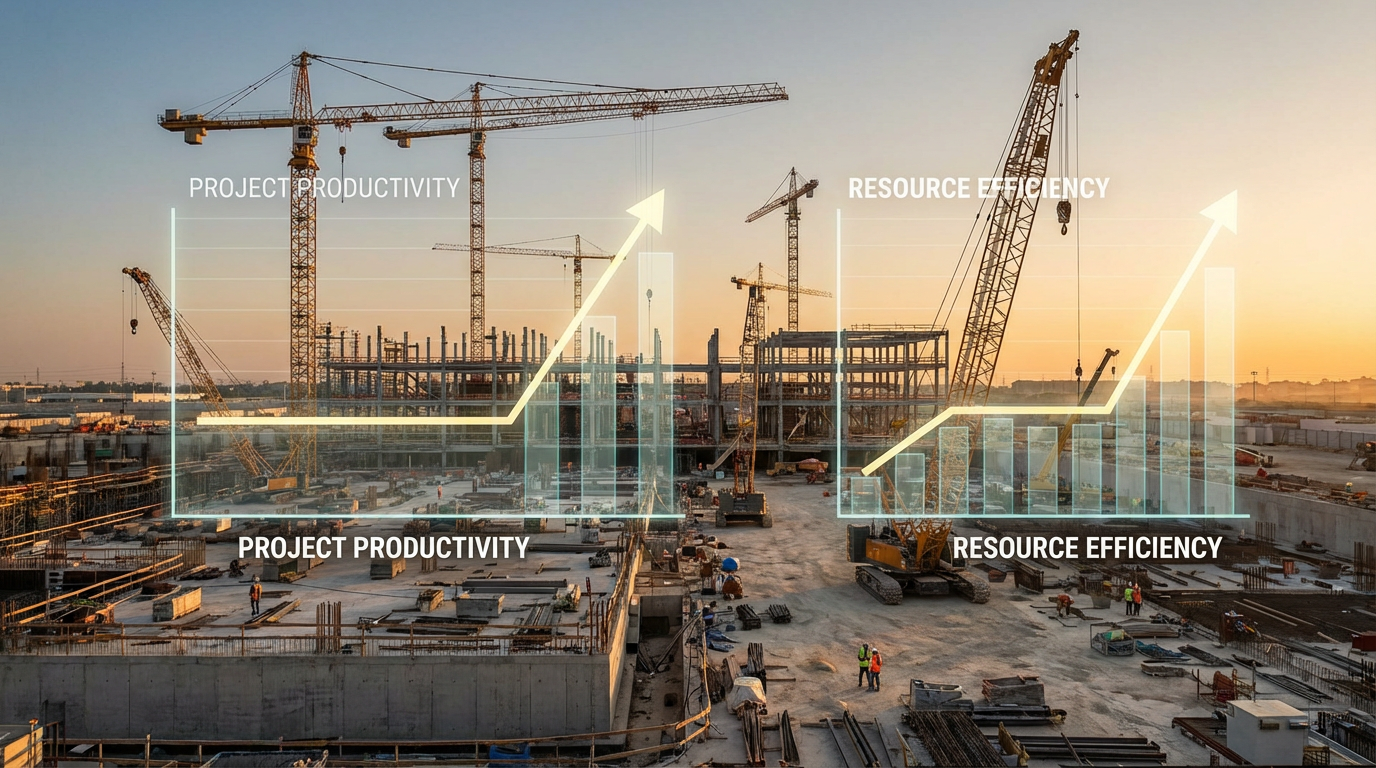
I’ve been running job sites for two decades. And here’s the number that should embarrass everyone in this industry: construction productivity has grown at just 0.4% per year since 2000. The total economy managed 2%. Manufacturing hit 3%. We barely moved the needle.
That’s not a talking point. That’s a McKinsey finding from their 2025 construction productivity report, and it explains why your house costs twice what it did twenty years ago even after accounting for materials inflation. We’re building roughly the same way we did when I started swinging hammers in 2004.
Sources: McKinsey — Delivering on Construction Productivity (2024) · ABC — 349,000 Worker Shortage (2026) · ALICE Technologies — $30M Series B (ENR) · Buildots — AI Construction Progress Tracking · MDPI Buildings — Cost of Rework in Construction (5–8%) · McKinsey via Kodifly — $13T to $22T Global Construction Spending by 2040
Why Construction Got Left Behind
Manufacturing figured out standardization, automation, and continuous improvement decades ago. Toyota’s production system, Six Sigma, robotic welding lines — the factory floor transformed while the job site stayed stuck. There are structural reasons for this.
Every construction project is a prototype. Unlike a factory producing 10,000 identical widgets, every house sits on different soil, faces different weather, meets different codes, and satisfies different owners. That makes standardization genuinely hard, not just culturally resistant.
Then there’s fragmentation. A typical residential build involves 22 to 30 subcontractors, each running their own scheduling, their own procurement, their own quality standards. Coordination overhead alone consumes 30–40% of project manager time, according to a 2024 Dodge Construction Network survey. I’ve lived that number. It’s real.
And the workforce is shrinking. The construction industry faces a 349,000-worker shortage in 2026, per the Associated Builders and Contractors. By 2040, advanced economies may see negative workforce growth in the trades. We can’t hire our way to higher productivity. We have to build smarter.
Where AI Actually Moves the Needle
I’m skeptical of tech hype — I’ve watched enough “construction apps” die on the vine. But AI hits differently because it attacks the specific problems that kept us stuck.
Scheduling and sequencing. ALICE Technologies uses AI to generate and compare thousands of construction schedules, optimizing for cost, time, and resource availability simultaneously. Their case studies show 15–25% schedule compression on commercial projects. For residential, that’s the difference between a 12-month build and a 9-month build — three fewer months of carrying costs for the homeowner.
Progress tracking. Buildots mounts cameras on hard hats that automatically compare as-built conditions against BIM models. Instead of a superintendent walking the site with a clipboard, AI flags deviations in real time. Buildots reports 75% fewer punch list defects on projects using their system. Fewer defects means less rework, and rework is the silent killer of construction productivity — consuming 5–8% of total project costs industry-wide.
Design optimization. Generative AI tools like Hypar and TestFit can produce and evaluate dozens of floor plans in the time it takes a human architect to sketch one. When the design phase compresses from weeks to days, the entire project timeline shifts forward.
“Every delay has a root cause. AI just finds it faster.”
The $22 Trillion Deadline
Global construction spending is projected to reach $22 trillion by 2040, up from $13 trillion in 2023. That growth is driven by renewable energy infrastructure, housing demand, and climate adaptation — projects the world genuinely needs. But McKinsey’s analysis is blunt: at current productivity levels, the industry simply cannot deliver that volume of work. The math doesn’t close.
A 2025 PCL Construction outlook found that firms adopting AI-powered project management and prefabrication saw productivity gains of 20–35% in controlled studies. The top performers aren’t just using AI for one task — they’re stacking it: AI scheduling + computer vision QA + generative design + autonomous equipment. Each layer compounds.
The residential sector, which has historically lagged commercial in technology adoption, has the most to gain. A custom home builder who adopts AI scheduling, automated progress tracking, and computer-vision inspections could realistically cut build times by 25% and defect rates by half. That’s not a dream. Those are numbers individual tools are already hitting in isolation.
Why This Time Might Be Different
I’ve been burned before by “the next big thing” in construction tech. BIM was going to fix everything in 2012. Drones were going to fix everything in 2016. Neither did — not because they weren’t useful, but because they addressed pieces of the problem.
AI is different because it addresses the coordination problem — the connective tissue between every tool, every sub, every phase. It doesn’t replace the electrician or the plumber. It makes sure the electrician isn’t waiting three days for the plumber to finish something that should have been sequenced last week.
Thirty years of flat productivity isn’t a technology problem. It’s an integration problem. And integration is exactly what AI does best.