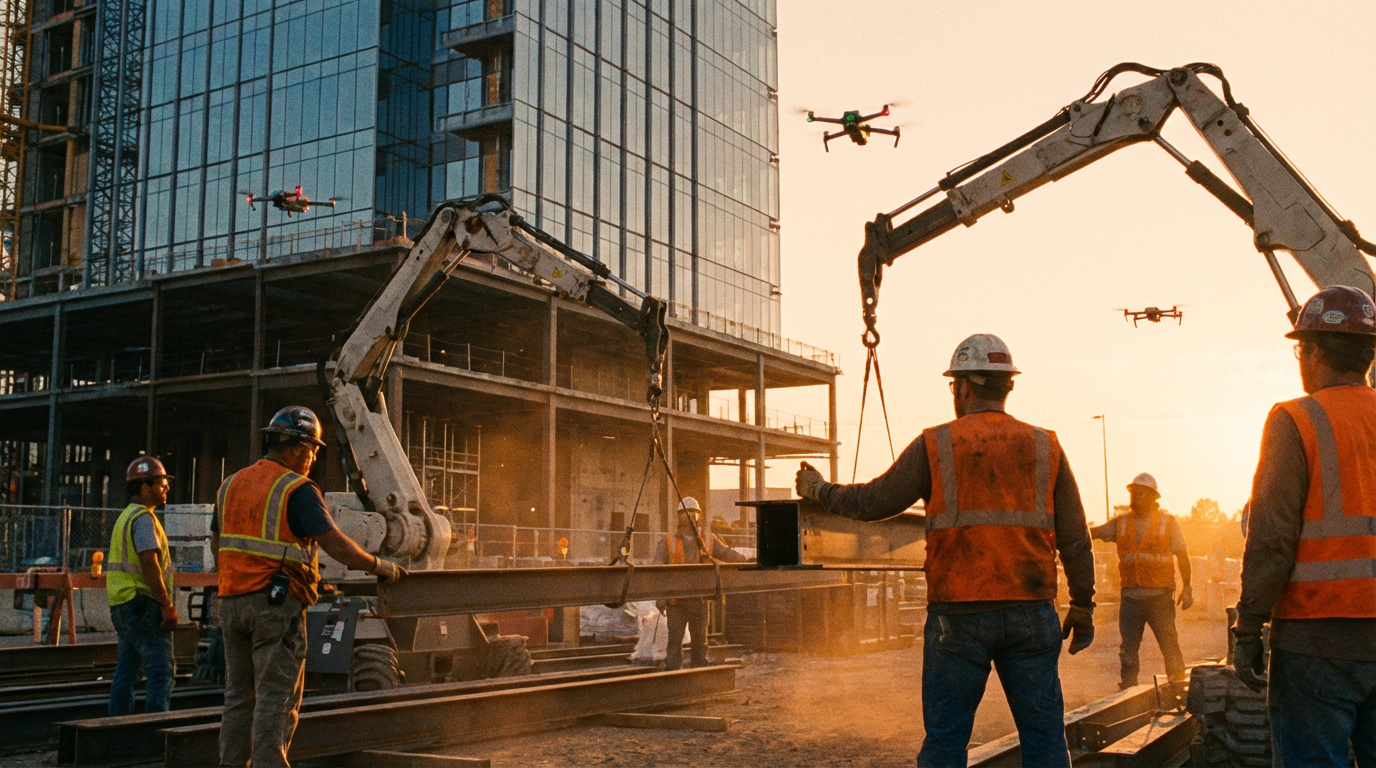
There are 500,000 construction jobs sitting empty in the United States right now. Not projected. Not seasonal. Right now, today, as you read this, half a million positions in framing, electrical, plumbing, and general labor have no one to fill them.
The Associated General Contractors of America has been tracking this number with increasing alarm. Their 2024 workforce survey found that 73% of construction firms report difficulty filling positions — the highest in the survey's history. The median age of a construction worker is 42 and climbing. The pipeline of young apprentices has thinned to a trickle.
The Robots Are Here (Sort Of)
Into this gap come the machines. Hadrian X, built by Australian company FBR (Fastbrick Robotics), lays 200 large-format blocks per hour — roughly the output of two skilled masons working an eight-hour shift, but Hadrian works 24/7 without breaks, back injuries, or callbacks. It's been deployed on commercial projects in Australia and is now targeting the U.S. residential market.
Built Robotics, based in San Francisco, retrofits conventional heavy equipment — excavators, dozers, compactors — with autonomous guidance systems. Their machines handle site preparation, trenching, and grading with GPS-level precision. The company has raised $112 million and deployed across solar farm construction, but residential applications are next.
Then there's ICON, the Austin-based startup that 3D-prints homes. Their Vulcan printer extrudes a proprietary concrete mixture called Lavacrete, building walls layer by layer. A 2,000-square-foot home takes about a week of print time. ICON has printed 200+ structures, including a planned community in Georgetown, Texas — 100 homes, all 3D-printed.
What the Numbers Actually Say
Here's where the narrative gets complicated. The Bureau of Labor Statistics projects construction employment will grow 4% through 2032, adding roughly 300,000 jobs. That's net growth despite automation. Why? Because the housing shortage is so severe — the National Association of Realtors estimates the U.S. is 5.5 million homes short of demand — that even with robots, we need more humans too.
McKinsey's 2023 report on construction productivity found that the industry's labor productivity has been essentially flat for 30 years. Every other major sector — manufacturing, agriculture, mining — has at least doubled output per worker. Construction hasn't. AI and robotics aren't replacing a thriving workforce; they're propping up a declining one.
The trades most resistant to automation are the ones requiring adaptive, fine-motor work in unpredictable environments: electricians routing wire through existing walls, plumbers fitting pipes in cramped crawl spaces, finish carpenters matching trim to warped old houses. A robot that can lay bricks on a flat slab is one thing. A robot that can snake a wire through a 1940s attic is science fiction.
The Human Cost of Doing Nothing
The construction industry lost 1,075 workers to fatal injuries in 2022, according to OSHA — the highest of any sector. Another 170,000 suffered non-fatal injuries serious enough to require days off work. Back injuries, falls, repetitive stress, heat exposure. The physical toll is staggering.
Robots don't fall off scaffolding. Autonomous dozers don't get heatstroke. 3D printers don't develop chronic back pain. The safety argument for automation may be stronger than the efficiency argument.
What Happens to the Workers?
The honest answer: it depends on who you are. A 55-year-old framer who's been hanging joists for 30 years is in a different position than a 25-year-old apprentice who can learn to operate and maintain robotic systems. The AGC reports that firms investing in automation are also investing in operator training — you need people who understand both construction and the machines.
The transition isn't robot replaces worker. It's robot + worker builds 3× what worker alone could build, and the worker's knees last 20 years longer.
But only if we invest in retraining. And historically, we're terrible at that.