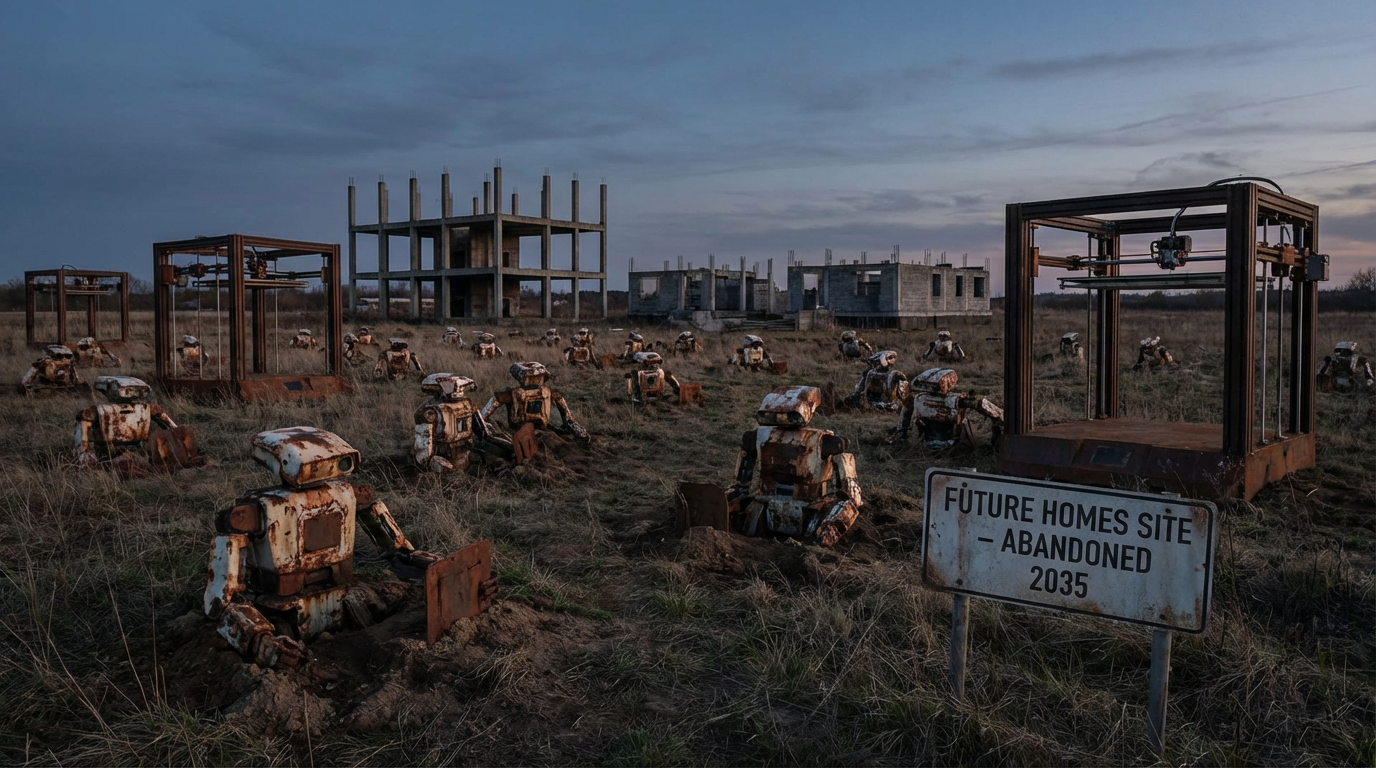
Katerra burned through $2 billion trying to reinvent construction from a WeWork office. Veev raised $647 million and quietly started looking for a buyer in 2024 after their prefab panels turned out to cost more than the framing crews they were supposed to replace. Mighty Buildings—$150 million in VC money, 100+ investors—put itself up for sale in February 2025 with a four-week deadline and a prayer for cash bids.
I keep a list. Not because I enjoy watching startups fail, but because every dead company teaches you something the pitch deck never mentioned. After two decades of running residential projects in Northern California, I’ve developed a pretty simple filter: can this thing survive a Tuesday in February when it’s raining, the concrete truck is two hours late, and your framing crew just quit?
Most of what gets funded in contech wouldn’t survive the parking lot.
The Dead and Dying
Katerra is the cautionary tale that should be tattooed on every contech founder’s forearm. They tried to vertically integrate everything—lumber mills, architecture, factory production, general contracting—because someone in a Menlo Park conference room decided construction was “just a supply chain problem.” It isn’t. It’s a coordination problem layered on top of a labor problem wrapped inside a regulatory problem. SoftBank’s money ran out in June 2021. The autopsy was brutal.
Veev repeated the exact same mistake at a smaller scale. Their panelized system worked in the factory. It worked less well when it arrived at a site with a foundation that was off by three-quarters of an inch, which is every foundation. They reportedly laid off most of their staff in 2024.
Mighty Buildings had beautiful renders. Genuinely beautiful. Their 3D-printed ADUs looked like something from an architecture magazine. Then they tried to scale production in Oakland and discovered that UV-cured thermoset polymer doesn’t behave the same way at 100 units as it does at 10. Up for sale as of early 2025.
ICON is the interesting one because they’re not dead—but they’re wounded. Laid off over 25% of staff in March 2025. Pivoting from “we print entire communities” to “we make really good printers and someone else figures out the construction part.” That Georgetown, Texas project? 100 homes, yes. But the last 50 took longer and cost more than the first 50, which is the opposite of what a scaled technology is supposed to do. They’re still alive. I wouldn’t bet my retirement on it.
What’s Actually Working
Here’s where I get less cynical. Some of this stuff is genuinely good.
Procore hit $339 million in quarterly revenue in 2025 and has a 95% gross retention rate. That means almost nobody leaves once they start using it. Why? Because it solved the actual problem contractors have, which isn’t “we need a robot”—it’s “where the hell is the RFI from two weeks ago and did the inspector sign off on the framing?” Document management. Scheduling. Communication between 14 subcontractors who all hate email. Boring. Profitable. Real.
OpenSpace does 360° photo documentation. Walk the site with a hard-hat camera, and their AI maps every photo to the floor plan and detects discrepancies from the BIM model. Over 2.3 billion square feet documented. The reason it works is that it doesn’t ask anyone to change their behavior. You walk the site anyway. Now you do it with a camera.
Dusty Robotics prints full-scale layout lines on concrete floors—replacing the chalk-line crew. It’s essentially a giant inkjet printer on wheels. Sounds trivial. Saves 70–80% of layout time. Nobody has to learn anything complicated. The robot shows up, prints the lines, leaves. A tool, not a transformation.
Why Most Contech Fails
The pattern is always the same. A team with deep technical talent and zero field experience builds something that works brilliantly in a controlled environment. Then they meet the job site.
Job sites are wet. Dusty. The WiFi doesn’t work. The power goes out. Someone backs a truck into your sensor array. The crew doesn’t read English. The superintendent is 58 years old and learned to build houses from his father and doesn’t need a 26-year-old in a Patagonia vest explaining “workflows.”
The tools that survive share three traits. They don’t require new skills. They don’t require new infrastructure. And they save time on something the crew already hates doing. Procore works because paperwork is miserable. OpenSpace works because documentation walks were already happening. Dusty works because snapping chalk lines in a 120,000-square-foot warehouse is back-breaking grunt work nobody misses.
The tools that die share one trait: they require the construction industry to become a different industry. It won’t.
My Scorecard
After 50 articles on this site breathlessly covering every new AI construction tool, someone should probably say this out loud: most of them will fail. The $5.4 billion VCs poured into contech from 2020 to 2024? A meaningful fraction of that money is already gone. Not because the technology was bad. Because the go-to-market assumed a customer that doesn’t exist—a general contractor eager to overhaul their entire operation based on a demo at a trade show.
The winners will be boring. They’ll solve one specific problem. They’ll work on a muddy slab with no internet. They’ll cost less than the labor they replace on day one, not after a “transformation journey.”
I’ve been wrong before. I thought smartphones on job sites were a fad in 2012. But I’ve been right more often than the pitch decks have been, and right now the pitch decks are losing.
Sources: Wolf Street — Katerra Collapse ($2B SoftBank) · Robots.net — Veev Shutdown ($647M Raised) · 3D Printing Industry — Mighty Buildings Up for Sale ($150M) · OpenTools — ICON 25% Layoffs (March 2025) · MIT Startup Exchange — OpenSpace (50B+ sq ft documented) · Bouma Corp — Dusty Robotics FieldPrinter