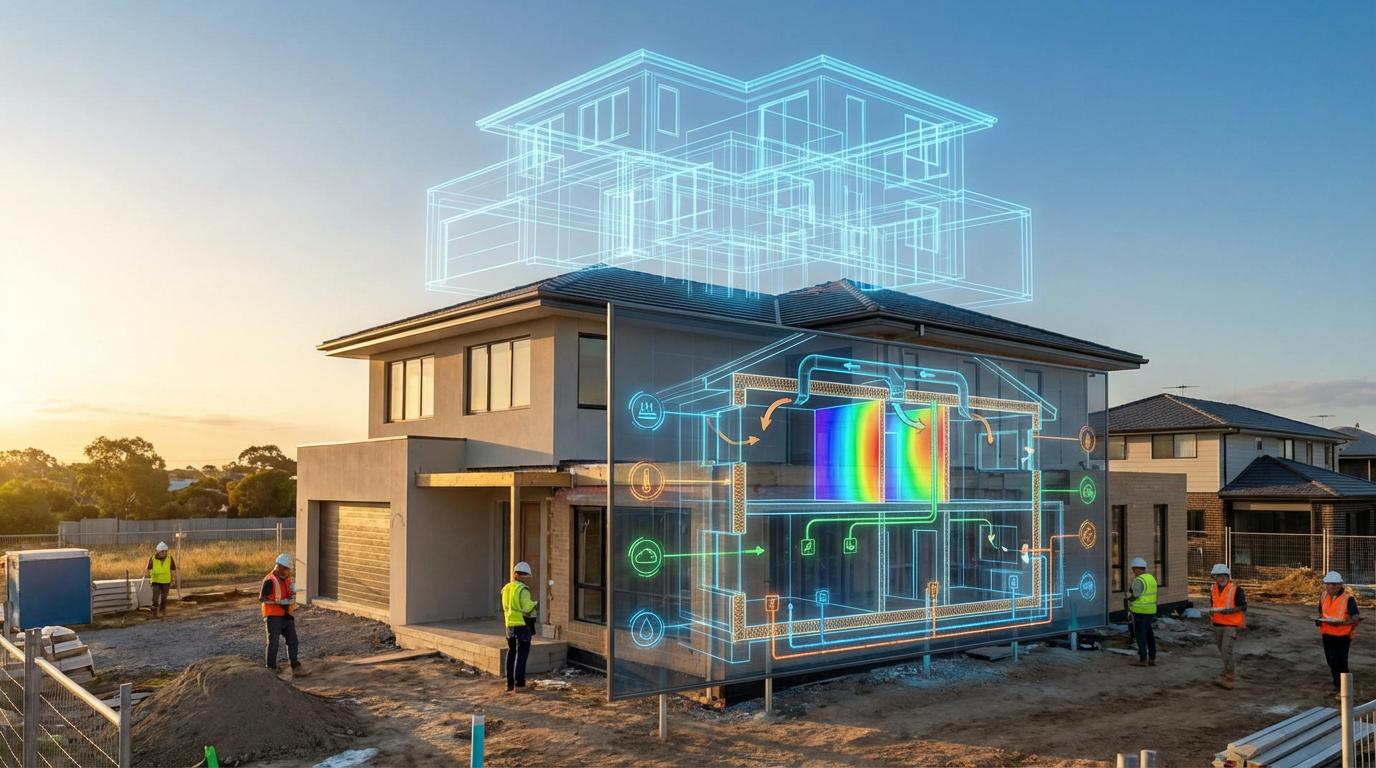
Multiconsult, a Norwegian engineering firm with 3,800 employees across 30 offices, spent months building a digital twin of a commercial facility using Autodesk Tandem. They connected sensors for heating, occupancy, CO₂, and humidity. The building manager could sit in Oslo and watch a mechanical room in Bergen breathe. The twin caught an HVAC scheduling conflict that had been silently wasting 12% of the building’s heating budget for two years.
That was a $200 million commercial project. The question that matters to you: when does this reach a $500,000 house?
Sooner than the industry admits.
The Market Nobody Expected to Grow This Fast
The digital twin construction market hit $7.73 billion in 2024 and is projected to reach $12.06 billion by 2028, growing at 11.7% annually, according to The Business Research Company’s 2026 market report. Nearly all of that is commercial and infrastructure. Residential is a rounding error.
But the tools are migrating downmarket.
A quantitative analysis published in the Global Building and Environment Journal documented digital twin deployments cutting project duration by 8–15%, rework costs by 60–80%, and material waste by 10–20%. Those numbers came from commercial projects. Scale them down to a $400,000 custom home where rework typically eats $20,000–$40,000, and even a 40% reduction pays for the technology several times over.
Three Paths to a Residential Twin
Autodesk Tandem is free up to 1,000 tracked assets. AEC Magazine’s deep-dive on Tandem confirmed the pricing: unlimited users, unlimited facilities, full data integration — zero cost for small projects. A typical custom home has 200–400 trackable assets (HVAC units, electrical panels, water heaters, appliances). That fits comfortably in the free tier. The catch: you need a Revit model to feed it, and most residential architects work in SketchUp or Chief Architect, not Revit.
Matterport took the opposite approach. Instead of requiring a BIM model from an architect, Matterport lets anyone with a smartphone create a 3D digital twin of an existing space. CoStar completed its $1.6 billion acquisition of Matterport in early 2025, signaling that real estate’s largest data company sees spatial capture as foundational infrastructure. The residential use case is obvious: scan your existing home before renovation, test demolition scenarios digitally, hand the scan to your architect as a starting point instead of a tape measure and a legal pad.
NVIDIA Omniverse is overkill for a house. But the physics simulation engine underneath it—real-time ray tracing, fluid dynamics, thermal modeling—is filtering into lighter tools. Bentley’s iTwin Platform uses similar principles for infrastructure digital twins and has started licensing its simulation APIs to third-party residential tools.
What the Twin Actually Catches
Energy simulation is the obvious win. Model the house, drop in your local climate data, and watch where the thermal bridges form before you insulate. The International Partnership for Energy Efficiency Cooperation has documented that buildings globally consume 25% more energy than their designs predicted. Half of that gap is construction defects—missed insulation, HVAC ducts routed through unconditioned spaces, windows oriented to bake the living room at 3 PM in July. A digital twin running thermal simulation catches these in the design phase, when fixing them costs a red-line edit instead of a drywall teardown.
Acoustics is the hidden one. I’ve written about architects for twenty years and I can count on one hand the residential projects that modeled sound propagation before construction. The result: master bedrooms that share a wall with the laundry room. Home offices above the garage where the automatic door opener triggers during every Zoom call. Digital twins with acoustic simulation—tools like CATT-Acoustic or Autodesk’s built-in environmental analysis—solve this for the cost of a few extra hours in the model.
Airflow is the third. COVID drove interest in residential ventilation, but most homes are still designed with rules of thumb. A twin running computational fluid dynamics shows you exactly where dead air pools, where cross-ventilation works, and where your kitchen hood exhausts grease particles into the hallway instead of outside.
The Honest Part
None of this is easy yet. Tandem needs Revit. Matterport captures geometry but not building systems. Running meaningful thermal or acoustic simulation requires someone who knows what they’re doing with the inputs—garbage in, garbage out applies to digital twins more than most technologies.
The residential architecture profession isn’t ready. Most custom home architects bill $150–$250 per hour and design 5–15 houses a year. Asking them to build a full BIM model with sensor-ready asset tagging is asking them to triple their design time for a benefit the homeowner can’t see until the house is occupied.
The breakthrough will come from the renovation side, not new construction. The 130 million existing homes in America are the real market. Scan your house with Matterport. Layer in utility data. Run a simulation that tells you whether that $15,000 mini-split system will actually fix the hot room upstairs, or whether the problem is really the uninsulated knee wall behind the attic conversion your previous owner did without a permit in 2003.
That simulation, today, costs less than the HVAC contractor’s diagnostic visit. The tools exist. The data pipelines are getting built. The question isn’t whether your house will have a digital twin. The question is whether you’ll build it before or after the expensive mistake.
Sources: Autodesk Tandem — Digital Twin Platform · The Business Research Company — Digital Twin in Construction Market Report (2026) · Global Building & Environment Journal — Economic Impact of Digital Twins in Architecture (2025) · AEC Magazine — Autodesk Tandem: Digital Twins in the Cloud · Virginia Business — CoStar Completes $1.6B Matterport Acquisition (2025) · Bentley iTwin Platform · International Partnership for Energy Efficiency Cooperation — Building Energy Performance Gap · CATT-Acoustic — Room Acoustics Simulation · Ours Global — How Matterport 3D Digital Twin Technology Works