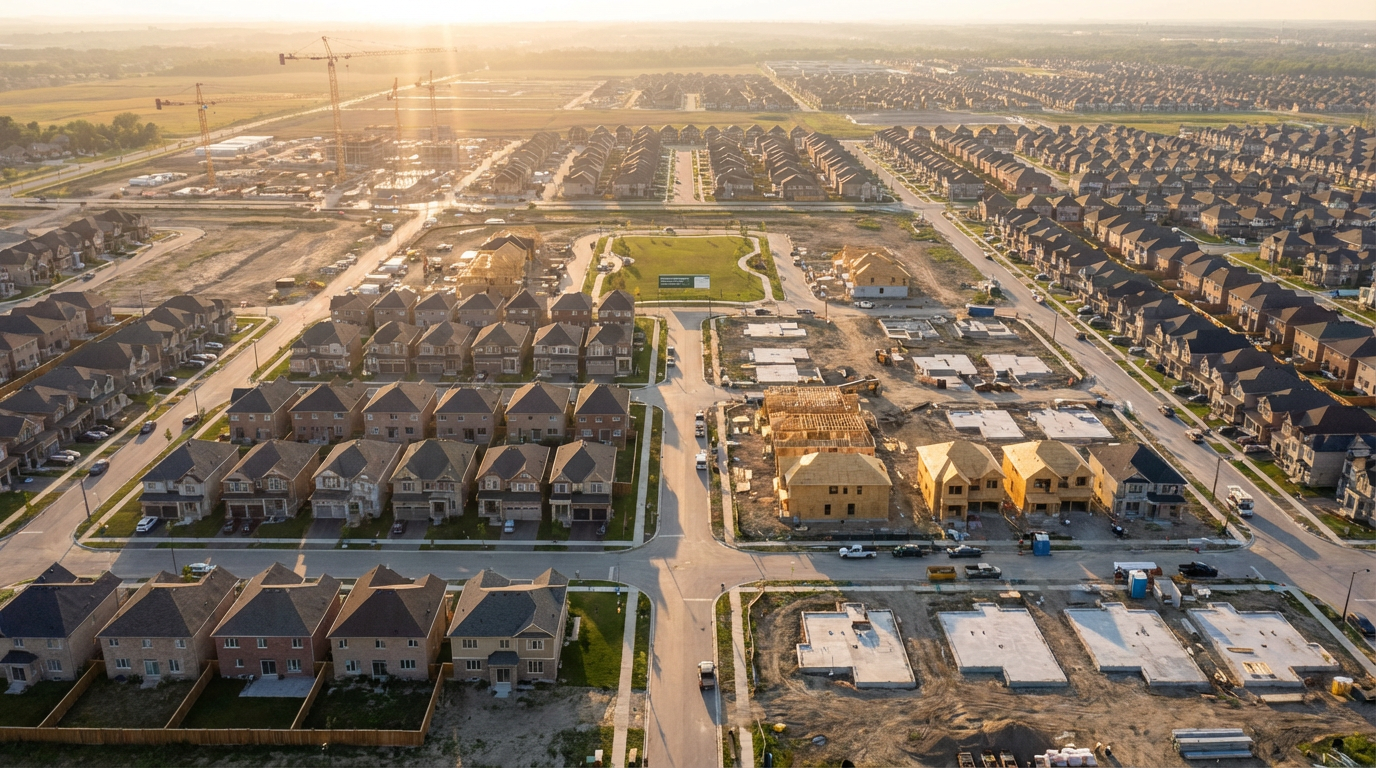
Last July, Zillow published a number that should have set off alarm bells across every state capitol in America: the US housing deficit had grown to 4.7 million units. Not shrunk. Grown — despite the biggest construction surge since 2006. We built more homes in 2024 than any year since the financial crisis, and the hole got deeper anyway.
The math is merciless. Household formation is outpacing construction by roughly 300,000 units per year. Immigration, delayed millennials finally buying, and aging boomers staying in their homes longer have all combined to create demand that no amount of framing crews can satisfy. The National Association of Home Builders estimates the industry is short more than 400,000 skilled workers — electricians, plumbers, carpenters — and that labor gap alone adds $89,000 to the average cost of a new home.
Where AI Actually Helps
D.R. Horton, the nation's largest homebuilder, recently partnered with AI startup Prophetic to analyze land parcels for new development. The platform cross-references zoning regulations, soil data, flood zones, utility access, and entitlement history — compressing what used to take a land acquisition team several hours into roughly 30 seconds. When you're evaluating hundreds of potential sites per quarter, that time savings compounds into months.
It's not just land analysis. AI is quietly reshaping every stage of the homebuilding pipeline:
- Permitting: Companies like PermitFlow and Symbium are cutting plan review times from months to days by automating code compliance checks. Folsom, California already processes solar permits in under an hour.
- Design: Generative tools like Maket AI produce zoning-compliant floorplans in minutes, letting builders iterate on layouts without burning architect hours.
- Estimation: Platforms like Togal.AI compress takeoff and bidding from weeks to hours with 3–5% accuracy — down from the industry's typical 15–25% error range.
- Construction: Robotic bricklayers, AI-directed prefab lines, and drone site monitoring are all chipping away at the labor bottleneck.
Where AI Can't Help
Here's the uncomfortable truth: the housing shortage is fundamentally a policy failure, not a technology gap. The biggest obstacles to building more homes are zoning restrictions, permitting delays, NIMBY opposition, and capital costs — problems that require political will, not better algorithms.
"You can have the fastest AI permit reviewer in the world, but if the zoning code says you can't build multifamily housing on 75% of residential land, the technology is irrelevant." — Urban planning researcher at Brookings
Single-family zoning still covers the majority of residential land in most American cities. Houston's relative affordability isn't because of superior construction technology — it's because the city famously lacks conventional zoning. Minneapolis legalized triplexes citywide in 2018 and saw a measurable increase in housing starts within two years.
Interest rates compound the problem. The NAHB Housing Market Index hit its 22nd consecutive month of contraction in February 2026. Builder sentiment is at its lowest point since 2012. AI can make each home cheaper and faster to build, but it can't make the financial math work when mortgage rates hover near 7% and land costs have doubled in a decade.
The Realistic Path Forward
The honest answer is that closing a 4.7-million-unit deficit requires both technology and policy working in concert. AI can realistically cut construction timelines by 20–30% and reduce per-unit costs by 10–15% through better estimation, automated compliance, and robotic construction. That's meaningful — it could add 200,000–300,000 additional units per year to current capacity.
But the remaining gap demands zoning reform, faster entitlement processes, workforce development investment, and creative financing. States like California (SB 9, SB 10), Oregon, and Montana have started legalizing more density. The real acceleration will come when AI-powered permitting meets reformed zoning codes — when the technology can move fast because the regulations finally let it.
The tools exist. The technology is advancing faster than anyone predicted. What's missing isn't intelligence — artificial or otherwise. It's the political courage to let people build.