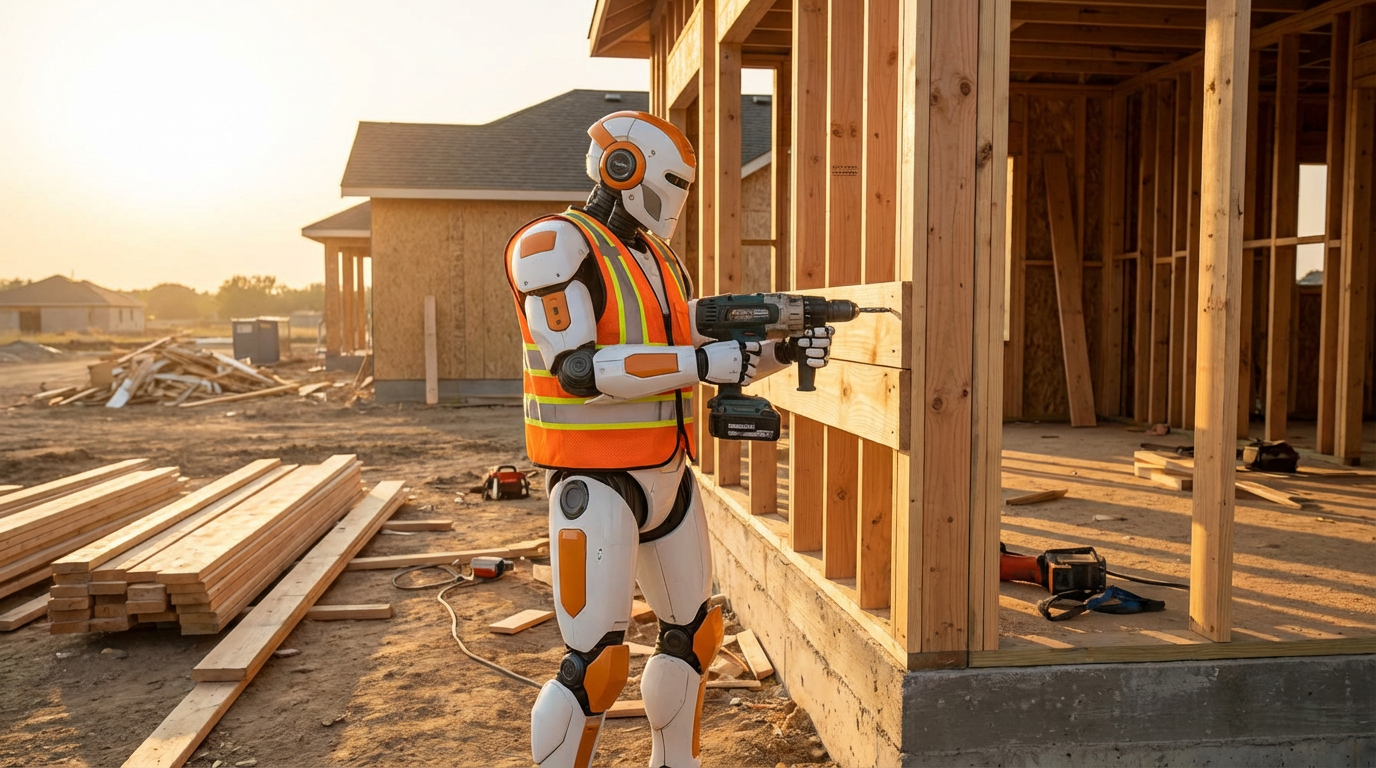
Last November, Figure AI pulled its humanoid robots off the BMW assembly line in Spartanburg, South Carolina. Not because they failed — because the pilot was over. In 11 months, the Figure 02 fleet helped build over 30,000 BMW X3 crossovers, handled 90,000 sheet metal parts, and logged more than 1,250 hours each at 99%+ accuracy. Ten hours a day, five days a week, no complaints, no OSHA incidents, no lunch breaks. Then they “retired” to make way for the next-generation Figure 03.
Meanwhile, in October, McKinsey published a report telling the construction industry to start planning for humanoid robots right now. Not in five years. Not as a thought experiment. Now. Their argument is straightforward: the industry is short 349,000 workers (ABC, January 2026), productivity has been flat for 30 years, and humanoid robot prices just collapsed past the point where the math works.
The Unitree G1 sells for $13,500 today. The 1X NEO ships in 2026 for $20,000 — or $499 a month on a Robot-as-a-Service subscription. EngineAI’s T800 lists at $25,000. Tesla is targeting $20,000–$30,000 for Optimus at mass production scale. The average US construction worker, fully loaded with benefits, insurance, and overhead, costs $72,000–$85,000 a year.
The Construction Case Is Different
Here’s the thing McKinsey gets right and wrong simultaneously: construction isn’t a factory. A BMW assembly line is a controlled environment — flat floors, consistent lighting, identical tasks repeated thousands of times. A residential job site is mud, rain, uneven terrain, constantly changing layouts, and a different configuration every day. The Figure 02 robots walked 200 miles on BMW’s polished concrete. Try that on a graded lot in February.
“Behind every labor statistic is someone’s mortgage payment. When we talk about robots replacing construction workers, we’re not talking about productivity curves. We’re talking about 349,000 families who can’t find those jobs — and millions more who currently have them.”
McKinsey identifies the realistic near-term construction tasks for humanoids: material handling (unloading trucks, staging supplies, moving drywall sheets), site cleanup (debris removal, tool organization), repetitive finishing work (painting, taping, sanding in structured environments), and inspection and monitoring (walking routes and documenting progress). The keyword is “structured.” High-rise housing projects with identical unit layouts are the sweet spot — not custom single-family homes where every room is different.
The Price Trajectory Is What Matters
Forget what humanoid robots can do today. Look at where the price curve is going. UBTech projects average humanoid prices dropping from $35,000 in 2025 to $17,000 by 2030 — a 51% reduction. The Unitree G1 already undercuts that 2030 target by 21%.
At $13,500 purchase price and a 5-year total cost of ownership around $32,000–$40,000 (including implementation, maintenance, and parts), the math gets uncomfortable. A single humanoid operating 10 hours a day at even 30% of a human worker’s productivity still costs less per productive hour than the human within the first year. At 50% productivity, it’s a no-brainer. The IRS allows full Section 179 deduction in year one — expense the entire cost immediately.
BuiltWorlds reports that 95% of contractors now evaluate robotics positively, up from 74% in 2024. But actual deployment fell from 65% to 46% — the gap between enthusiasm and execution. The hardware is getting cheap. The software is getting capable. What’s missing is the integration: someone has to figure out how a humanoid fits into an actual construction workflow without a team of robotics engineers supervising it.
Who Gets Displaced First
This is where I lose patience with the McKinsey framing. Their report is addressed to “construction leaders” — general contractors, project managers, C-suite executives deciding whether to be “first movers,” “early adopters,” or “selective deployers.” Nowhere does it address the people standing on the other side of the equation.
The most vulnerable residential construction roles aren’t the skilled trades. A robot isn’t wiring a panel or plumbing a manifold anytime soon. The first jobs to go are the ones that require a body but not a license: laborers, material handlers, cleanup crews, and entry-level finishing workers. These are the $35,000–$45,000-a-year positions that serve as the on-ramp into construction careers. Kill the on-ramp, and you don’t just lose the laborers — you lose the pipeline that produces tomorrow’s journeymen and foremen.
Construction already has a demographic crisis. The median worker is 42.3 years old (BLS). Only 10.4% of workers are under 25. The industry needs 546,000 new workers beyond normal hiring just to meet demand, according to the Associated Builders and Contractors. If robots take the entry-level jobs — the ones that don’t require experience — where does the next generation learn the trade?
The Third Path Nobody Talks About
The standard narrative has two lanes: robots steal jobs (labor view), or robots fill a shortage nobody else wants (industry view). Both are partially true and totally incomplete.
The third path is what actually happened in automotive manufacturing. Robots didn’t eliminate factory workers — they changed what factory workers do. The BMW plant where Figure 02 worked still employs thousands of humans. But those humans don’t spot-weld anymore. They supervise, troubleshoot, program, and maintain. The job title stayed; the job description transformed.
For construction, the equivalent would be a site robotics operator — someone who supervises 3–5 humanoid robots handling material movement and cleanup while the skilled tradespeople focus entirely on craft work. Built Robotics already trains this role for autonomous excavators. Granite Construction runs supervised autonomous machinery on active job sites today. The operator doesn’t dig — they manage machines that dig.
“The question isn’t whether humanoid robots show up on construction sites. The question is whether we build the training pipeline before they get here, or after half the entry-level workforce has nowhere to go.”
But that transition doesn’t happen by itself. It requires investment in retraining that the construction industry has historically refused to make. The average US construction firm spends less than $1,000 per worker per year on training — barely enough to cover OSHA refreshers. Retooling a laborer into a robotics supervisor requires months of education and new certifications that don’t exist yet.
The robots are getting cheaper faster than the training programs are being built. That gap is where the damage happens — and right now, nobody on either side of the humanoid hype cycle is being honest about how wide it’s getting.
Sources: Figure AI — BMW Spartanburg Pilot (30,000 X3 vehicles, 90K parts) · Unitree G1 — $13,500 Humanoid Robot (2026 Review) · 1X NEO — $20,000 / $499/mo Humanoid (2026) · McKinsey — Humanoid Robots in Construction (Oct 2025) · ABC — 349,000 Worker Shortage (Jan 2026) · BLS via SBCA — Median Construction Worker Age: 42 · Built Robotics & IUOE — Robotic Equipment Operator Training