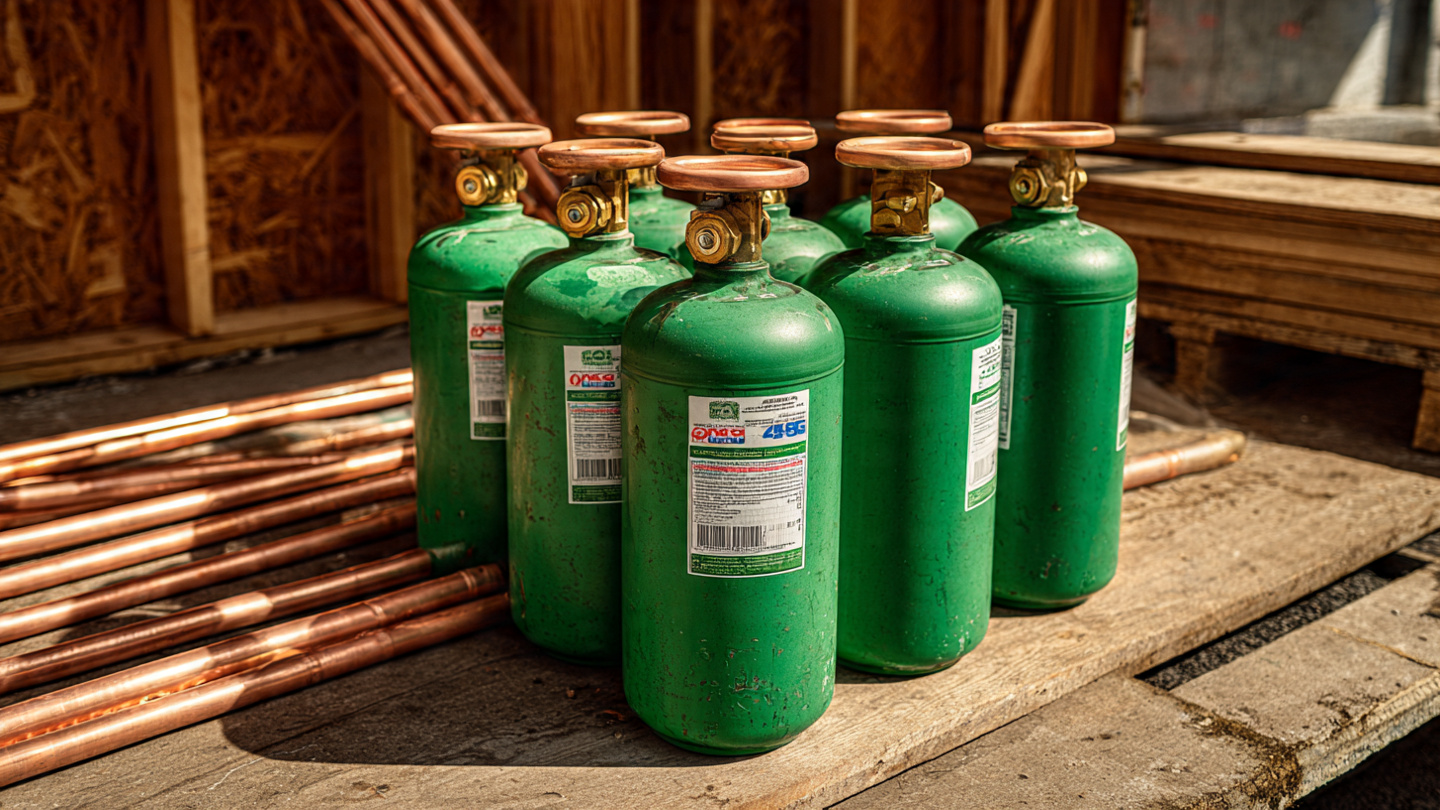
Honeywell raised the price of R-454B by 42% on April 11, 2025. That came after a 15% increase in February and an 8% increase in March. In three months, the cost of the refrigerant that every new residential air conditioner and heat pump in America now requires went up by roughly 65%. Honeywell cited "unprecedented demand" that domestic production could not meet, rising raw material costs, and anticipated tariffs. Contractors who had been struggling to find cylinders at all suddenly discovered that the cylinders they could not find were also becoming dramatically more expensive.
This was supposed to be the smooth part.
R-454B exists because R-410A, the standard residential HVAC refrigerant for two decades, has a global warming potential of 2,088. One pound released into the atmosphere traps as much heat as 2,088 pounds of carbon dioxide. Multiply that by the millions of residential systems charged with it, factor in the slow leaks that accumulate over a system's 15-to-20-year life, and you have a significant and measurable contribution to climate change that nobody disputes. Congress passed the American Innovation and Manufacturing Act in 2020, directing the EPA to phase down HFC production by 85% over 15 years. The January 1, 2025, deadline banned manufacturers from producing new residential HVAC equipment charged with refrigerants whose GWP exceeds 700.
R-454B's GWP is 466. That is a 78% reduction. The environmental math is correct and the policy direction is sound. What happened next was a supply chain that failed to prepare for a deadline that everyone saw coming five years in advance.
How the Shortage Happened
Two problems converged. First, refrigerant cylinders became scarce. R-454B ships in specialized cylinders, and manufacturing capacity for those cylinders did not scale in time. Second, HVAC contractors and distributors, watching the January 2025 deadline approach, did exactly what consumers did at the start of the pandemic: they bought everything they could find and stockpiled it. ACHR NEWS called it "the HVAC industry version of toilet paper" in their coverage of the crisis, noting that contractors purchasing refrigerant they did not immediately need were compounding the very shortage they feared.
There was also a demand surge that caught manufacturers off guard. In the second half of 2024, contractors rushed to install R-410A systems before the cutoff, pulling forward demand that should have been distributed over a longer period. When January 2025 arrived and every new installation switched to R-454B, demand for the new refrigerant spiked at precisely the moment when supply chains had been drained by the R-410A rush.
Manufacturers responded, but slowly. Trane announced on May 7, 2025, that it would temporarily increase the factory pre-charge of refrigerant in its residential split systems, reducing the amount of R-454B that contractors needed to add on site and therefore reducing the number of cylinders each installation consumed. Carrier followed on May 16, increasing pre-charge from a standard 15-foot line set to 30 feet on most residential ducted splits. Carrier absorbed the cost. Trane added a per-unit surcharge. Lennox reported in its Q1 2025 earnings call that approximately 50% of its equipment sales were already R-454B product, with R-410A inventory "nearly depleted," and revenue was up 2% year-over-year to $1.1 billion. Wall Street was pleased. Contractors were sweating through their busiest season with half-empty supply rooms.
What Changed for Builders
If you are building a new home in 2025 or 2026, you are buying R-454B equipment whether you planned for it or not. No manufacturer produces new residential HVAC equipment charged with R-410A. The transition is complete at the manufacturing level. What is not complete is the downstream adjustment in pricing, availability, training, and code compliance that the transition requires.
Start with cost. Equipment prices were already rising before the refrigerant shortage, driven by raw material inflation, tariffs on imported components, and the engineering investment required to redesign product lines for a new refrigerant. Layer on Honeywell's 65% cumulative refrigerant price increase, OEM surcharges, and the premium that scarcity commands in a panicking market, and the installed cost of a new residential HVAC system in 2025 is running $500 to $1,500 higher than an equivalent R-410A system would have cost 18 months earlier. For a custom home builder running a $1.2 million project, that is a line-item irritation. For a production builder pricing 200 lots, it is a $300,000 margin hit that was not in the proforma.
Then there is the flammability question. R-410A was classified A1, meaning not flammable at all. R-454B is classified A2L, meaning "mildly flammable." In practical terms, R-454B requires both an ignition source and specific concentration conditions to burn, propagates flame slowly if ignited, and presents minimal risk in residential settings where charge sizes are small and equipment is outdoors or in mechanical spaces. The data supports the safety classification. But "mildly flammable" is not the phrase you want on a spec sheet when you are trying to close a home sale. A buyer reading their own HVAC installation manual and encountering the word "flammable" for the first time is going to have questions that the sales team needs to answer correctly.
Leak Detectors Are Now Required
Because R-454B carries an A2L flammability classification, the updated UL 60335-2-40 safety standard requires that indoor HVAC units include built-in refrigerant leak detection systems. If the detector senses refrigerant concentration approaching a defined threshold, it must trigger an equipment shutdown and an audible alarm. Most new equipment ships with these detectors integrated, so the cost is embedded in the unit price rather than appearing as a separate line item. But for builders working with ductless mini-split installations where multiple indoor units serve different zones, each unit carries its own detector, and each detector requires power, a sensor element with a defined service life, and eventual replacement.
New York City published A2L heat pump design guidance in 2025, specifically addressing installation requirements for A2L equipment in residential buildings. Other jurisdictions are slower. Some states have adopted updated mechanical codes that recognize A2L refrigerants and establish installation requirements. Others still reference older code editions that do not explicitly address A2L classifications, creating a regulatory gray area where the equipment is federally mandated but locally uncertain. A builder in a jurisdiction that has not adopted the 2024 International Mechanical Code may find their inspector unsure whether to approve an A2L installation, even though no A1 alternative exists for new equipment.
The Sustainability Math
Strip away the supply chain chaos and the transition still stands on solid ground. A residential heat pump system charged with R-454B and operating for 15 years will leak some fraction of its charge over that period. Industry estimates for residential leak rates range from 2% to 8% of total charge per year depending on system age, maintenance, and installation quality. For a typical residential system with a 7-to-10-pound charge, the lifetime refrigerant emissions difference between R-410A (GWP 2,088) and R-454B (GWP 466) translates to a CO2-equivalent savings measured in thousands of pounds per system. Scale that across the approximately 1.4 million new single-family homes started in the United States each year, and the aggregate climate benefit is significant.
R-32, the other leading A2L replacement, has a GWP of 675, roughly 68% lower than R-410A. Goodman and Daikin have chosen R-32 for much of their residential lineup. Both refrigerants meet the AIM Act threshold. A builder does not choose between them; the manufacturer does. What the builder chooses is the brand, and the brand determines the refrigerant.
| Property | R-410A | R-454B | R-32 |
|---|---|---|---|
| Global Warming Potential | 2,088 | 466 | 675 |
| GWP reduction vs R-410A | Baseline | 78% | 68% |
| Flammability class | A1 (none) | A2L (mild) | A2L (mild) |
| Efficiency vs R-410A | Baseline | Comparable to ~5% better | Comparable |
| Major residential OEMs | Legacy only | Carrier, Lennox, Trane | Goodman, Daikin |
Sources: EPA AIM Act documentation, AHRI performance data, manufacturer product specifications. Efficiency range depends on specific equipment design and operating conditions.
What Builders Should Do Right Now
If you are a production builder with homes closing in the next six months, call your HVAC subcontractor today and confirm they have refrigerant supply secured for your closings. Do not assume availability. If your sub cannot confirm cylinder access, get a second quote from a competitor who can. Some production builders are pre-purchasing equipment packages with factory-charged units to reduce field refrigerant needs. This locks in pricing and reduces your exposure to spot market spikes.
If you are a custom builder starting a project, specify the HVAC system early in the design phase rather than leaving it to the mechanical sub's discretion at rough-in. Brand selection now determines refrigerant type. Carrier, Lennox, and Trane use R-454B. Goodman and Daikin primarily use R-32. Both work. The point is to confirm availability before you frame the mechanical chase and discover your sub cannot source equipment for eight weeks.
If you are a buyer closing on a new home, the refrigerant transition does not change your comfort. Your house will cool and heat the same. The system operates the same. Ask your builder two questions: which refrigerant does the system use, and who services it locally? The A2L transition requires technicians to carry updated EPA Section 608 certification, and not every local HVAC company has completed the training. Confirming that at least two local contractors can service your specific system protects you against future maintenance lock-in.
What This Analysis Did Not Cover
I did not calculate the exact installed cost premium for R-454B vs R-410A systems because equipment pricing varies by region, brand, system size, and distribution channel, and because the current shortage creates pricing volatility that makes any single number misleading within months. The $500-to-$1,500 range cited above represents contractor reports and industry estimates, not a controlled comparison. I did not attempt to forecast when the cylinder shortage will resolve, though Carrier's Nick Arch told ACHR NEWS he expected supply to "start to level off" by late July 2025. I did not address commercial HVAC, which faces its own transition timeline under different AIM Act provisions. And I did not evaluate whether the AIM Act's phasedown schedule is optimally paced, because that is a policy question that the supply chain data cannot answer on its own.
Sources
- EPA. "AIM Act Overview." American Innovation and Manufacturing Act. 85% HFC phasedown over 15 years, GWP ≤700 threshold for new equipment
- ACHR NEWS (April 2025). "Honeywell Announces 42% Surcharge on R-454B." Cumulative ~65% increase over three months (Feb 15% + Mar 8% + Apr 42%)
- ACHR NEWS (May 2025). "3 Things the HVAC Industry Must Do Now to Solve the R-454B Shortage." Cylinder shortage, contractor hoarding, OEM pre-charge responses
- ACHR NEWS (May 2025). "OEMs Address R-454B Shortage, Tariffs in Earnings Calls." Lennox Q1 2025: 50% R-454B sales mix, $1.1B revenue
- AC Direct (March 2026). "R-454B Is Here: What Every Homeowner Buying HVAC Equipment in 2026 Needs to Know." R-410A GWP 2,088 vs R-454B GWP 466, manufacturer adoption
- Lennox (August 2024). "Homeowner's Guide to the 2025 New Refrigerant Transition." R-454B for ducted, R-32 for ductless
- UL (2024). "Updated Requirements for Refrigerant Detection Systems." UL 60335-2-40, A2L leak detector requirements
- NYC HPD (2025). "A2L Heat Pump Design Considerations," Rev1. Residential A2L installation guidance
- ACCA. "R454B Resource Center." Contractor certification, training resources