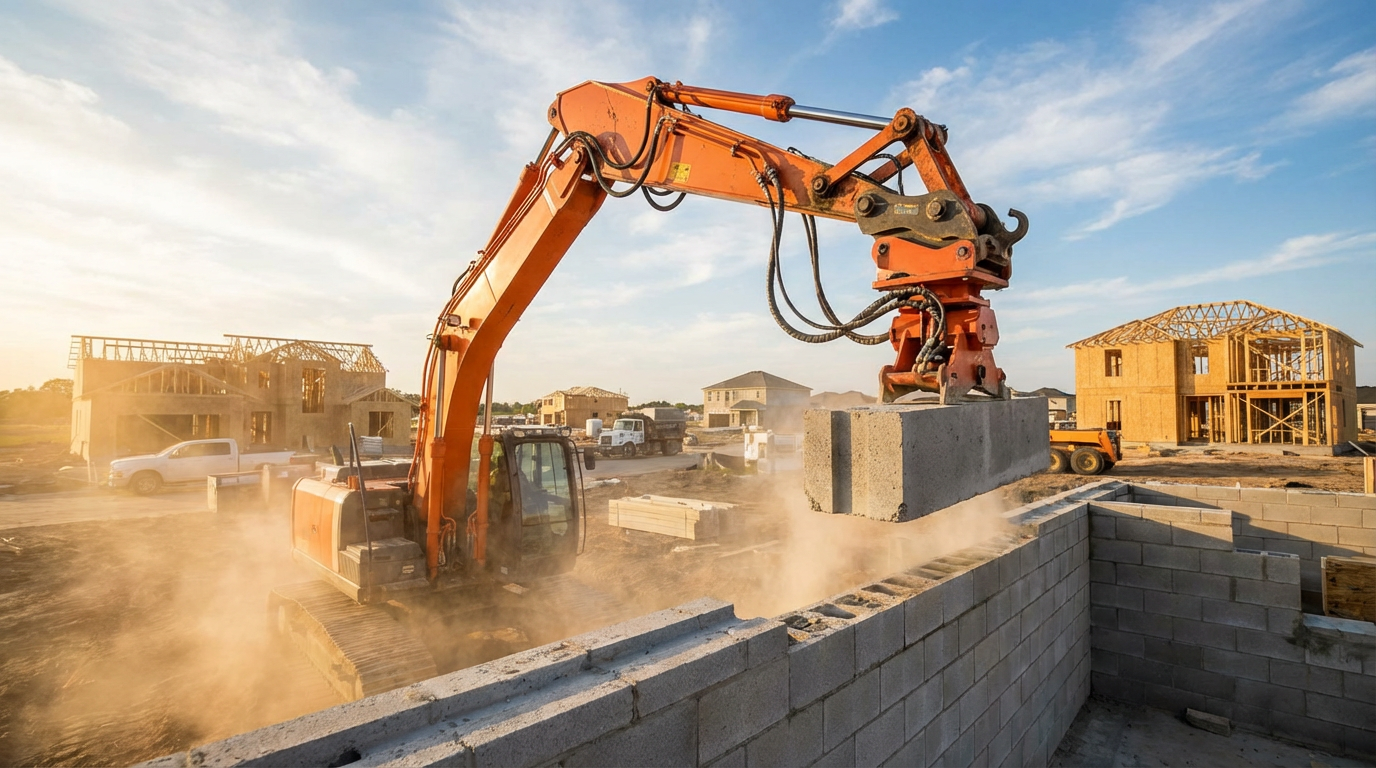
Last September, a 30-meter robotic arm mounted on a truck rolled onto a residential lot somewhere in the United States and built the walls of a house. Not a demo wall. Not a lab prototype. A full, code-compliant home, certified to local building standards, built in partnership with CRH Ventures — one of the world’s largest building materials companies. The machine was FBR’s Hadrian X, and it lays blocks at a pace that makes human bricklayers look like they’re working in slow motion.
How It Actually Works
The Hadrian X isn’t a humanoid robot pretending to be a bricklayer. It’s a 30-meter telescopic boom mounted on a truck chassis, guided by a proprietary system FBR calls Dynamic Stabilisation Technology (DST). The boom compensates for wind, vibration, and its own flex in real time, placing blocks with millimeter accuracy even at full extension.
Blocks are fed through the boom on a conveyor system. Adhesive is applied automatically — no mortar, no trowels, no mixing. The machine reads a 3D CAD model of the house and translates it directly into block placement sequences. Window openings, door frames, electrical conduit channels, plumbing chases — all accounted for in the digital model before the first block is placed.
“If it can’t survive a job site, it doesn’t belong on one. The Hadrian X was designed for Australian heat, American humidity, and the general chaos of residential construction. It’s not a lab toy.”
The Numbers That Matter
A skilled bricklayer in the US lays roughly 300–500 bricks per day — about 40–60 per hour during productive time. The Hadrian X lays 360 large-format blocks per hour, each one significantly bigger than a standard brick. In volumetric terms, one Hadrian X replaces a crew of 4–6 masons working a full shift.
But speed isn’t the whole story. The construction industry has been hemorrhaging skilled tradespeople for years. The US is short an estimated 500,000 construction workers right now. The median age of a bricklayer is 42 and climbing. Young workers aren’t entering the trade at anywhere near replacement rates. Hadrian X doesn’t solve the shortage — it sidesteps it entirely.
From Australia to America
FBR is an Australian company, publicly traded on the ASX, and the Hadrian X has been building homes in Perth since 2023. The US Demonstration Program with CRH Ventures, completed in September 2024, was the first international deployment. The walls passed all relevant US building code inspections — a critical milestone for commercial viability.
The company isn’t alone. Construction Robotics in New York builds the SAM100 (Semi-Automated Mason), which works alongside human masons rather than replacing them. Okibo in Israel makes a tiling robot. Canvas (acquired by Dusty Robotics) automates drywall finishing. But FBR’s Hadrian X is the only system that builds entire wall structures autonomously from a digital model.
What This Means for Your Home
Don’t expect a robot to build your house next year. FBR is still scaling from demonstration to commercial deployment, and the Hadrian X works best with large-format blocks — not every home design is compatible. But the trajectory is clear: the construction robotics market is projected to reach $426 million by 2030, growing at over 15% annually.
When robotic construction goes mainstream, expect three things: faster build times (wall framing in days, not weeks), more consistent quality (millimeter precision beats human variability), and — eventually — lower costs as the labor premium disappears from the most physically demanding trades.
The bricklayer isn’t obsolete yet. But the 30-meter arm on the truck is patient, and it doesn’t take lunch breaks.