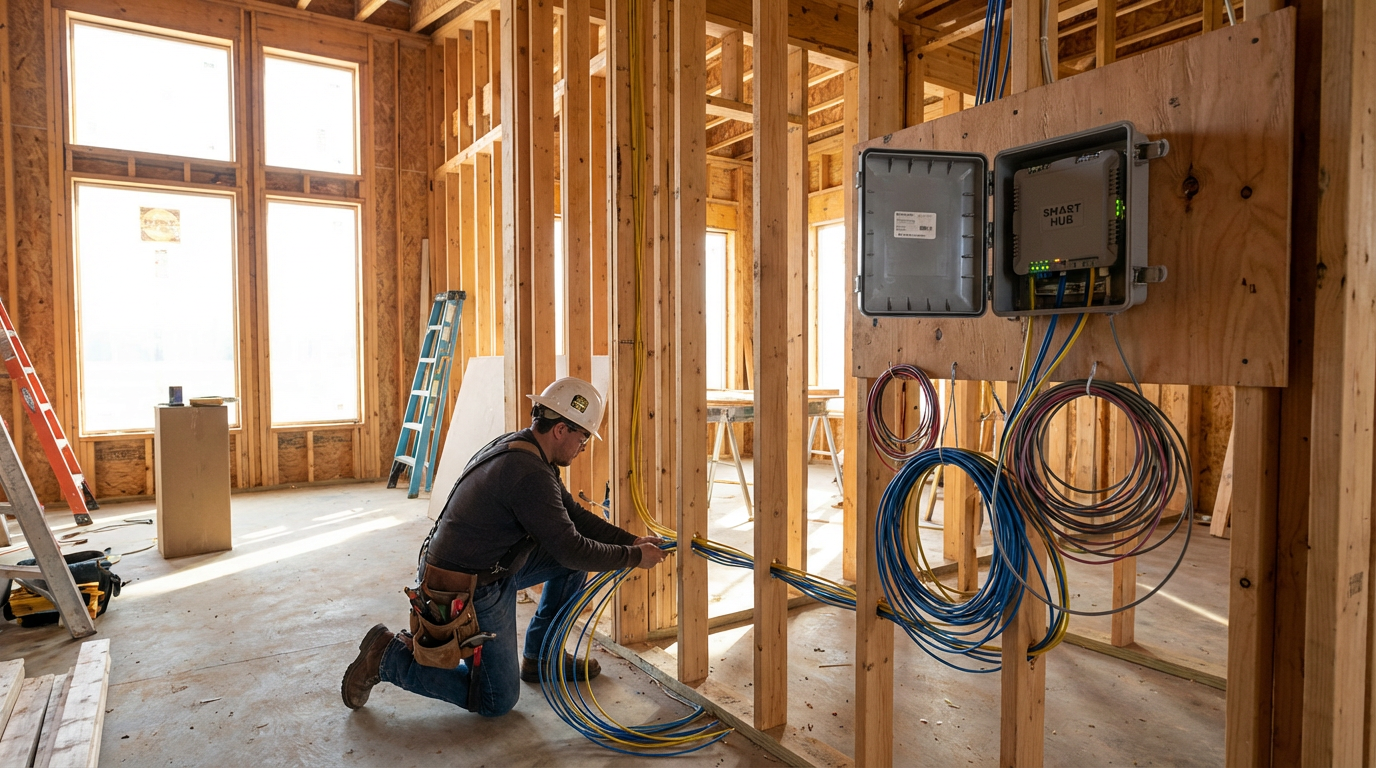
Here’s a number that should haunt every builder who skips the “smart home” line item: pre-wiring a new home during framing costs $2,000–$5,000. Retrofitting that same infrastructure into finished walls? $15,000–$25,000. I’ve watched electricians fish Cat6 cable through a finished ceiling for four hours to cover a distance that takes ten minutes with open studs. The drywall doesn’t care about your timeline.
The global smart home market hit $232.4 billion in 2026, and 63% of new construction projects now incorporate some form of automation from the ground up. This isn’t about Alexa turning on your lights anymore. It’s about building homes that are genuinely intelligent — and the window to do it cheaply closes the moment the drywall goes up.
The Matter Protocol Changed Everything
For years, the smart home was a compatibility nightmare. Zigbee devices couldn’t talk to Z-Wave. Apple HomeKit ignored Google Home. Every ecosystem was a walled garden, and builders were terrified of picking the wrong one.
Matter, the universal smart home protocol backed by Apple, Google, Amazon, and Samsung, solved this. Launched in late 2022 and now supported by over 1,000 certified devices, Matter means a builder can install infrastructure without committing to a specific ecosystem. The homeowner picks their platform later. For builders, this eliminated the single biggest objection to pre-wiring: “What if the buyer uses something different?”
Thread — Matter’s mesh networking layer — means smart devices form their own low-power network through the house. But Thread still needs ethernet backhaul to border routers, which means you still need Cat6A in the walls. The wireless future runs on wired backbone.
What to Run During Framing
Based on what I’m seeing on job sites and what the data supports, here’s the minimum smart-home rough-in for a 2026 new build:
Cat6A ethernet to every room. Not Cat5e. Cat6A supports 10 Gbps and Power over Ethernet (PoE), which powers wireless access points, cameras, and smart displays without separate electrical runs. Run two drops per room — one for a device, one spare. A 2,500 sq ft home needs roughly 24–30 drops at about $150–$200 per run.
Ceiling drops for wireless access points. One per floor, centered. These replace consumer routers and give whole-home Wi-Fi 6E/7 coverage. Enterprise-grade APs from Ubiquiti or TP-Link Omada run on PoE — no outlet needed if you pulled Cat6A.
Conduit to exterior corners for cameras. Four corners plus the front door and garage. Run 1” conduit with a pull string — even if you don’t install cameras now, the pathway is there. PoE cameras are one cable, power and data.
A dedicated structured media panel. A 42” structured media enclosure in a utility closet where all cables terminate. This is your home’s nervous system — network switch, patch panel, fiber ONT, UPS battery backup. Budget $500–$800 for the panel and gear.
“If it can’t survive a job site, it doesn’t belong on one. But Cat6A in conduit? That’s infrastructure that outlasts the house.”
AI Is Making Pre-Wire Smarter
Here’s where it gets interesting. Tools like Josh.ai and Savant now use AI to learn occupant patterns — adjusting HVAC, lighting, and shading based on actual behavior, not static schedules. Josh.ai’s natural language processing understands commands like “make it feel like a movie night” and coordinates a dozen systems simultaneously.
Crestron Home OS is deploying predictive AI that pre-conditions rooms based on calendar events and historical occupancy. The system learns that you arrive home at 5:47 PM on Tuesdays and starts cooling the house at 5:30. Over a year, AI-driven HVAC optimization delivers 15–25% energy savings — on a $3,000/year utility bill, that’s $450–$750 annually, compounding forever.
The ROI Case for Builders
Smart home integration isn’t just a buyer amenity — it’s a competitive differentiator. Homes with integrated smart systems sell 20–30 days faster and command a 3–7% price premium, with luxury properties seeing up to 11% above comparable traditional homes. On a $500,000 house, that’s $15,000–$35,000 in added value from a $3,000–$5,000 investment during construction.
The energy management angle is equally compelling. A $5,000–$10,000 smart energy system — AI-managed thermostat, automated shading, solar integration, smart water heater — pays for itself in 3–5 years through reduced utility costs. After that, it’s pure savings.
The builders who are winning bids in 2026 aren’t the cheapest. They’re the ones who hand the buyer a structured media panel in the closet and say, “Your house is ready for whatever comes next.” Because in ten years, a home without smart infrastructure will feel as dated as one without ethernet — and just as expensive to fix.