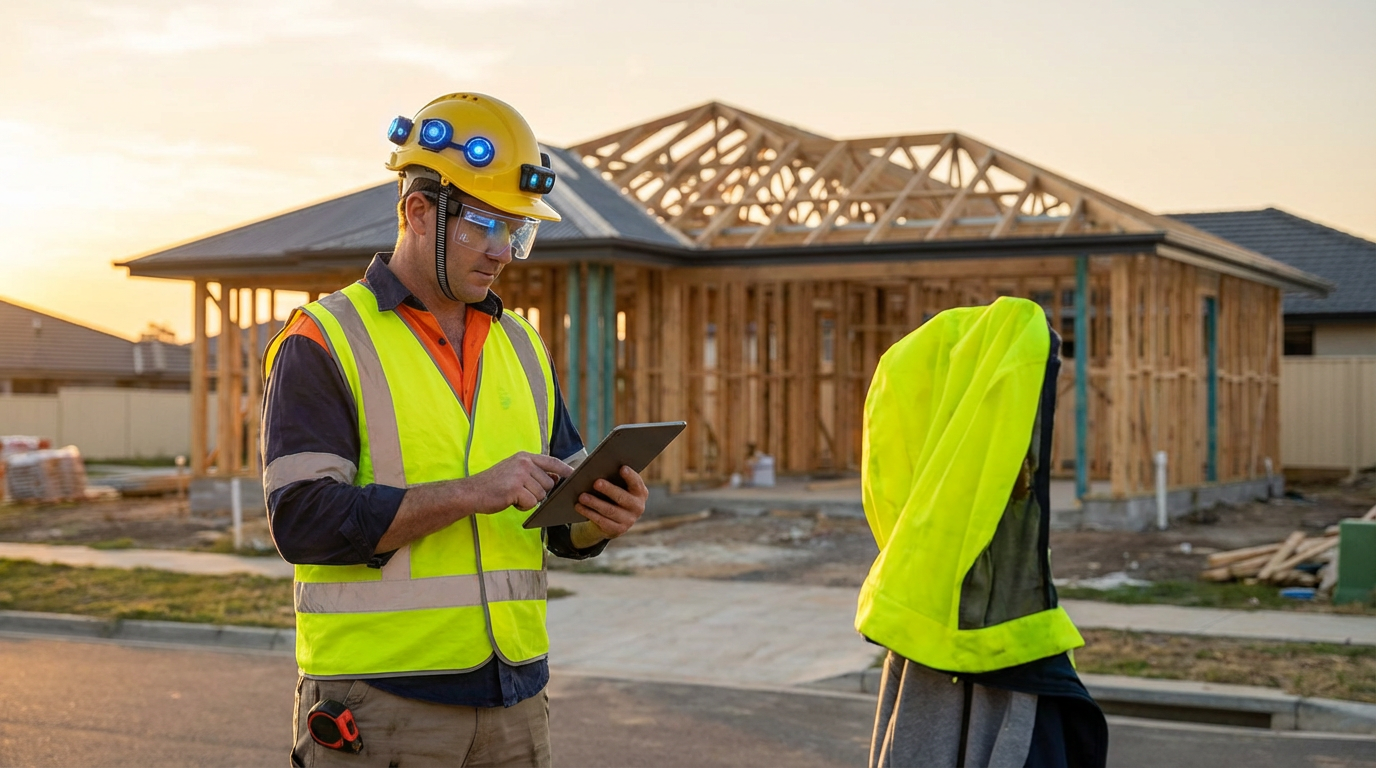
Eddie Reyes collapsed on a roof deck in Tempe, Arizona last August. Heat index of 118°F. His foreman noticed four minutes later, when another crew member tripped over his legs. By the time the ambulance arrived, Eddie had been unconscious for eleven minutes. He lived. Barely.
A $3 sensor clipped to his hard hat would have flagged his core temperature two degrees before he went down.
That sensor exists. It ships in volume. Almost nobody building houses uses it.
The Numbers That Don’t Change
The Bureau of Labor Statistics reported 1,034 construction deaths in 2024—41 fewer than 2023, which BLS apparently considers progress. The fatality rate dipped to 9.2 per 100,000 full-time workers, the lowest since 2011. Falls, slips, and trips killed 389—38% of the total, the leading cause for as long as anyone has tracked it.
Workplace injuries cost the industry $170 billion annually. The average injury claim runs $41,000. Fatal accidents exceed $1.2 million in total costs. OSHA estimates indirect costs—insurance premiums, lost productivity, replacement hiring, legal fees—run four to ten times higher than the direct bill.
These numbers have barely moved in a decade. The hard hat sitting on most residential sites is fundamentally the same polyethylene shell that MSA patented in 1953.
What’s Actually Shipping
| Product | What It Does | Cost |
|---|---|---|
| WakeCap | Solar-powered helmet sensor: real-time location, fall detection, heat stress, geofencing | ~$1/worker/day |
| Triax Spot-r | Belt-clip sensor: location tracking, fall detection, automated muster, evacuation alerts | ~$2/worker/day |
| Kenzen | Wristband: continuous core body temp, heart rate, sweat rate, personalized heat alerts | ~$500/device + subscription |
| Soter Analytics | Clip-on sensor: spinal motion tracking, real-time posture coaching, injury risk scoring | Subscription model |
| Hilti EXO-01 | Passive upper-body exoskeleton: reduces shoulder fatigue 47% on overhead work | ~$3,500 |
WakeCap raised $28 million in May 2025 to scale globally. Their sensor clips onto any standard hard hat, charges itself with a solar cell the size of a quarter, and runs for the life of the helmet. Under a dollar a day per worker. It tracks location to within three meters, detects falls within two seconds, and flags heat stress before the worker feels it. The company processes data from construction sites across the Middle East, Europe, and North America.
Triax deploys on some of the largest commercial sites in the U.S.—hospitals, data centers, infrastructure projects. Their Spot-r system automatically takes roll during evacuations. If you’re in the hole and can’t get to the muster point, the system knows.
Kenzen went deep on heat. Their wristband doesn’t just measure skin temperature—it models core body temperature using a combination of heart rate, skin conductivity, ambient conditions, and the worker’s own physiological baseline. Different bodies overheat differently. Kenzen learns yours. A 27% reduction in workplace incidents is the number the industry keeps citing for wearable adoption broadly, per Build-News aggregated data.
Where It Works and Where It Doesn’t
Big commercial sites are buying in. Turner Construction, Skanska, Suffolk—they have safety directors with budgets, insurance carriers demanding data, and OSHA citation histories that make wearable ROI easy math. A single prevented fall saves the $41,000 average claim. At a dollar a day per worker, the break-even is measured in weeks.
Residential? Almost nothing.
My uncle ran framing crews out of Bowie, Maryland for 22 years. Six guys, sometimes eight. No safety director. No insurance carrier calling about incident data. His safety program was “don’t be stupid” and a laminated OSHA poster in the trailer that hadn’t been updated since the Obama administration.
He’s not unusual. Most residential builders in America are firms with fewer than 20 employees. They don’t have IT departments. They don’t have dashboards. The idea of managing a fleet of IoT sensors on a five-person roofing crew is, to put it gently, disconnected from how those crews actually operate.
The Residential Gap Is a Product Problem, Not a Safety Problem
The crews care about safety. The products don’t care about the crews.
Every wearable on the market is designed for commercial deployment: site-wide mesh networks, centralized dashboards, fleet management consoles, API integrations with project management software. WakeCap’s pitch deck starts with “enterprise-grade project controls.” Kenzen sells annual per-seat licenses. Triax needs base stations installed across the site.
A roofer in Fresno doing four houses a month doesn’t need project controls. He needs something that clips on, beeps when someone’s about to fall or pass out, and doesn’t require a login.
That product doesn’t quite exist yet. But the components are absurdly cheap. The MEMS accelerometer that detects falls costs $0.40 in volume. A thermistor for skin temperature is $0.15. Bluetooth Low Energy chips run $0.80. The total bill of materials for a clip-on fall-and-heat detector is under $5. The smart PPE market hit $5.39 billion in 2026 at a 16.2% growth rate, according to The Business Research Company. Eventually, the price will drop low enough that even a five-person crew can justify it.
What a Smart Residential Job Site Looks Like
Not much different from a dumb one, honestly. Same trucks. Same lumber. Same guys arguing about where to put the cooler.
The difference is invisible. The foreman’s phone buzzes when the new guy’s heart rate has been above 160 for six minutes. The clip-on sensor screams when it detects a 15-foot freefall. The system logs that everyone left the site by 5:30, so when the homeowner calls at 7 AM claiming someone was there at midnight, the data says otherwise.
Nobody has to look at a dashboard. Nobody has to manage anything. The system runs in the background like a seatbelt—something you forget about until the one time it matters.
We’re not there yet. But the pieces are all on the table, priced low enough that the only thing missing is someone willing to assemble them for the small builder instead of the enterprise buyer.
Eddie Reyes went back to work six weeks after his heat collapse. Same crew, same site. No sensor on his hard hat. I asked his foreman why not. “Nobody sells them to us,” he said. “They sell them to Skanska.”
Sources
- Bureau of Labor Statistics, Census of Fatal Occupational Injuries 2024 — via Construction Dive (Feb 2026). 1,034 deaths, 9.2/100K rate, 389 fall deaths.
- Build-News, “Smart Wearables Revolutionize Construction Site Safety” (July 2025). $170B annual injury costs, $41K average claim, 27% incident reduction with wearables.
- HAX, “WakeCap Raises $28M Series A” (May 2025). Solar-powered helmet sensors, <$1/worker/day, global construction deployment.
- OTB Ventures, “Soter Analytics Raises $12 Million”. Spinal motion tracking, ergonomic coaching, musculoskeletal injury prevention.
- The Business Research Company, Smart PPE Market Report 2026. $5.39B market size, 16.2% CAGR, $4.64B in 2025.
- Construction Junkie, “Hilti EXO-01 Exoskeleton”. Passive exoskeleton for overhead work, ~$3,500, 47% shoulder fatigue reduction.
- ABC SoCal, “Wearable Construction Technology”. Overview of construction wearable categories and adoption trends.
- OSHA indirect cost multiplier: 4–10× direct costs of workplace injuries (OSHA Safety Pays program methodology).