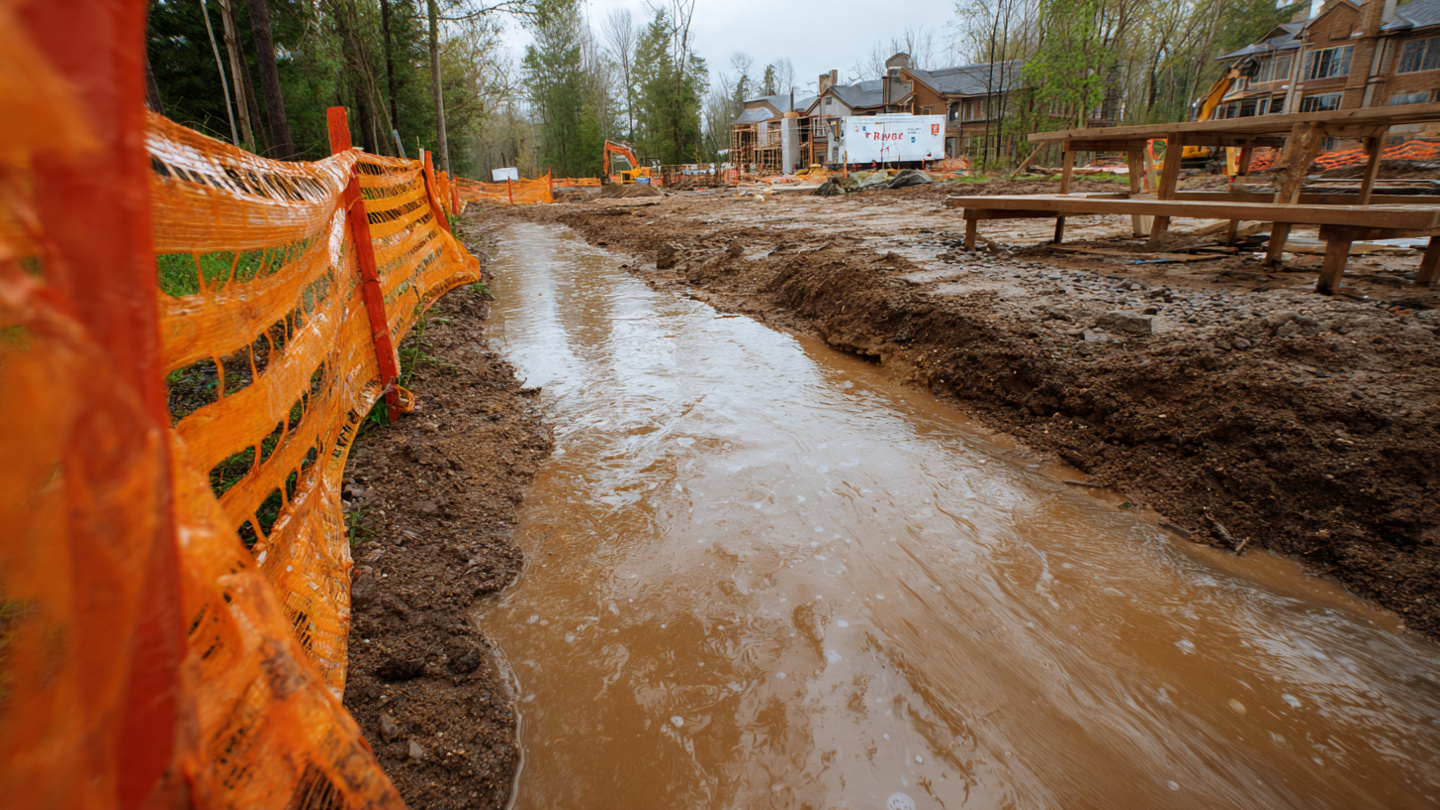
Toll Brothers paid $741,000 in 2012 because its construction sites were bleeding sediment into the Chesapeake Bay watershed. The DOJ complaint documented over 600 stormwater violations across residential sites in multiple states, discovered through EPA inspections that found silt fencing trampled flat, sediment basins overflowing, and Stormwater Pollution Prevention Plans that existed on paper but not on the ground. Four years earlier, four of the nation's largest homebuilders had collectively paid $4.3 million in a national settlement covering 34 states. These were not small operators cutting corners. These were publicly traded companies with legal departments, compliance officers, and environmental health and safety teams whose specific job was to prevent exactly the kind of failures that EPA's inspectors documented at site after site after site, and their stormwater programs still failed.
Since then, the penalty per violation has nearly tripled. Per day.
That is not a theoretical number. EPA completed 2,127 civil enforcement cases in fiscal year 2025, the highest count in nine years, assessing over $650 million in total penalties across all environmental statutes. Clean Water Act violations, including construction stormwater, remain a significant enforcement category, and the question for residential builders is not whether enforcement happens but whether the binder in the job trailer will survive scrutiny when it does.
How Bad Construction Runoff Actually Is
According to EPA's own fact sheet on construction site runoff, sediment discharge from active construction is 10 to 20 times greater than from agricultural land and 1,000 to 2,000 times greater than from forested land. During a short construction window, a single site can dump more sediment into a stream than decades of natural deposition would produce. That is not a metaphor. EPA measured it. A single residential subdivision during active grading can discharge sediment loads that would take decades of undisturbed natural erosion to match, and nobody bothers to quantify the actual discharge because the permit system relies on Best Management Practices rather than effluent monitoring.
Every residential project that disturbs one acre or more of land needs coverage under a National Pollutant Discharge Elimination System permit, which means filing a Stormwater Pollution Prevention Plan with the permitting authority, installing erosion and sediment controls before breaking ground, inspecting those controls after every qualifying rain event and at regular intervals, maintaining inspection logs, and modifying the plan when conditions change. The permit requires all of this, and the question, as always in environmental compliance, is who checks.
What a SWPPP Requires and What Actually Happens
A properly maintained SWPPP is a living document. It identifies every potential pollutant source on the site, specifies Best Management Practices for each, establishes an inspection schedule, tracks corrective actions, logs precipitation events, and gets updated when the site changes. Silt fence goes up before grading, inlet protection covers every storm drain, and stabilized construction entrances prevent trucks from tracking mud onto public roads. Stabilized construction entrances prevent trucks from tracking mud onto public roads. After every rainfall of half an inch or more, someone walks the site, photographs the controls, notes deficiencies, logs corrective actions with deadlines, and signs the inspection form.
On a 40-lot residential subdivision, that means inspecting silt fencing along every active lot perimeter, checking sediment basins and their outlet structures, verifying that concrete washout areas have not overflowed, confirming that stockpile covers are intact, and doing it all again after the next storm. Multiply that across a superintendent managing three or four active phases simultaneously, and the inspection paperwork becomes the thing that gets done last, filled out from memory in the trailer on Friday afternoon, backdated to the rain event that happened Tuesday, and filed in a binder that nobody looks at until a regulator arrives.
I am not speculating. Ask any construction stormwater inspector at a regional water board how often they find inspection logs that are complete, current, and match the actual site conditions they observe, and the answer, invariably, is that the logs trail reality by days or weeks, the corrective actions listed as "completed" often are not, and the site map in the binder shows a phase of construction that ended two months ago.
The Real Cost of a Violation
Penalty math runs in two directions, and builders usually only consider the visible one: the fine itself. At $68,445 per day per violation, a two-week enforcement action on a single deficiency category generates $958,230 in potential penalty exposure before any negotiation. Each concurrent violation multiplies the daily count, and a site with four deficiency categories running for two weeks generates exposure that exceeds the annual profit of most residential projects. Toll Brothers resolved 600+ violations for $741,000, which works out to roughly $1,235 per violation, a negotiated outcome that reflects cooperation, good-faith remediation, and the government's interest in settlement efficiency rather than maximum extraction.
The invisible cost, and the one that actually terrifies a project manager, is the stop-work order. When a permitting authority issues a stop-work for stormwater non-compliance, every trade on site goes home. Framers, electricians, plumbers, roofers, concrete crews. Gone. while the violation gets corrected, the agency reinspects, and the order lifts. A residential project carrying $12,000 to $18,000 per week in overhead, financing, and subcontractor delay costs can burn $25,000 to $36,000 during a two-week stop-work. Add the fine and you are looking at $30,000 to $50,000 in total exposure from a single stormwater incident on a single project, which is roughly the profit margin on one or two entry-level homes in many markets.
What Digital Compliance Tools Actually Do
The stormwater compliance software market has matured quietly while residential builders were not paying attention. Quietly. SW2 provides digital SWPPP inspection forms that inspectors complete on mobile devices in the field, with automated NOAA weather data synced to each project site, real-time map updates connected to inspection findings, corrective action tracking that stays visible until closed, and one-click report generation with a complete audit trail. Procore integrates SWPPP inspection templates into its project management platform, so stormwater checks live alongside RFIs and submittals instead of in a separate binder. Esri's Stormwater Construction Activity Management solution uses GIS-based site mapping tied directly to inspection workflows.
None of these tools are AI in the way a press release would define it, because they are not training neural networks on sediment transport models or generating novel stormwater engineering solutions from first principles. What they do is eliminate the failure modes that cause most violations: inspections that are late, incomplete, or fabricated; corrective actions that are documented but never verified; precipitation events that nobody noticed triggered an inspection requirement; and site maps that have not been updated since the first phase of grading finished three months ago.
An Original Cost Calculation
Comparable construction compliance SaaS platforms price between $200 and $500 per month per project, depending on the number of active sites and user seats. For a 40-lot subdivision with an 18-month build cycle, that totals $3,600 to $9,000 for the full project duration. Midpoint: $6,300.
One day of Clean Water Act violation: $68,445. That single-day penalty covers the compliance software cost for the entire project between 7 and 19 times over, which means one avoided violation day per project pays for the platform's annual subscription multiple times, a ratio that in any other line-item review would be approved before the meeting ended. But the penalty comparison understates the real math because it assumes the builder gets caught. The more useful comparison is against the stop-work scenario: $25,000 to $36,000 in project delay costs from a two-week stop-work, plus the fine, versus $350 per month for software that keeps the inspection trail current, the corrective actions tracked, and the documentation audit-ready.
Inputs and assumptions for this calculation: software pricing is estimated from comparable construction compliance SaaS products, as SW2 and Esri do not publish per-seat pricing publicly. Project overhead of $12,000 to $18,000 per week is based on industry estimates for a mid-size residential subdivision including financing carry costs, site supervision, insurance, and subcontractor mobilization/demobilization charges. The $68,445 maximum daily penalty is from EPA's January 2025 inflation adjustment published at 90 FR 2544.
What Washington State Is Doing Next
While EPA's federal Construction General Permit governs sites in jurisdictions where the agency is the direct permitting authority, 46 states administer their own NPDES construction stormwater programs, and some are materially stricter than the federal baseline. Washington State's Department of Ecology held public hearings in April 2025 on its 2026 Construction Stormwater General Permit reissuance. Separately, EPA proposed a modification to the federal CGP to expand the list of areas eligible for coverage, and the proposed 2026 Multi-Sector General Permit introduces climate-forward requirements: stormwater control measures must now be designed using "best available data," defined to include forward-looking flood projections rather than historical records alone. Build for the 100-year flood using current conditions, not the ones your engineer modeled in 2019.
For residential builders, this means the compliance target is moving, and a SWPPP designed around historical rainfall data may not satisfy a permit that requires forward-looking climate projections, which means updating those plans manually at engineering rates of $150 to $250 per hour. Platforms that integrate NOAA data automatically and flag when precipitation patterns exceed design assumptions start looking less like overhead and more like infrastructure.
Against This Article
The strongest objection is the simplest: EPA does not commonly target small residential builders. The headline enforcement cases involve publicly traded production builders with hundreds of active sites. A custom builder running two or three infill lots per year in a suburban jurisdiction is far more likely to encounter a local municipal stormwater inspector than an EPA enforcement officer, and many local programs are underfunded, understaffed, and rarely issue penalties that approach federal maximums. For a small builder, the realistic penalty exposure may be a $500 municipal fine and a notice to correct, not $68,445 per day.
That is largely true. Federal enforcement concentrates on large operators where the environmental impact is greatest and the deterrent value is highest, which means the Toll Brothers and Lenhars of the world absorb the headline penalties while thousands of smaller builders operate in a regulatory shadow where inspection frequency is measured in years, not months. But the regulatory trend matters more than the current enforcement posture, and that trend, visible in the proposed 2026 MSGP's climate-forward requirements, in state-level electronic reporting mandates, and in EPA's nine-year-high case count, runs unambiguously toward more monitoring, more data, and more accountability at every scale of construction activity. Several states now require electronic submittal of inspection records, which makes compliance auditing cheaper and non-compliance easier to detect. The paper binder in the job trailer may still work today, but it is becoming harder to defend as the regulatory infrastructure digitizes around it and enforcement agencies gain the capacity to audit electronically submitted records at a scale that paper never permitted.
What You Should Do Right Now
If you are a production builder with 20+ active lots: evaluate digital SWPPP compliance platforms against your current process. Measure time spent on stormwater inspections, corrective action tracking, and report generation. If your superintendents spend more than two hours per week per project on stormwater paperwork, a $300/month platform probably pays for itself in labor savings alone, before you factor in enforcement risk. Run a pilot on one subdivision, compare inspection completion rates and corrective action closure times against your paper-based sites, and let the data decide.
If you are a small custom builder: the $300/month platform may not justify itself at two or three sites. But at minimum, set up automated weather alerts for your project ZIP codes so you know when a qualifying rainfall event triggers an inspection requirement. NOAA and Weather Underground both offer free precipitation alerts. Document every inspection with timestamped photos. Keep your SWPPP updated when the site changes. The cost of this is zero dollars and 15 minutes per rain event, and the cost of getting caught without it is your next project's margin.
If you are a stormwater consultant: the builders who cannot justify SaaS platforms are your clients. Offer inspection-as-a-service on a per-rain-event basis at $150 to $250 per visit. A 40-lot subdivision with 30 qualifying rain events per year represents $4,500 to $7,500 in annual revenue per project. You bring the expertise and the audit trail. The builder gets compliant documentation without adding headcount.
What This Analysis Did Not Prove
No published study compares violation rates between construction sites using digital compliance tools and those using paper-based systems. My cost comparison relies on estimated SaaS pricing because SW2 and Esri do not publish per-project rates, and the actual cost for a specific builder depends on the number of users, sites, and features selected. EPA enforcement statistics do not disaggregate residential construction from commercial and heavy civil, so the residential-specific violation rate cannot be calculated from public data. Stop-work order duration and cost estimates are based on industry conventions rather than a specific dataset. And the forward-looking climate requirements in the proposed 2026 MSGP apply to industrial stormwater, not directly to the construction general permit, though state programs often follow the federal lead in tightening climate-related design standards.
Sources
- DOJ (June 2012). "Homebuilder Toll Brothers Inc. to Pay $741,000 Clean Water Act Penalty." 600+ violations at residential construction sites, Chesapeake Bay watershed
- EPA (June 2008). "Home Builders to Pay $4.3M in National Settlement Over Construction Site Storm Water Permit Issues in 34 States."
- EPA FY2025 Civil Enforcement Annual Results. 2,127 cases (9-year high), $650M+ in penalties
- Crowell & Moring (Jan 2025). "EPA Increases Fines for Civil Non-Compliance." CWA penalty: $68,445/day/violation, effective Jan 8, 2025, per 90 FR 2544
- EPA Fact Sheet on Construction Site Runoff Control. Sediment rates 10-20x agricultural, 1,000-2,000x forest land
- Clean Water Act Section 309. Federal enforcement authority, civil penalty provisions
- Beveridge & Diamond (Dec 2024). "EPA Proposes Updated General Clean Water Act Industrial and Construction Permits." 2026 MSGP climate provisions, CGP modification
- Washington Stormwater Center (April 2025). "2026 Construction Stormwater General Permit Presentation Recap."
- SW2 Stormwater Compliance Software. Digital SWPPP inspections, automated weather integration, audit trail
- Procore SWPPP Inspection Template.
- Esri (2024). "Stormwater Construction Activity Management Solution." GIS-based inspection workflow