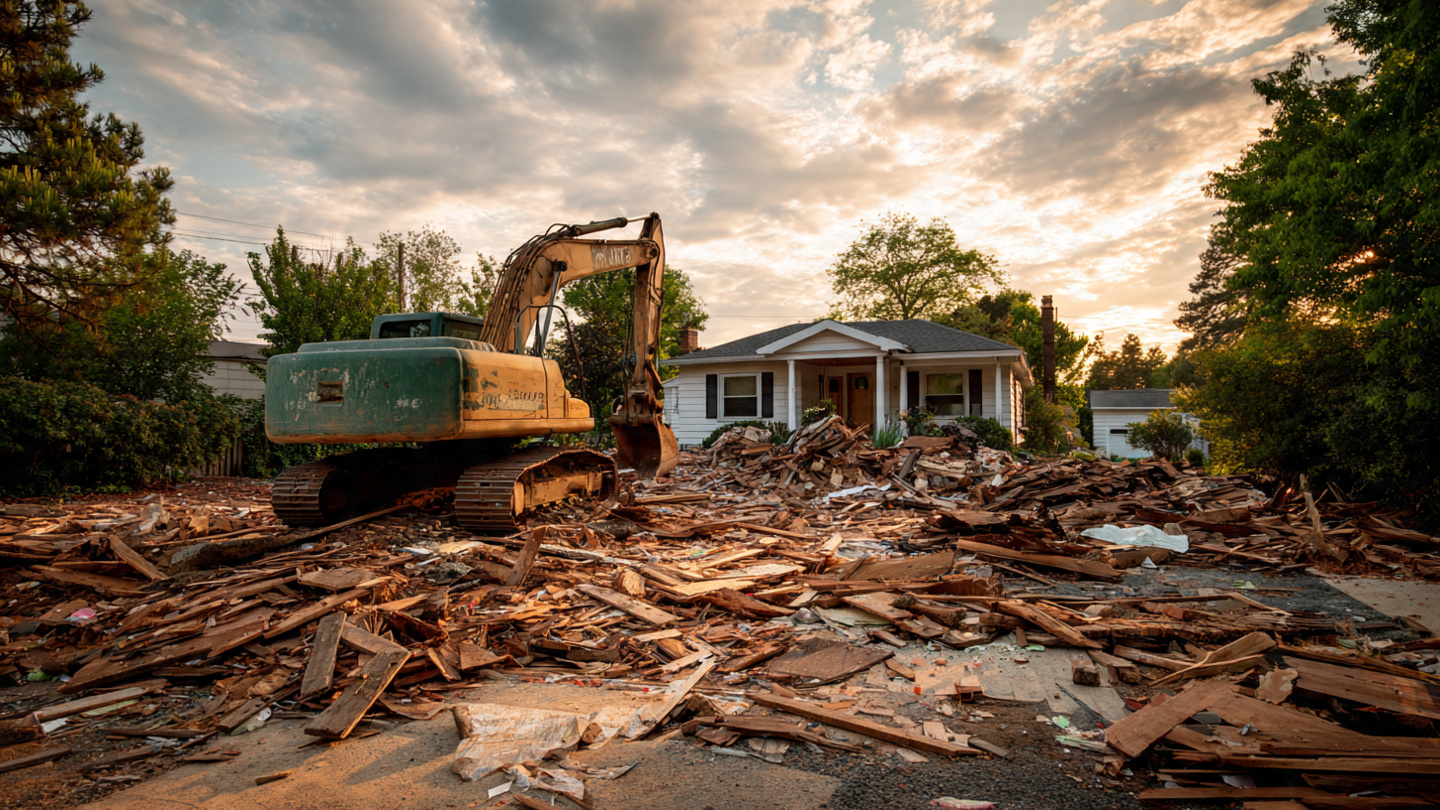
A couple in Palo Alto bought a 1,760-square-foot 1972 ranch last spring for $2.8 million. They gutted it mentally before escrow closed. Their plan: demolish, build a 2,400-square-foot all-electric home with triple-pane windows, a 9.6 kW solar array, a heat pump, and enough insulation to hit a HERS score under 40, their vision of sustainable living assembled from a blank slab.
Demolition alone produced 94 tons of debris, roughly 38% of which went to landfill. That was day one. A concrete truck that poured their new foundation burned 120 gallons of diesel in a single day, and the structural steel framing their second story traveled 1,400 miles from a mill in Arkansas before a crane set it. By the time they hung drywall, their home had released an estimated 52 metric tons of CO2-equivalent into the atmosphere, and nobody inside it had yet flipped on a light switch.
They could have retrofitted the existing ranch instead, preserving the structure that already paid its carbon debt half a century ago. New insulation blown into the walls, a heat pump replacing the gas furnace, upgraded double-pane windows throughout, and a solar array on the existing roof, the kind of renovation that any decent energy auditor can scope in a single afternoon and a qualified contractor can execute in six to eight weeks without touching the foundation or the framing. Total embodied carbon of that retrofit approach: roughly 12 metric tons of CO2-equivalent. Forty fewer tons of CO2 sitting in the atmosphere before a single kilowatt-hour of operational savings begins to accumulate.
The Payback Period Nobody Calculates
Embodied carbon is the emissions baked into materials and construction before a building operates. For a typical new US single-family home, peer-reviewed estimates cluster between 250 and 400 kgCO2e per square meter of floor area. At 300 kgCO2e/m2 for the Palo Alto build, the new home carries roughly 67 metric tons of upfront carbon (2,400 sq ft = 223 m2). Add the 10-12 metric tons from demolition equipment, hauling, and landfill decomposition of the old structure, and you reach about 78 metric tons total.
A deep energy retrofit of the ranch would embed approximately 12-18 metric tons: spray foam insulation, replacement windows, a cold-climate heat pump, electrical panel upgrade, and rooftop solar. Both scenarios achieve comparable operational performance after completion, around 25-35 MMBtu per year for heating, cooling, hot water, and appliances, with a gap between them smaller than most homeowners would expect. Marginally, the new build is tighter, with an achievable ACH50 of 1.5 versus perhaps 3.0 for the retrofit, translating to maybe 1.0-1.5 metric tons per year of additional operational savings.
Run the numbers. The teardown route dumps an extra 60 metric tons of CO2e into the atmosphere compared to the retrofit. At 1.0-1.5 extra tons of operational savings per year, the new construction needs 40 to 60 years to erase its carbon advantage over the renovation it replaced, and that assumes a static grid. As California's electricity supply decarbonizes, operational emissions fall for both buildings, which means each year of savings is worth less carbon than the year before, which means the actual payback stretches even longer, potentially past the building's own useful life.
Why Teardowns Keep Climbing Anyway
Residential demolition permits in 2025 ran 34.2% above 2018 levels, according to NAHB analysis of Construction Monitor data. California led the nation at 13.3% of all demolition permits, followed by New Jersey at 10.4%, two states where land values dwarf improvement values so thoroughly that the structure on the lot is an accounting line item to be cleared, not an asset to be preserved. The driver is not sustainability but land value: in coastal California markets where the lot costs four times the improvement, tearing down and rebuilding is a financial decision that happens to wear a green label.
Nobody is lying when they call the replacement home "high-performance." It genuinely is. The R-values are higher, the envelope is tighter, the systems are electric. But that framing hides the real question.
High-performance relative to what it replaced is not the same as low-carbon relative to what it displaced, and conflating the two has become a comfortable industry habit that lifecycle analysis tools are now making impossible to sustain.
AI Is Finally Making the Invisible Visible
Until recently, nobody calculated teardown carbon because the tools did not exist at the residential scale. Commercial LCA software like One Click LCA starts at enterprise pricing and requires BIM models most custom home architects do not produce. The free EC3 calculator from Building Transparency handles material-level comparisons but not whole-building lifecycle scenarios, and even if it did, the homeowner standing in her 1972 kitchen trying to decide between a $120,000 renovation and a $900,000 teardown-rebuild is not going to open a carbon database and run the numbers herself, which is precisely the gap that automated tools need to close.
That changed in March 2026, when researchers at the University of Bath published the first AI tool that predicts embodied carbon from plain-language building descriptions, requiring no BIM file and no material takeoff spreadsheet. Describe your project in a paragraph, specify the dimensions, name the major materials, and the model outputs a credible carbon estimate in seconds. Tested with 43 building professionals on real projects, it correctly identified key materials 80% of the time and produced estimates consistent enough to rank buildings by carbon intensity. The tool was trained on 150,000 synthetic building profiles because real-world embodied carbon data remains catastrophically scarce, a limitation the researchers acknowledge openly (Oshidero et al., Architectural Engineering and Design Management, 2026; DOI: 10.1080/17452007.2026.2613773).
California is not waiting for the tools to mature. Assembly Bill 2446 directs CARB to build a framework for measuring and reducing embodied carbon in new buildings, with a target of 40% net GHG reduction by 2035. That framework will eventually require residential builders to account for the carbon baked into their materials. Teardown math gets awkward fast. When it does, the teardown premium will show up on paper, and it will be large, and it will be awkward for marketing departments that sold the demolition as the green option.
What You Should Do
If you own a pre-1990 home and want to go green: Get an energy audit before calling a demolition contractor. A deep energy retrofit (insulation, air sealing, heat pump, solar) typically costs $80,000-$150,000, reaches 50-70% energy reduction, and embeds one-quarter of the carbon that demolition and rebuilding would require. You keep your existing foundation, framing, and roof structure, all of which already paid their carbon debt decades ago, and none of which need to travel 1,400 miles from a steel mill or consume 120 gallons of diesel to pour, which is exactly the kind of unglamorous advantage that marketing departments never mention because it is hard to photograph a wall cavity that did not get demolished.
If teardown is the only option: Deconstruct rather than demolish. Selective deconstruction recovers 30-50% of materials by weight for reuse or recycling, and the IRS allows a charitable deduction for donated salvage. Budget an extra 5-15% over conventional demolition and recoup most of it in tax benefits. Specify low-carbon concrete (Portland Limestone Cement cuts 10% of concrete emissions at zero cost premium) and regionally sourced lumber for the new build.
If you are choosing between two listings: The renovated home with a heat pump and blown insulation may carry a lower lifetime carbon footprint than the brand-new net-zero home next door, even if its HERS score is 20 points worse. Ask for the embodied carbon story, not just the operating one.
Against My Own Argument
Some old homes genuinely cannot be saved: termite-compromised framing, slab foundations with no crawlspace access for insulation, asbestos tile throughout, or knob-and-tube wiring that makes deep electrification a rewire-the-entire-house proposition. In FEMA flood zones, renovations exceeding 50% of the structure's market value trigger substantial improvement rules that can require rebuilding to current flood elevation standards anyway, making retrofit physically indistinguishable from a teardown. And the operational gap between a retrofitted home at ACH50 of 3.0 and a new build at ACH50 of 1.0 is not trivial in extreme climates: in Minneapolis or Phoenix, that tightness difference compounds into meaningful energy savings year after year that my payback estimate, which uses California energy prices and carbon intensity, does not capture.
What This Analysis Did Not Prove
The embodied carbon figures used here are estimates. Nobody knows the exact number. No standardized, peer-reviewed database of US single-family residential embodied carbon exists at the building level, which is precisely why the Bath AI tool trained on synthetic data. The 300 kgCO2e/m2 figure represents a midpoint of published ranges that span 200-500 kgCO2e/m2 depending on materials, location, and methodology. Demolition emissions are even less standardized: the 10-12 metric ton estimate draws from equipment fuel consumption models and EPA C&D waste characterization, not direct measurement of residential teardowns. Grid carbon intensity varies by a factor of four across US regions, which swings the operational savings calculation substantially. The Palo Alto scenario would look quite different in West Virginia, where the grid is coal-heavy and operational savings are larger, potentially cutting the payback period to 15-20 years. None of this accounts for the social value of additional housing supply in constrained markets, where adding a bedroom through teardown-rebuild may deliver community benefits that carbon accounting alone does not capture.
Sources
- NAHB/Home Innovation Research Labs, Builder Practices Survey (2024 data). 6.9% of new SF homes are teardowns, 20.1% infill
- NAHB Economics, Aging Housing Stock Keeps Demolition Activity Elevated (March 2026). Demolition permits 34.2% above 2018 levels, California 13.3%, NJ 10.4%
- EPA, Sustainable Management of C&D Materials (2018 data). 600M tons C&D debris, 90% from demolition, 145M tons landfilled
- European Environment Agency, Building Renovation: Where Circular Economy and Climate Meet. 20-25% of building lifecycle emissions from embodied carbon
- RMI/Skanska, Reducing Embodied Carbon in Buildings (2021). 19-46% reductions at <1% cost premium
- Oshidero et al., Talking Carbon: A Lexical Approach to Predictive Embodied Carbon Analysis (2026). DOI: 10.1080/17452007.2026.2613773. AI tool predicts embodied carbon from text descriptions, 43 professionals tested
- CARB, California Embodied Carbon Framework (AB 2446). 40% GHG reduction target by 2035, embodied carbon up to 50% of building-related emissions