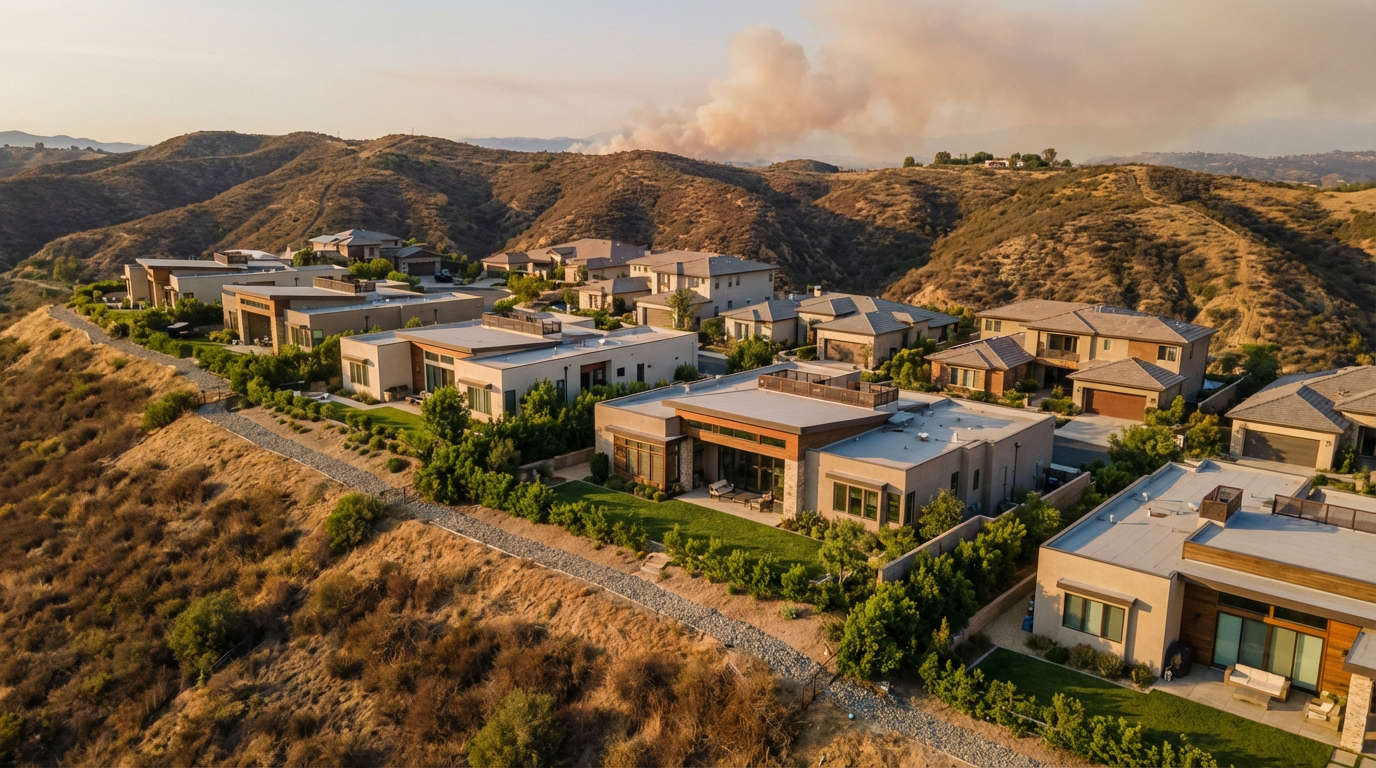
January 7, 2025. The Palisades fire jumped the 405 freeway and burned through Pacific Palisades in hours. The Eaton fire hit Altadena the same night. Combined: 37,400 acres, more than 15,000 structures destroyed or damaged, at least 32 people dead, and somewhere between $25 billion and $40 billion in insured losses.
The fires didn’t just destroy neighborhoods. They destroyed the fiction that wildfire is a rural problem.
The Map Nobody Had
ZestyAI’s 2025 wildfire analysis assessed every residential property in the country—126 million of them—using AI models trained on over 2,000 historical wildfires. The models ingested satellite imagery, aerial photos, topography, vegetation density, and structure-specific characteristics down to individual roof materials and vent types.
The finding that matters: 4.3 million homes face high wildfire risk. California leads with $1.16 trillion in exposed property value. But Colorado sits at $190.5 billion. Utah at $100.3 billion. North Carolina—not a state most people associate with wildfire—has $71.2 billion at risk and 4.6% of its homes in the high-risk category.
South Dakota. Eleven percent of homes.
Traditional risk models drew circles around forests and called it a day. AI models look at your specific house. Is the roof Class A rated? How far is the nearest vegetation from the exterior wall? What’s the slope grade behind the property? Are the eave vents ember-resistant? The answers to those questions determine whether embers ignite your attic or blow past it.
What Actually Saves a House
The Insurance Institute for Business & Home Safety updated its Wildfire Prepared Home standard in June 2025—the first revision since the program launched in 2022. The science is specific and unglamorous:
| Feature | Requirement | Why It Matters |
|---|---|---|
| Zone 0 (0–5 ft) | Noncombustible materials only | Where 90% of home ignitions start |
| Roof | Class A rated | Embers land on roofs first |
| Vents | ASTM E2886 ember-resistant | Attic ignition through soffit vents killed homes in Palisades |
| Eaves | Fully enclosed, noncombustible | Open eaves are ember funnels |
| Windows | Tempered glass minimum | Radiant heat shatters single-pane |
| Defensible space | Maintained 100 ft from structure | Reduces flame length approaching the home |
Two designation levels: base (ember protection) and plus (direct flame and radiant heat). Homeowners must resubmit annually—a three-year designation with annual landscaping verification. Currently available in California and Oregon.
None of this is exotic. Noncombustible vents cost $15–40 each. Class A roofing is standard on most new construction. The 5-foot noncombustible zone is gravel or concrete—not rocket science. The expensive part is the 100-foot defensible space on steep terrain, where vegetation management can run $3,000–$8,000 annually.
The Insurance Death Spiral
Here’s where AI becomes existential rather than optional. Major California insurers—State Farm, Allstate, Farmers—stopped writing new policies in fire-prone areas before the January fires. The California FAIR Plan, the insurer of last resort, saw its exposure balloon to $724 billion by December 2025. That’s a plan designed to cover a few billion in edge cases now backstopping three-quarters of a trillion dollars in property.
The regulatory response: California now allows insurers to use forward-looking catastrophe models instead of relying solely on historical loss data. The Department of Insurance approved its first wildfire catastrophe model in July 2025, with two more following shortly after. In exchange, carriers must offer premium discounts for mitigation actions under the Safer from Wildfires framework.
Cape Analytics takes this further. Their computer vision platform analyzes aerial and satellite imagery to assess defensible space, vegetation encroachment, roof condition, and structure spacing at property scale. When they partnered with Maxar for nationwide satellite coverage, they completed full geographic coverage of every residential property in the country. Insurers using Cape’s data can distinguish between a home with a maintained 5-foot noncombustible zone and its neighbor with juniper bushes touching the siding.
The implication for builders: the house you build today will be scored by an algorithm before the certificate of occupancy dries. Design for that reality.
Building Fire-Resistant from Day One
California’s Chapter 7A building code (Wildland-Urban Interface requirements) mandates ember-resistant construction for new homes in WUI zones. The 2025 code cycle tightened requirements further. Other states are watching.
For a new build in a fire-prone area, the cost premium for full WUI compliance is surprisingly modest:
| Upgrade | Approximate Cost Premium |
|---|---|
| Class A roof (metal or concrete tile vs. composite) | $2,000–$8,000 |
| Ember-resistant vents (whole house) | $300–$800 |
| Tempered/dual-pane windows | Already standard in most builds |
| Enclosed eaves with fiber cement | $1,000–$3,000 |
| 5-ft noncombustible zone (hardscape) | $1,500–$4,000 |
| Total premium over standard build | $5,000–$16,000 |
Against a $400,000–$600,000 new build, that’s 1–4%. Against a $15,000 annual insurance premium in a high-risk zone—or the inability to get insurance at all—the math is not complicated.
What AI Can’t Fix
I want to be careful here. AI can identify which homes are vulnerable. It can score mitigation actions. It can help insurers price risk more accurately so coverage stays available.
It cannot stop a fire. It cannot make a homeowner clear their defensible space. It cannot force a municipality to adopt WUI building codes. And it cannot address the fundamental problem that one in eight U.S. homeowners already lacks adequate insurance coverage, a number that’s rising.
ZestyAI projects it will help extend coverage to a million previously uninsurable properties in 2025. That’s meaningful. But 4.3 million homes are at high risk, and the Wildland-Urban Interface keeps expanding as development pushes into fire-prone landscapes.
If you’re building in fire country—and increasingly, everywhere is fire country—the $12,000 for full fire-resistant construction is the cheapest investment you’ll make. Your insurer’s AI is going to look at your roof, your vents, and your landscaping whether you like it or not. Better to give it something good to see.
Sources
- ZestyAI, “$2.15 Trillion in Property Value at Risk as Wildfire Exposure Expands Across the U.S.” (2025) — 126M property assessment, 4.3M high-risk homes, state-by-state exposure
- IBHS, “Updated Wildfire Prepared Home Standard” (June 2025) — Zone 0 requirements, ember-resistant vent standards, designation levels
- IBHS Wildfire Prepared Home — Homeowner Guide — mitigation checklist, defensible space requirements, accessory structure rules
- Cape Analytics — Wildfire Intelligence — computer vision property assessment, Maxar satellite partnership, nationwide coverage
- Milliman, “California Homeowners Insurance: Current State of the Market” — FAIR Plan $724B exposure, carrier non-renewals
- CoverageCat, “California Home Premiums Rising in 2025” — LA fire losses ($25–40B), forward-looking catastrophe model regulation, 1-in-8 underinsured stat
- Santa Cruz Architect, “2025 California Code Cycle Updates” — Chapter 7A WUI building code tightening
- Vulcan Vents — Codes and Compliance — ASTM E2886 ember-resistant vent testing standards, WUI code requirements